

Geert Wilders has power in his sights in the Netherlands, but the bleach-blond populist’s shock election win will reverberate well beyond the waterlogged north-west corner of Europe.
Parties met on Friday to begin the long process of forming a Dutch government after voters gave Mr Wilders, who campaigned for slashing migration and a “Nexit” from the EU, the strongest hand in the new parliament.
Analysts expect any Wilders-flavoured government to put the brakes on EU enlargement and take a hard line on asylum.
Mr Wilders’ uncompromising pro-Israel stance is also a wild card in the shadow of the Israel-Gaza conflict, with Jordan intervening to condemn the “racist positions of a Dutch radical parliamentarian”.
Even before a new coalition takes shape, populists across Europe and beyond are taking inspiration from Mr Wilders as they look to go back on the march.
In a climate of liberal shock recalling Donald Trump’s 2016 triumph in the US, university bosses felt moved to reassure students who might be “emotionally affected”. Businesses called for stability.
In an internal memo seen by The National, left-wing Dutch politician and European Parliament member Agnes Jongerius said a Wilders government would have "big ramifications for the role of the Netherlands inside the EU".
She said the "shock over Wilders’ victory dominates at this point" as she pointed the blame at the centre-right for normalising the Freedom Party by signalling it was open to co-operation.
The result "further underlines the far-right wind blowing through Europe," she said ahead of an EU-wide vote in 2024. "Let us reflect what lessons we can learn from this in preparation for the European elections."
Race to 76
Any coalition needs 76 out of 150 seats for a majority. Mr Wilders’ Freedom Party (PVV) has 37 and could get over the line with support from the ruling centre-right liberals and the upstart New Social Contract party.
Those parties have sent mixed signals on their willingness to co-operate with Mr Wilders and would be sure to demand concessions. A party of disgruntled farmers – whose leader Caroline van der Plas arrived for the talks on a green tractor – could also be brought on board in a four-party arrangement.
As a first step, party leaders appointed a “scout”, the PVV's Gom van Strien, who will take the first soundings on a coalition. One issue is whether mainstream parties would accept Mr Wilders as prime minister or demand a more acceptable frontman or woman.

Third-placed party leader Dilan Yesilgoz-Zegerius said her VVD liberals would not join the cabinet but were willing to tolerate a right-wing government.
Although the PVV had a similar arrangement with a centre-right government from 2010 to 2012, joining the cabinet would mark a dramatic departure in Dutch politics and a major breakthrough for the far right in Europe.
It would be mathematically possible to exclude Mr Wilders with the help of a green-left alliance under former EU climate chief Frans Timmermans, although this would also be politically fraught.
“I dare to say this is not going to be the easiest formation we've ever had,” said New Social Contract leader Pieter Omtzigt. The horse-trading took 299 days last time.
Eurosceptics
Around the EU table, the Netherlands is generally known as a pro-European voice, a founder member of the bloc, but a frugal country reluctant to share its credit card with bigger southern spenders.
A four-party Wilders government could look quite the opposite.
“The government’s stance is likely to become more sceptical towards the EU and European integration,” economists Marcel Klok and Marieke Blom said in an analysis for Dutch bank ING.
The potential partners have big spending plans at home and might oppose new EU budget rules, the economists said, although the centrist wing of a coalition would “rule out a significant move on the euro or Nexit”.
The PVV also “takes a more nationalist approach toward defence, by wanting to stop supporting Ukraine with money and weapons and by arguing in favour of using the army for border patrols” to tackle immigration, they said.
Geert Wilders through the years – in pictures
-
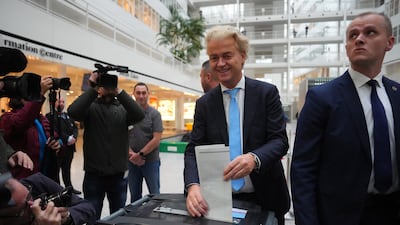
Geert Wilders, leader of the Party for Freedom, casts his vote in the Netherlands' general election in November in The Hague. Getty Images -
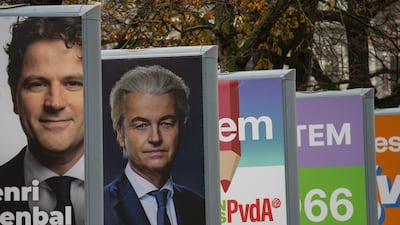
Mr Wilders on an election campaign poster near the Dutch parliament building in The Hague this month. Getty Images -
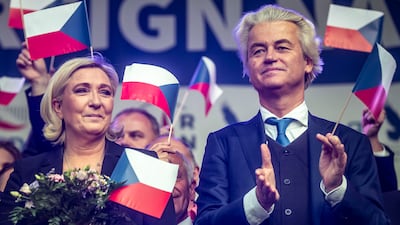
Leader of France's National Rally party Marine Le Pen and Mr Wilders during a meeting of populist far-right party leaders in Prague, Czech Republic, in 2019. Getty Images -
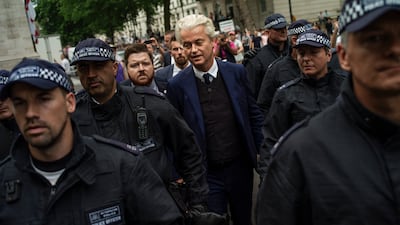
Mr Wilders surrounded by police during a Free Tommy Robinson protest in London in 2018. Getty Images -
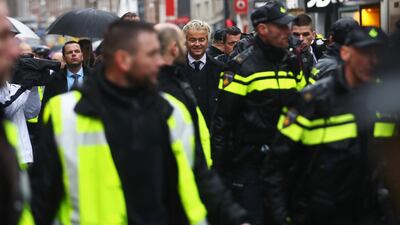
Mr Wilders with a police guard during his election campaign in Breda, Netherlands, in 2017. Getty Images -
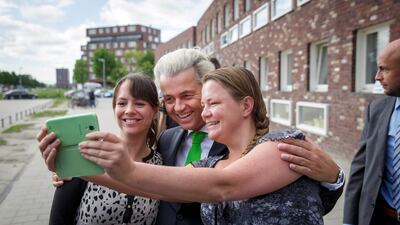
Mr Wilders with supporters in The Hague in 2014. AP -

Mr Wilders attends the inauguration of King Willem Alexander of the Netherlands in Amsterdam in 2013. Getty Images -

Mr Wilders in Sydney, Australia, in 2013. Getty Images -
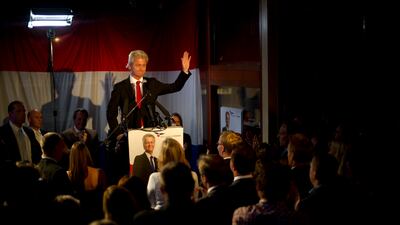
Mr Wilders on 2012 election night in The Hague, Netherlands. Getty Images -

Mr Wilders in London in 2009 after being allowed into the UK when he overturned a ban by the UK immigration authorities. Getty Images -
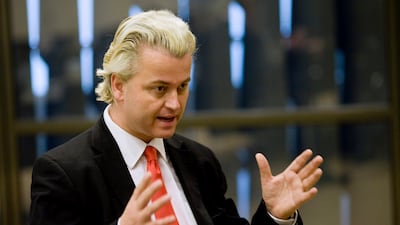
Mr Wilders during an interview in The Hague. AP


On Gaza, Mr Wilders – who wished Israel “good luck” in its ground offensive and says “Jordan is Palestine” so Palestinian people could simply relocate there – is out of line with the EU’s careful stance on the conflict.
“We condemn racist positions of a Dutch radical parliamentarian adopting [the] illusion of solving [the] Palestinian issue at [the] expense of Jordan,” said Jordan’s Foreign Minister Ayman Safadi late on Wednesday. “His position has no impact. It just further exposes his abominable racism.”
In the 27-member European Council, a Prime Minister Wilders would be a powerful ally for perennial EU contrarian Viktor Orban, the nationalist leader of Hungary.
Mr Orban was among the first to congratulate Mr Wilders, proclaiming that “the winds of change are here”.
Far-right friends
It was not just Mr Orban savouring the Dutch result, as nationalists around Europe look to emulate Mr Wilders by breaking down firewalls against the far right.
The far-right Alternative for Germany (AfD) has its sights on victory when three states in its eastern heartland vote in regional elections next year, in what would amount to a similarly historic dam breach.
“The people of Europe are sending a clear message at the ballot box – we don’t want to be overwhelmed by foreigners and lose our homeland,” said AfD MP Rainer Kraft. “Together with Geert Wilders the AfD is fighting for a Europe of fatherlands.”
Philippe Ballard, a spokesman for Marine Le Pen’s far-right National Rally party in France, said the Dutch result showed “the dream of nations” who oppose “an obese European Union that suffocates them”.
Mr Wilders has long cultivated links to the far-right in the UK, US and Europe, having protested in London on behalf of street agitator Tommy Robinson and contributed to American alt-right website Breitbart.
A guest at the 2016 Republican National Convention, where he supported Mr Trump’s calls for a ban on Muslim immigration, Mr Wilders is now being feted again by the US right-wingers.
Migration
The focus of Mr Wilders’ campaign was reducing immigration. As other right-wing leaders have found, it is easier said than done.
Giorgia Meloni, the leader of Italy’s furthest-right government since the Second World War, campaigned on curbing Mediterranean migration but it has risen on her watch. She is seeking deals with third countries such as Albania to manage asylum seekers on Italy’s behalf.
Austria is interested in an arrangement similar to the UK’s stalled proposal to deport migrants to Rwanda. EU law limits countries’ options and, even with Mr Wilders at the table, that would not change overnight.
Dutch election results – in pictures
-

An election poster for Geert Wilders, leader of the Freedom party (PVV) is removed near the Dutch parliament buildings in The Hague, a day after the general elections. EPA -

Mr Wilders speaks in The Hague after exit polls and early results predicted his PVV party would win the election with 37 seats. Reuters -
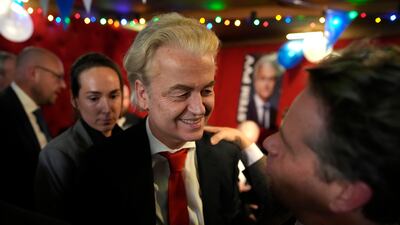
Mr Wilders talks to his supporters in The Hague. AP -
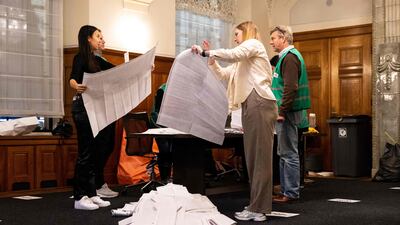
Election staff count the votes at a polling station in Rotterdam. AFP -
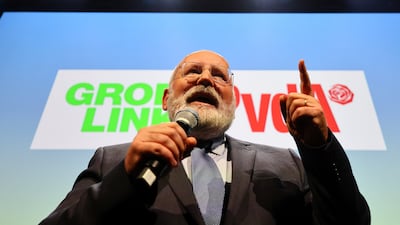
Frans Timmermans' GroenLinks-PvdA was nine seats behind Mr Wilders' party, according to the exit poll. Reuters -
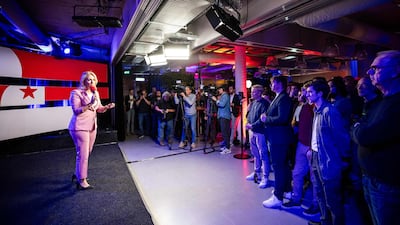
Socialist Party leader Lilian Marijnissen speaks in Amersfoort. AFP -

Prime Minister of Netherlands Mark Rutte addresses the media in The Hague. His People's Party for Freedom and Democracy, or VVD, was in third place at 23 seats, according to the exit poll. AP -

CDA leader Henri Bontenbal responds to the results in The Hague. EPA -
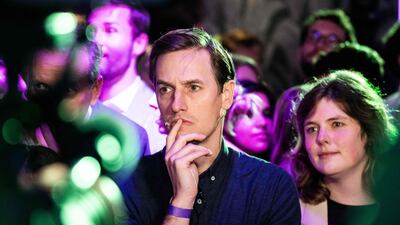
Volt party leader Laurens Dassen follows the announcement of the first exit polls in Utrecht. AFP


National initiatives to cut immigration “can’t happen effectively unless you are also able to agree with third countries on returns being carried out,” said Anastasia Karatzas, an analyst at the European Policy Centre, speaking before the Dutch vote.
There is also concern in Dutch society because of Mr Wilders’ long history of anti-Islam rhetoric, even after he somewhat toned it down to boost his hopes of a coalition.
Vinod Subramaniam, the president of the University of Twente who grew up in India, said the results “emotionally affect many people in our community” who may feel “less welcome” in the Netherlands.
“It is a feeling that I recognise myself and it hurts to realise that this also applies to others,” he said.

