


A harnessed Beluga whale that first turned up in Norway in 2019, sparking speculation it was a spy trained by the Russian navy, has appeared off Sweden's coast, an organisation following him said on Monday.
After it was discovered in Norway's far northern region of Finnmark, the whale spent more than three years slowly moving down the top half of the coastline, before suddenly speeding up in recent months to cover the second half and on to Sweden.
On Sunday he was observed in Hunnebostrand, off Sweden's south-western coast.
"We don't know why he has sped up so fast right now," especially since he is moving "very quickly away from his natural environment", Sebastian Strand, a marine biologist with the OneWhale organisation, told AFP.
"It could be hormones driving him to find a mate. Or it could be loneliness as Belugas are a very social species. It could be that he's searching for other Beluga whales."
Mr Strand said the whale, believed to be 13 to 14 years old, is "at an age where his hormones are very high".
But the closest population of Belugas is in the Svalbard archipelago, in Norway's far north.
Beluga whale stranded in the Seine river - in pictures
-

Vets look after a beluga whale that was stranded in the Seine river, near Notre Dame de la-Garenne in northern France. AFP -
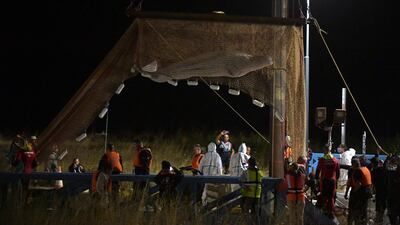
The whale was lifted from the river by a net and crane on Wednesday morning and placed on a barge. AFP -

More than a dozen vets tended to the marine mammal. Reuters -
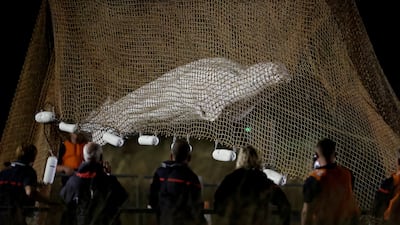
The extraction of the 800-kilogram animal took six hours. Reuters -
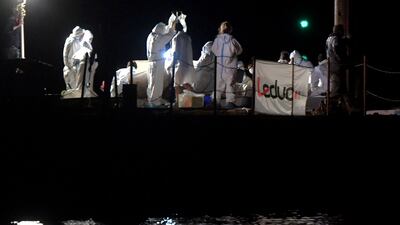
It was the first stage of an ambitious rescue operation to return it to the sea. It will now be transferred to a saltwater basin in Normandy. AFP -
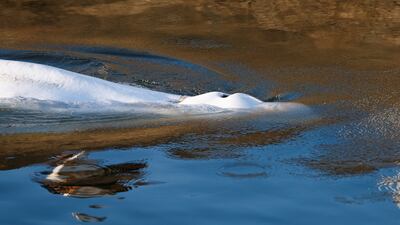
The whale was first spotted on August 2 in the Seine river. EPA


The whale is not believed to have seen a single Beluga since arriving in Norway in April 2019.
Norwegians nicknamed it "Hvaldimir" – a pun on the word "whale" in Norwegian, hval, and a nod to its alleged association to Russia.
When he first appeared in Norway's Arctic, marine biologists from the Norwegian Directorate of Fisheries removed an attached man-made harness.
The harness had a mount suited for an action camera and the words "Equipment St Petersburg" printed on the plastic clasps.
Directorate officials said Hvaldimir might have escaped an enclosure, and might have been trained by the Russian navy as it appeared to be accustomed to humans.
Moscow has never issued any official reaction to Norwegian speculation that he could be a "Russian spy".
Group of killer whales attack boat in Strait of Gibraltar - video
The Barents Sea is a strategic geopolitical area where western and Russian submarine movements are monitored.
It is also the gateway to the Northern Route that shortens maritime journeys between the Atlantic and Pacific oceans.
Mr Strand said the whale's health "seemed to be very good" in recent years, as it foraged for wild fish under Norway's salmon farms.
But his organisation was concerned about Hvaldimir's ability to find food in Sweden and had already observed some weight loss.
Beluga whales, which can reach a size of six metres and live to between 40 and 60 years of age, generally inhabit the icy waters around Greenland, northern Norway and Russia.

