


President Volodymyr Zelenskyy and western leaders struck a defiant note on Friday as Ukraine marked the anniversary of Russia's invasion.
Mr Zelenskyy saluted his people for a “year of invincibility” in which Ukraine “inspired the world” by resisting Moscow's troops.
“We endured. We were not defeated. And we will do everything to gain victory this year,” he said.
Nato allies renewed their vows of solidarity as a war that Russia hoped to win in days enters its second year with no end in sight.
In a symbolic vote, the UN General Assembly passed a resolution demanding a Russian withdrawal, supported by 141 countries and opposed by seven.
Landmarks including the Eiffel Tower in Paris were lit up in Ukraine's blue and yellow, while UK Prime Minister Rishi Sunak held led a minute's silence in Downing Street.
In Kyiv, Mr Zelenskyy awarded medals to families of the fallen and handed battle flags to Ukrainian assault brigades.
Visiting the capital, Poland's Prime Minister Mateusz Morawiecki said his country had already delivered four German-made Leopard tanks to Ukraine.
Support for Ukraine on the anniversary of the war - in pictures
-
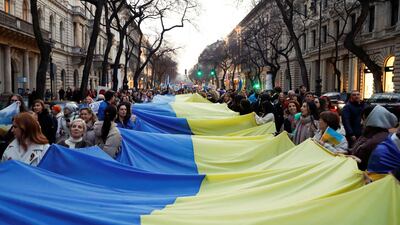
Supporters hold a Ukrainian flag at a solidarity march to mark the first anniversary of the Russian invasion of Ukraine, in Budapest, Hungary. Reuters -
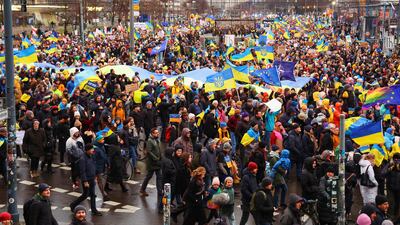
A protest to mark the one-year anniversary of the Russian invasion of Ukraine, in Berlin. Reuters -
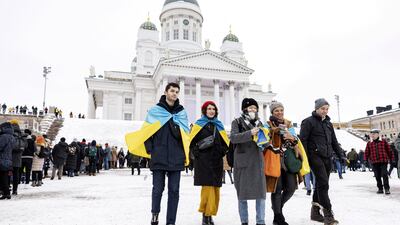
Supporters in front of Helsinki Cathedral during Light for Ukraine candlelight memorial event at Senate Square in Helsinki, Finland. Reuters -
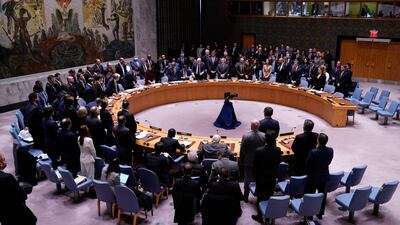
Representatives stand for a moment of silence during the United Nations Security Council meeting on the maintenance of peace and security of Ukraine at the UN headquarters in New York. AFP -
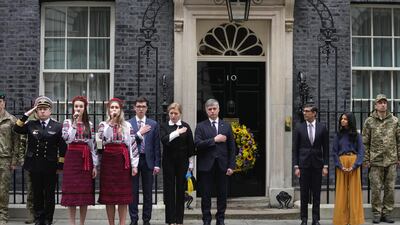
Britain's Prime Minister Rishi Sunak and his wife Akshata Murty, with Ukrainian ambassador to the UK Vadym Prystaiko, centre, his wife Inna and members of the Ukrainian Armed Forces outside 10 Downing Street in London, as they observe a minute's silence. AP -
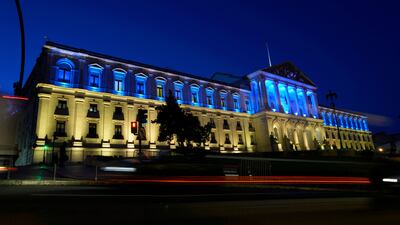
The Portuguese Parliament is lit with the blue and yellow of the Ukrainian flag, in Lisbon AP -
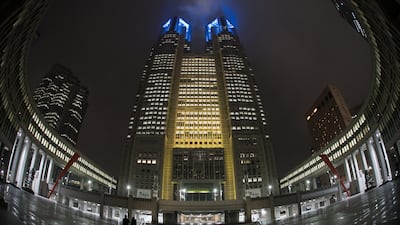
The Tokyo Metropolitan Government building is lit with the Ukraine national flag colours. Getty Images -
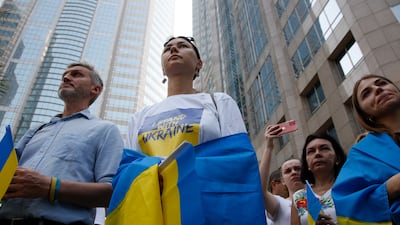
Supporters carry Ukrainian flags during a demonstration in Bangkok. EPA -
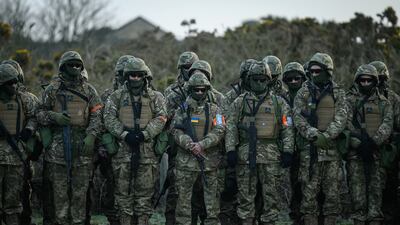
Ukrainian volunteers take part in prayers and observe a minute of silence, in south-east England. Getty -
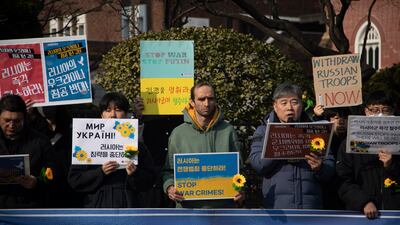
Protesters near the Russian embassy in Seoul, South Korea. EPA -
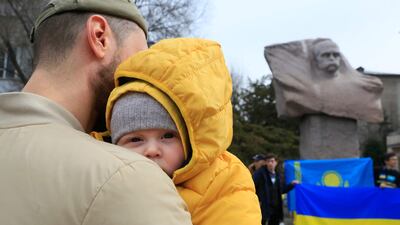
People lay flowers at a monument of Ukrainian poet, writer, artist, public and political figure Taras Shevchenko, in Almaty, Kazakhstan. AFP -
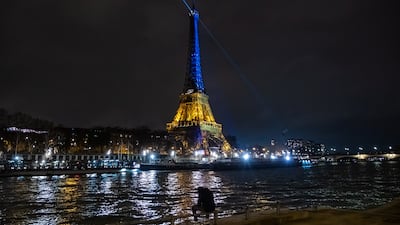
The Eiffel Tower in Paris is lit up in the colours of Ukrainian flag. EPA -
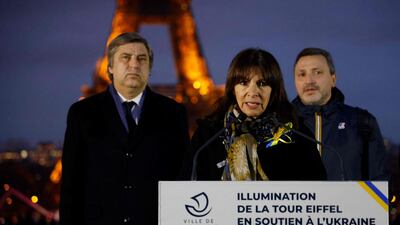
Paris Mayor Anne Hidalgo speaks alongside the Ukrainian ambassador to France, Vadym Omelchenko, during the event. AFP -
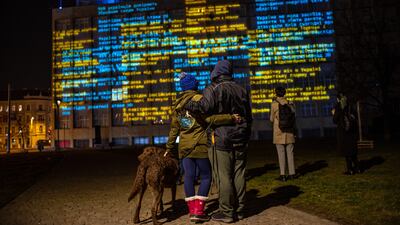
Watching video-mapping on the Czech Interior Ministry building, in Prague. EPA -
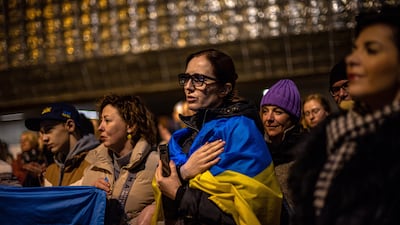
A woman expresses her solidarity with Ukraine at the Czech National Theatre, in Prague. EPA -
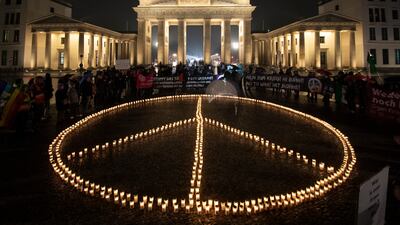
Activists place candles forming the peace sign in front of the Brandenburg Gate, in Berlin. AP -
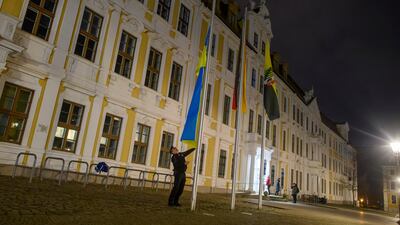
A police officer raises the Ukrainian flag in front of the state parliament of Saxony-Anhalt in Magdeburg, Germany. AP -
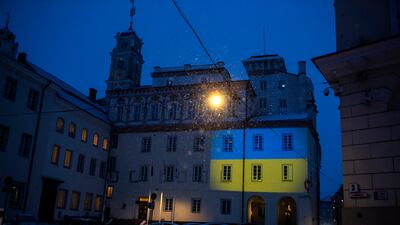
A Vilnius University building is illuminated in blue and yellow in support of Ukraine, in Vilnius, Lithuania. AP -
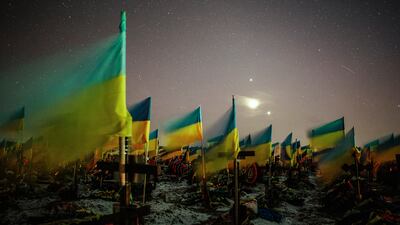
Ukrainian flags placed over the graves of fallen Ukrainian soldiers in a military cemetery in Kharkiv, north-eastern Ukraine. EPA -

A commemoration event with a light installation at the Field of Mars cemetery where hundreds of Ukrainian soldiers are buried, in Lviv, western Ukraine. Getty -
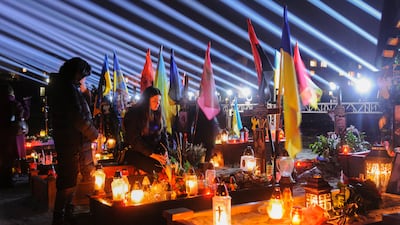
Friends and relatives of fallen Ukrainian soldiers take part in a prayer as Rays of Memory illuminate the night sky over Lychakiv military cemetery in Lviv. EPA -
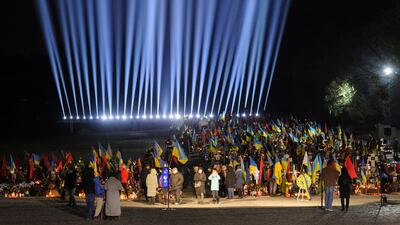
Rays of memory illuminate the sky over Lychakiv military cemetery in Lviv. EPA -
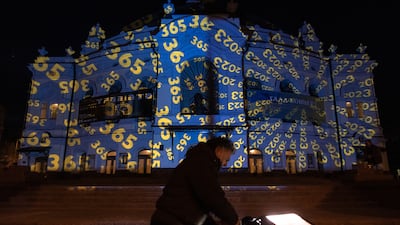
The National Opera of Ukraine building illuminated by Swiss artist Gerry Hofstetter in the colours of the Ukrainian flag, in Kyiv. Getty -
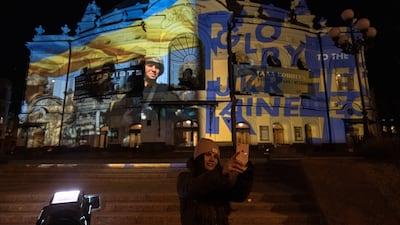
A woman takes selfies in front of The National Opera of Ukraine, illuminated by Swiss artist Gerry Hofstetter. Getty -

A candlelit vigil in front of the Russian consulate, in New York. Reuters -
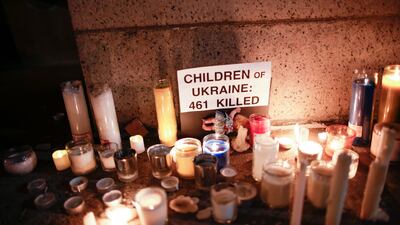
Candles lit outside the Russian consulate in New York during a vigil to commemorate children killed in Ukraine. AFP -

A silent candlelit vigil in New York. Reuters -
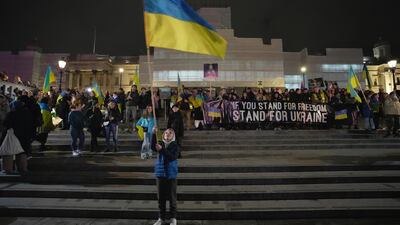
A Trafalgar Square vigil organised by the Ukrainian and US embassies in London. AP -
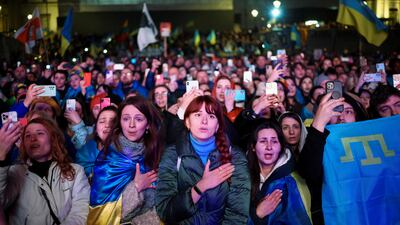
A vigil for Ukraine at Trafalgar Square in London. Reuters -
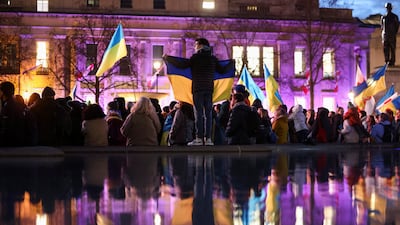
The Trafalgar Square vigil. Reuters -
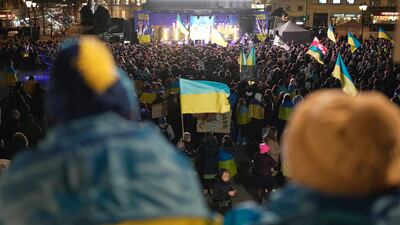
Crowds gather at Trafalgar Square. AP -
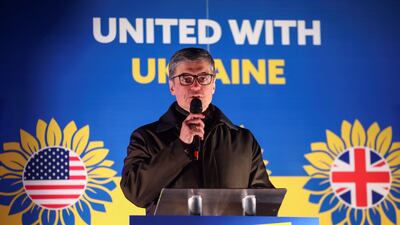
The Ukrainian ambassador to the UK, Vadym Prystaiko, addresses the London vigil. Reuters -
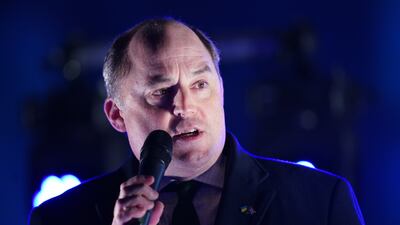
British Defence Secretary Ben Wallace speaks at the vigil. PA -
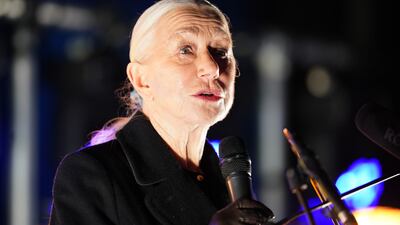
Actress and activist Helen Mirren addresses the London vigil. PA -
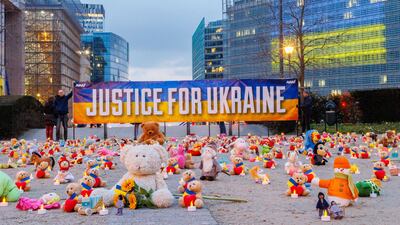
Teddy bears and other toys left by Ukrainian refugees and members of the Avaaz global activist network at Schuman Roundabout, in front of the European Commission, in Brussels. AP -
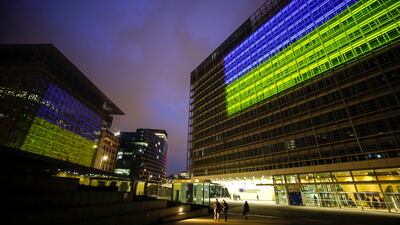
The EU Council and Commission buildings illuminated in the colours of the Ukrainian flag. EPA -
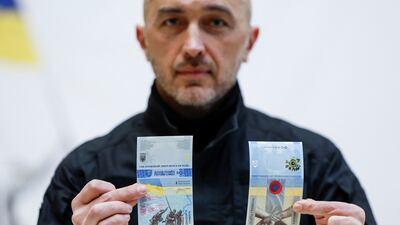
Governor of the National Bank of Ukraine Andriy Pyshnyi holds banknotes marking the first anniversary of Russia's invasion on Ukraine, in Kyiv. Reuters -
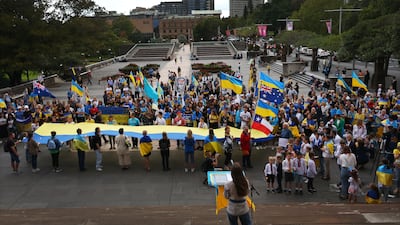
Supporters gather at St Mary's Cathedral Square during the 365 Days Strong rally and candlelight vigil in Sydney. Getty -

France's ambassador to Ukrain Etienne de Poncins, left, and the French Culture Minister Rima Abdul-Malak visit Independence Square in central Kyiv. AFP


Members of Nato used a joint statement to pay tribute to Ukrainians for their “heroic defence of their nation, their land, and our shared values”.
“Russia’s efforts to break the resolve of the brave people of Ukraine are failing,” they said. “One year on, Ukrainians are fighting valiantly for freedom and independence. We stand with them.”
The UK announced new export bans on “every item Russia has been found using on the battlefield”.
Leaders of the G7 countries — the US, Canada, Britain, France, Germany, Italy and Japan — were to hold virtual talks later on Friday.
Mr Sunak said he would urge allies to give Ukraine a “decisive advantage on the battlefield” to force Russia into retreat. German Chancellor Olaf Scholz said western aid would hasten the day when Russian President Vladimir Putin “realises he will not achieve his imperialist goals”.
Britain's King Charles paid tribute to the “remarkable courage and resilience” of Ukrainians in the face of what he called an “unprovoked full-scale attack on their nation”.
In Russia, former president Dmitry Medvedev — an ally of Mr Putin — declared on Friday that “victory will be achieved”.
In his latest warning, Mr Medvedev said Russia's aim was to “push back the borders that threaten our country as far as possible, even if they are the borders of Poland”.
China unveiled what it called a 12-point peace plan, which urged a ceasefire and an end to Russia's nuclear threats, while also opposing sanctions and suggesting both sides had valid concerns.
Western leaders reacted cautiously. European Commission president Ursula von der Leyen said China had already “taken sides” with Russia, while German President Frank-Walter Steinmeier said it was “questionable whether China wants to play a constructive role”.
The UN's nuclear watchdog meanwhile said Ukraine had been fortunate to avoid a nuclear disaster after shelling near the Zaporizhzhia plant.
Mr Putin announced the invasion at dawn on February 24, 2022, claiming Russia was under threat from a western-backed Ukraine.
He said Russia's “special military operation” was meant to demilitarise Ukraine and protect the Russian-speaking minority in the east of the country.
The West rejected these as baseless excuses for a war of aggression to seize Ukrainian territory and force Ukraine back into Moscow's orbit.
The US and its allies responded with massive sanctions on Russia and an increasing flow of weapons to Ukraine, helping it stall the invasion.
They are now watching China's next move amid speculation that it could provide arms to Russia.
Fear of Russian attack prompted Sweden and Finland to seek Nato membership, a process delayed by Turkish objections.
Nato Secretary General Jens Stoltenberg said on Friday that he saw progress on that front with Turkey, Sweden and Finland to hold talks in Brussels next month.
“Both Finland and Sweden have lived up to the commitments they signed up to at the Nato summit last year so I think the time has come to ratify both now,” he said.
Millions of Ukrainians have fled their country, while those who stayed behind have seen homes destroyed and power cuts caused by Russian bombardment. Around the world, the war has led to a surge in food and energy prices.
Human rights inspectors at the Organisation for Security and Co-operation in Europe said the war was having a “devastating effect” on civilians.
“The consequences of the conflict that started one year ago will be felt for generations to come by the people of Ukraine,” said Matteo Mecacci, the OSCE's human rights director.
One year of the Russia-Ukraine war — in pictures
-
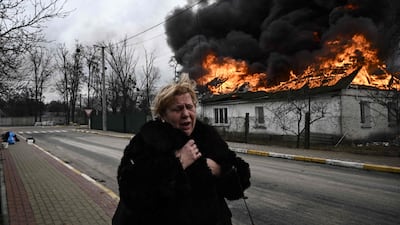
February 24 will be a year since Russia started the Ukraine war. The National picks out the most powerful images from the conflict. AFP -
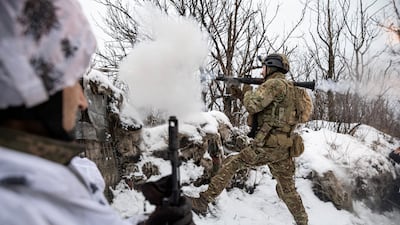
A member of Ukraine's 79th Air Assault Brigade fires a rocket-propelled grenade at Russian positions near Marinka in February. Reuters -
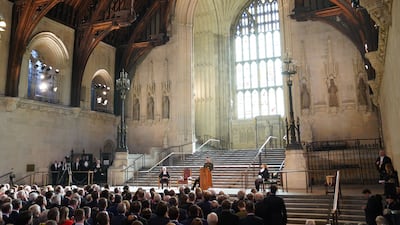
Ukrainian President Volodymyr Zelenskyy addresses MPs in Westminster Hall, London, in February 2023. Getty Images -

Destroyed buildings 32km west of the front lines in Donetsk in January. Getty Images -
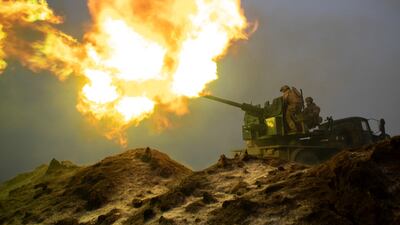
An anti-aircraft gun in January fires at Russian positions near Bakhmut, Donetsk. Reuters -
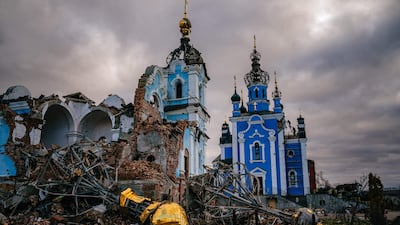
Destruction in the village of Bohorodychne, Donetsk. AFP -

A Ukrainian artilleryman discards an empty shell on the outskirts of Bakhmut, eastern Ukraine, in December 2022. AFP -
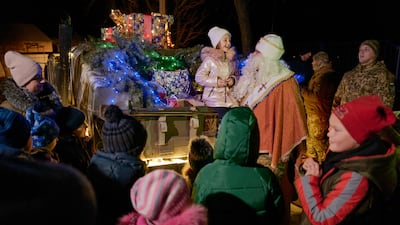
Children receive presents from a Ukrainian soldier dressed as Santa on Christmas Eve in Sloviansk. Getty Images -
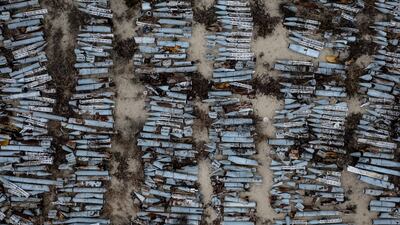
More than 1,000 missiles and rockets fired by Russian forces collected for cataloguing in Kharkiv in December 2022. Getty Images -
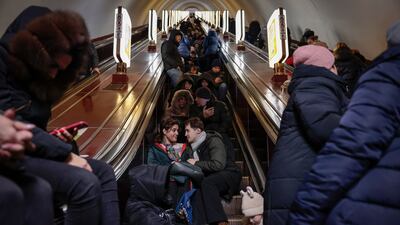
The Metro provides shelter as Russia launches another missile attack on Kyiv, Ukraine's capital, in December 2022. Getty Images -

Children at a PE class in Kyiv after Russia abandoned its attempt to seize the capital in November 2022. Getty Images -
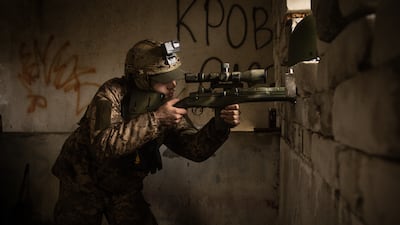
A sniper searches for Russian positions on the bank of the Dnipro river in Kherson in November 2022. Getty Images -
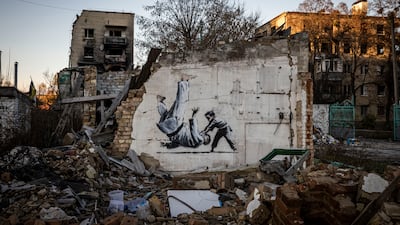
Graffiti by Banksy on a wall among the debris in Borodyanka in November 2022. Getty Images -
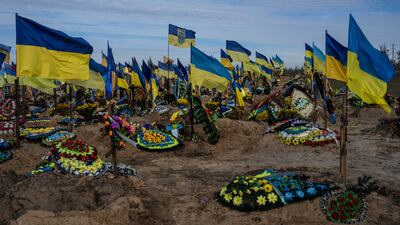
Ukrainian flags flutter around graves in a cemetery for soldiers killed in action in Kharkiv in October 2022. Getty Images -
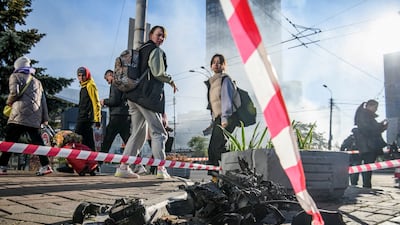
Parts of a drone, which Ukrainian authorities said was Iranian-made, after a Russian strike in Kyiv in October 2022. Reuters -
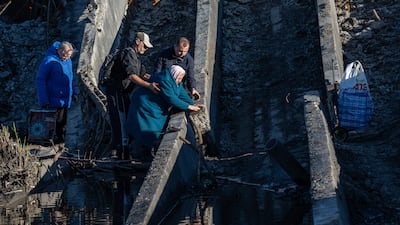
An elderly woman is helped across a damaged bridge in Bakhmut in October 2022. Getty Images -
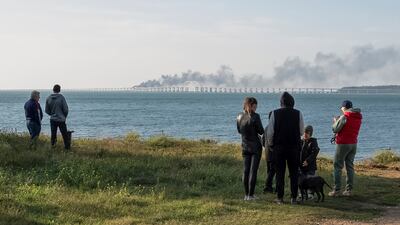
Fuel tanks ablaze on damaged sections of the Kerch bridge in Crimea, in October 2022. Reuters -

A destroyed bridge makes crossing the Donets river difficult, in Staryi Saltiv, east of Kharkiv, in September 2022. AFP -
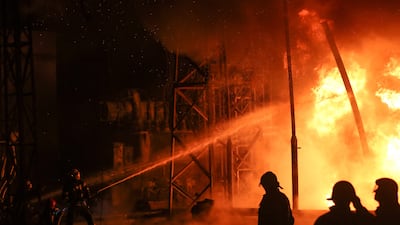
Firefighters at a thermal power plant in Kharkiv damaged by a Russian missile strike in September 2022. Reuters -
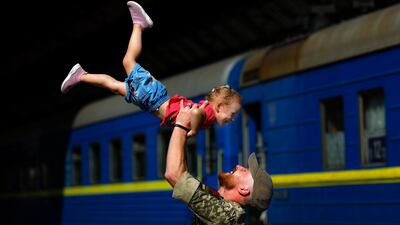
Ukrainian soldier Oleksandr with his daughter Nikole at Lviv railway station in August 2022. Getty Images -
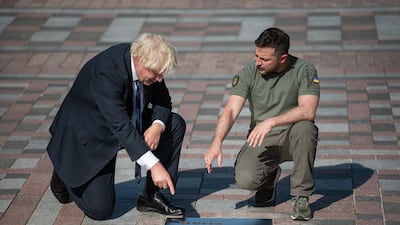
Ukrainian President Volodymyr Zelenskyy and then-British prime minister Boris Johnson read a plaque in Kyiv in August 2022 dedicated to the latter for his support. Getty Images -
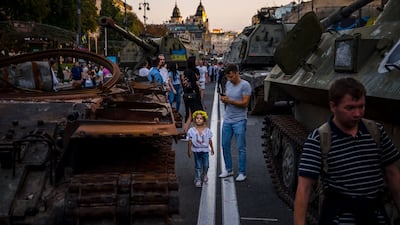
Destroyed Russian military equipment on Khreshchatyk street in Kyiv. The materiel was turned into an open-air military museum ahead of Ukraine's Independence Day on August 24. AFP -
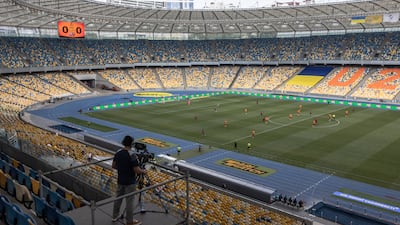
Shakhtar Donetsk v Metalist Kharkiv kicks off the Ukrainian Premier League season in August 2022 amid fears of bomb and missile alerts. EPA -
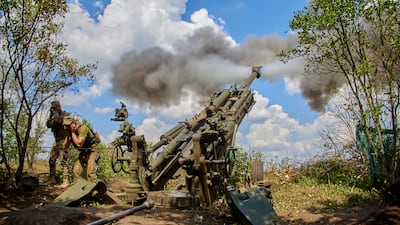
Ukrainian servicemen fire an American-made 155mm M777 howitzer in July 2022 in the Kharkiv area. EPA -
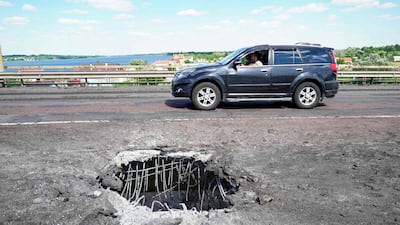
A bomb crater on the Antonovsky bridge across the Dnipro river in Kherson, July 2022. AFP -

Maksym and Andrii with plastic guns at a 'checkpoint' they set up while playing in Kharkiv, July 2022. AP -
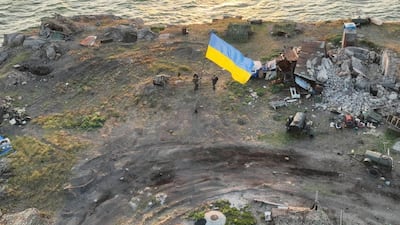
Ukrainian troops on Snake Island in June 2022. Reuters -
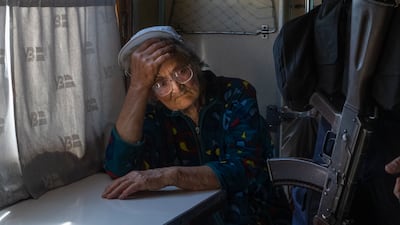
A woman evacuated from an area of conflict in June 2022 contemplates what the next move might be. AP -
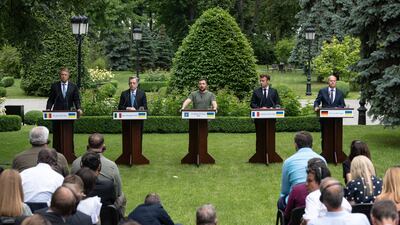
Romanian President Klaus Iohannis, Italian Prime Minister Mario Draghi, Ukrainian President Volodymyr Zelenskyy, French President Emmanuel Macron and German Chancellor Olaf Scholz in Kyiv in June 2022. Getty Images -
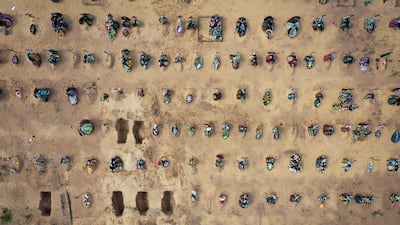
Graves in Irpin cemetery, May 2022. Getty Images -
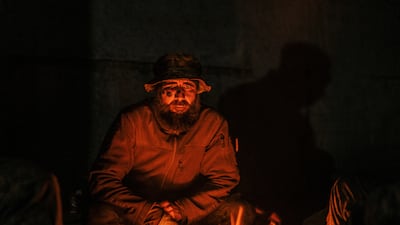
A Ukrainian soldier trapped within the besieged Azovstal Iron and Steel Works complex in Mariupol in May 2022. Reuters -
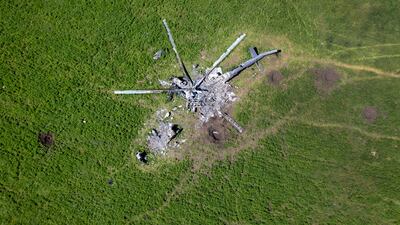
The wreckage of a Russian helicopter in a bomb-cratered field in Biskvitne, May 2022. Getty Images -
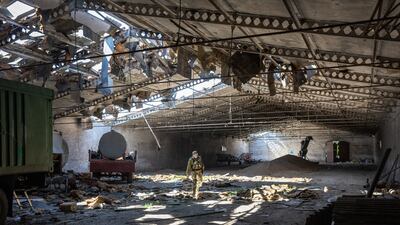
A Ukrainian army officer inspects a grain warehouse shelled by Russian forces in May 2022 near Novovorontsovka, Kherson. Getty Images -
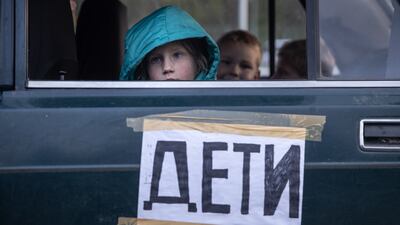
A boy from Mariupol arriving at an evacuation point in Zaporizhzhia in May 2022. Getty Images -
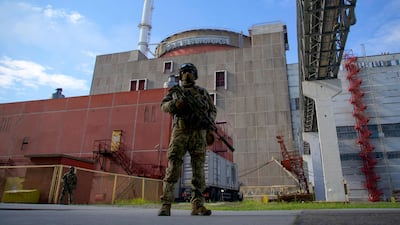
A Russian serviceman on guard outside Zaporizhzhia nuclear power station in May 2022. AFP -
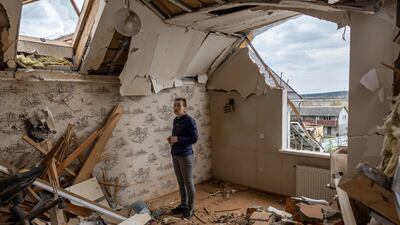
Oksana searches for salvageable items on the destroyed second floor of her home in Hostomel, April 2022. Getty Images -

A floral memorial wall in Lviv for Ukrainian civilians killed during the Russian invasion, April 2022. Getty Images -
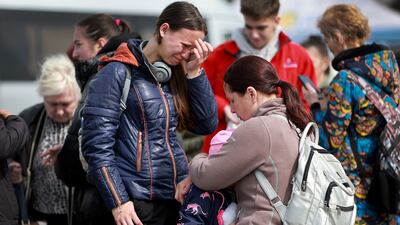
People fleeing Lviv, eastern Ukraine, in April 2022, wait for a bus that will take them to Poland. Getty Images -
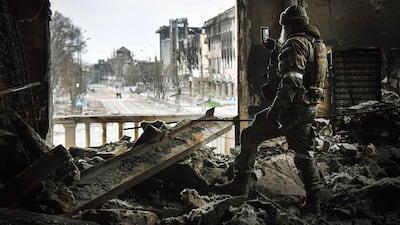
A Russian soldier patrols a bombed Mariupol theatre in April 2022, as Moscow intensified its campaign to take the strategic port city. AFP -
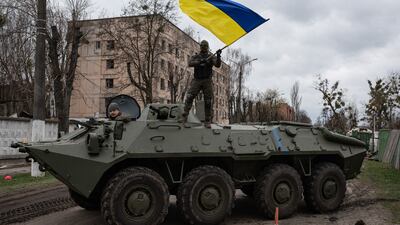
A Ukrainian celebrates success in Hostomel in April 2022. Getty Images -
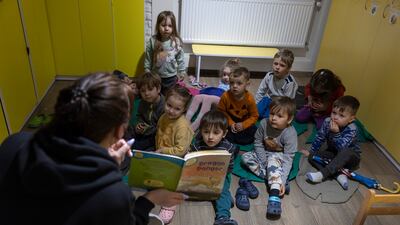
Julia Palovskaya reads to children during an air raid drill in the basement shelter at a preschool in Lviv, April 2022. Getty Images -
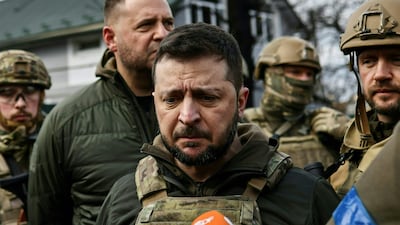
Volodymyr Zelenskyy in Bucha in April 2022, where hundreds of bodies were found in the street and it was claimed the Russian leadership was responsible for killing civilians. AFP -
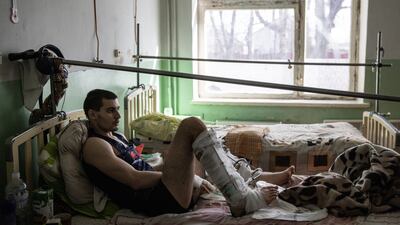
Oleh Smolin, 23, who suffered leg injuries from Russian shelling in April 2022, in hospital in Chuhuiv. Getty Images -
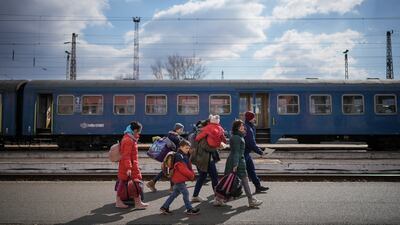
Fleeing refugees arrive at the border train station of Zahony, Hungary, in March 2022. Getty Images -
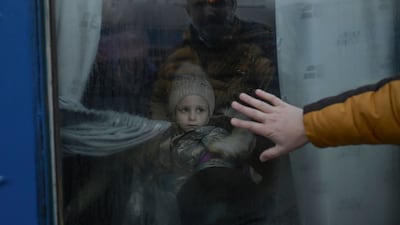
A father says goodbye to his daughter on an evacuation train about to leave Odesa in March 2022. AFP -
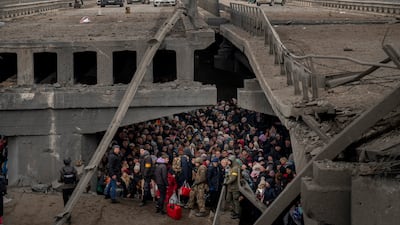
Ukrainians under a destroyed bridge as they try to cross the Irpin river on the outskirts of Kyiv in March 2022. AP -
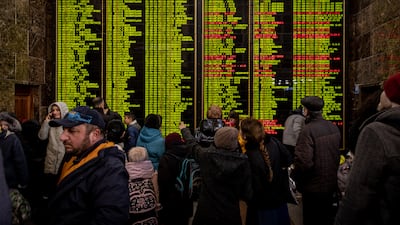
People cram into Kyiv station to catch trains to Poland or to western parts of Ukraine, shortly after the initial invasion in February 2022. Getty Images -
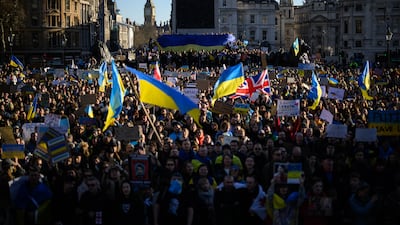
A demonstration in support of Ukraine in Trafalgar Square, London, February 2022 . Getty Images -
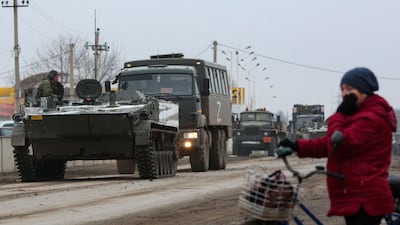
Russian army vehicles in Armyansk, Crimea, in February 2022. AFP -
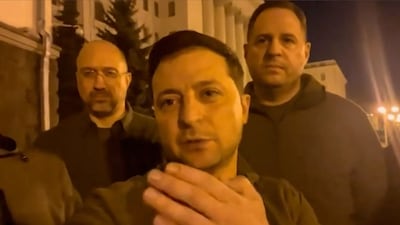
Volodymyr Zelenskyy in Kyiv on February 25, 2022, in a video on Facebook. He said 'we are all here', shortly after the Russian invasion began. AFP -
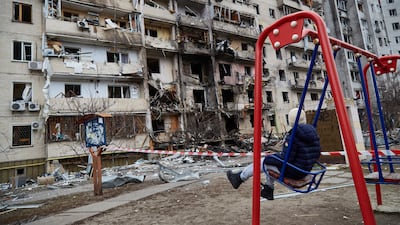
A residential building damaged by a missile strike in Kyiv in February 2022. Getty Images -

A metro station in Kyiv in February 2022, crowded with people trying to escape the invasion. AFP -
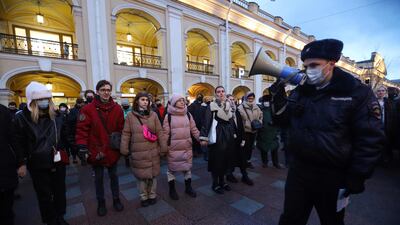
A police officer addresses people gathered to protest against the invasion of Ukraine, in central Saint Petersburg, Russia, February 2022. AFP -
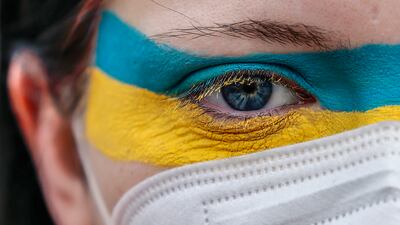
A protester in support of Ukraine, in Berlin, Germany, in February 2022. Getty Images -
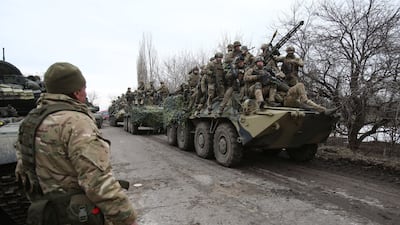
Ukrainian soldiers prepare to repel an attack in Ukraine's Lugansk region on February 24, 2022. AFP -
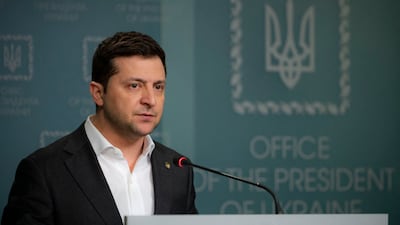
Volodymyr Zelenskyy in Kyiv on February 24, 2022, after Russia launched a full-scale invasion. AFP -
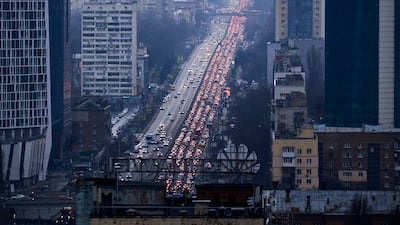
A mass exodus from Kyiv after pre-offensive missile strikes by Russian armed forces on February 24, 2022. Getty Images -
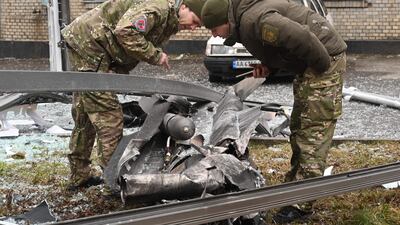
Security personnel inspect the remains of a shell in Kyiv on February 24, 2022, soon after Russian President Vladimir Putin announced a military operation in Ukraine. AFP -
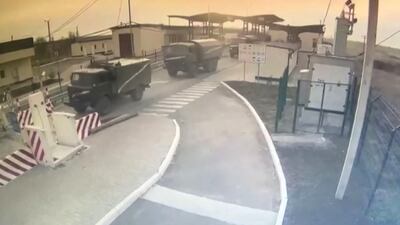
CCTV footage shows Russian military equipment crossing a Crimea border checkpoint on February 24, 2022. AFP -
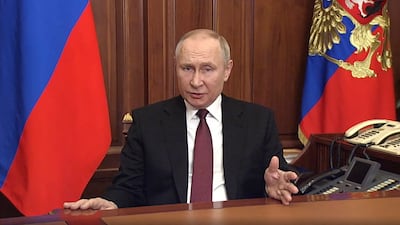
Russian President Vladimir Putin in the Kremlin early on February 24, 2022, when he announced a 'military operation' in Ukraine. AFP



