

Albania on Wednesday hit back at what it said were attempts by Britain to pin the blame for a border crisis on Albanian migrants.
The country's Prime Minister Edi Rama said the UK should “stop discriminating against Albanians to excuse policy failures”.
His intervention came after the UK's Home Office published new data showing a surge in Albanian migrants crossing the English Channel.
The new figures were revealed after Home Secretary Suella Braverman said that some of the Channel migrants were not in dire humanitarian need.
With overcrowded migrant facilities putting the government under pressure, UK Prime Minister Rishi Sunak admitted the asylum system was moving too slowly.
He was challenged on the subject at his second Prime Minister's Questions on Wednesday, when Labour leader Keir Starmer asked how many asylum claims had been processed.
Mr Sunak replied: “Not enough is the answer, very straightforwardly, not enough. That’s what we are going to fix.”
The government said 11,102 Albanians arrived between May and September this year, compared with 815 in the whole of last year.
“Small boat crossings are dangerous and unnecessary for Albanians,” Ms Braverman's department said in a fact sheet published on Wednesday.
“Those coming from Albania — a safe and prosperous country — are travelling through multiple countries to make the journey to the UK.”
But Mr Rama hit back in a strongly worded statement that said blaming Albanians was “easy rhetoric but ignores hard fact”.
“Albanians in the UK work hard and pay tax. UK should fight the crime gangs of all nationalities and stop discriminating against Albanians to excuse policy failures,” he said.
“Albania is not a rich country and was for a very long time a victim of empires, we never had our own.
“Ready to work closer with UK but facts are crucial. So is mutual respect.”
Until June this year, almost half of small boat crossings in the previous four years had been made by Iranian or Iraqi nationals, the Home Office said.
It said the pattern had started to change in the first half of this year, when Albanians made up 18 per cent of arrivals, Afghans another 18 per cent and Iranians 15 per cent.
From May to September, Albanians represented about 42 per cent of small boat crossings.
In the House of Commons, Mr Sunak said another 500 processing officials would be in place by the spring to deal with asylum claims he admitted were not moving fast enough.
Sir Keir replied: “Not enough? He can say that again. It's 4 per cent, 4 per cent of people arriving in small boats last year had their claims processed.”
Mr Sunak was challenged several times about immigration during the exchange at PMQs.
“They have lost control of borders on their side of the house,” Sir Keir said. “If the asylum system is broken and his lot has been in power for 12 years, how can it be anyone’s fault but theirs?”
Mr Sunak said people rightly wanted to see Britain get a grip on migration and its borders.
“We are clear we want to defend our borders,” he said.
It came amid an increasingly bitter debate on migration and pressure on Ms Braverman over her handling of the Channel crossings.
As images of distress surfaced at the overcrowded Manston asylum centre, Ms Braverman was criticised for saying Britain was facing a migrant “invasion”.
The Home Office said in its briefing that Albanians, on previous experience, are less likely than the average asylum seeker to have their claims approved.
The grant rate for Albanians is 53 per cent compared to a general figure of 76 per cent, the Home Office said, without specifying in what period.
Migrants at processing centre in Manston — in pictures
-

A person gestures through a fence at the immigration processing centre in Manston, Kent in southern England. Reuters -
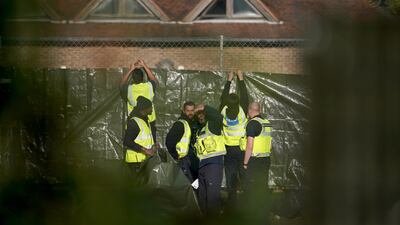
Security staff work to cover the view of people thought to be migrants in the Manston centre. PA -
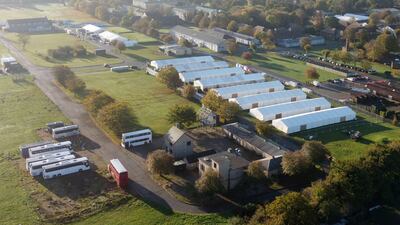
An aerial view of the facility in Manston. PA -

Seven hundred people were moved to the centre for safety reasons after incendiary devices were thrown at a Border Force migrant centre in Dover on Sunday. Reuters -

A man holds up a baby in the immigration processing centre. Reuters -

A woman at the Manston centre. Reuters -

A tent inside the processing centre. Reuters -
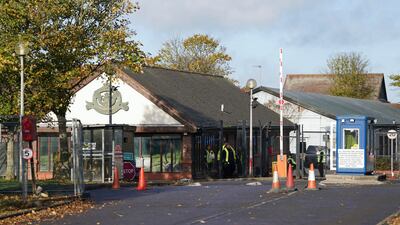
The entrance to the Manston immigration holding facility. AP


The Home Office said men represented 95 per cent of Albanian small boat arrivals between 2018 and last June.
This was a “significantly different gender balance” compared to the general mass of asylum applications, it said.
While some asylum claims from Albanians have been approved in that time, only 35 per cent of them were men.
Officials said more comprehensive statistics would be published on November 24.
Ms Braverman promised this week to fix what she called a hopelessly lax asylum system as the Manston centre buckled under the strain.
Concern was heightened after petrol bombs were thrown at a migrant centre in Dover, at England's south-eastern tip, with the suspected perpetrator later found dead.
The home secretary was separately under pressure over her handling of government papers, after a security lapse led to her sacking by former prime minister Liz Truss.
Mr Sunak restored her to the Cabinet when he came into office only days later, but fresh evidence has since surfaced, raising further questions about Ms Braverman's conduct.

