

There will not be a better offer for Iran to revive a nuclear deal with world powers, French Foreign Minister Catherine Colonna said on Monday.
Ms Colonna said it was up to Tehran to decide now because the window to find a solution was closing.
Indirect talks between Iran and the US have foundered over several issues, including Tehran's insistence that the International Atomic Energy Agency close an investigation into uranium traces found at three undeclared sites, and a US guarantee that Washington would not walk out of any nuclear pact again.
"There will not be a better offer on the table and it's up to Iran to take the right decisions," Ms Colonna said outside the UN General Assembly in New York.
She said no initiatives were under way to unblock the situation.
Western diplomats have said there are no talks at the moment and it was unlikely that a breakthrough could happen before the US mid-term elections in November.
They have accused Iran of going backwards in the talks, which Tehran denies.
"There are indications that the IAEA intends to close the case of the three sites," Iran’s nuclear chief Mohammad Eslami told Iranian state media on Monday.
"We hope that they will be honest and do not waste more time in order to pressure Iran."
Iran's nuclear programme - in pictures
-
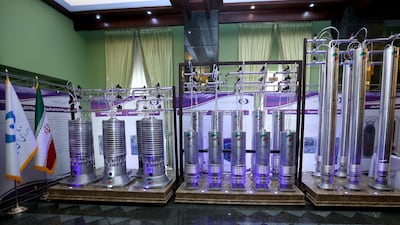
New generation Iranian centrifuges on display for Iran's National Nuclear Energy Day in Tehran, in April 2021. Iranian Presidency Office / Wana -

President Ebrahim Raisi, second right, is accompanied by Atomic Energy Organisation of Iran chief Mohammad Eslami, at Nuclear Technology Day in Tehran in April 2022. Iranian presidency / AFP -
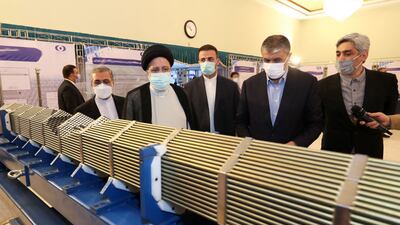
Mr Raisi and Mr Eslami at the April 2022 event. Iranian presidency / AFP -
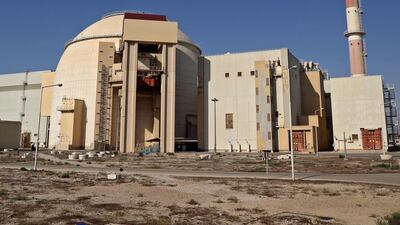
The Bushehr Nuclear Power Plant during a visit by Mr Raisi in October 2021. Iranian Presidency / AFP -
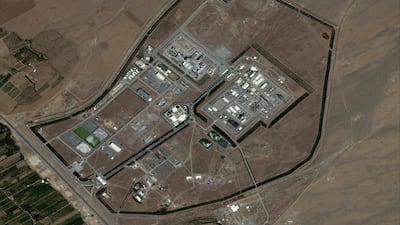
Iran's Arak Heavy Water Reactor complex, south of the capital Tehran in January 2020. Maxar Technologies / AFP -
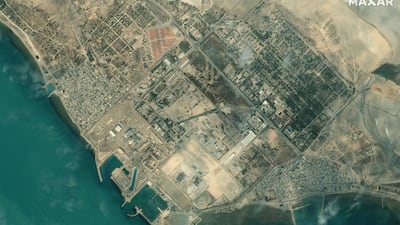
A satellite image of Iran's Bushehr Nuclear Power Plant in January 2020. Maxar Technologies / AFP -
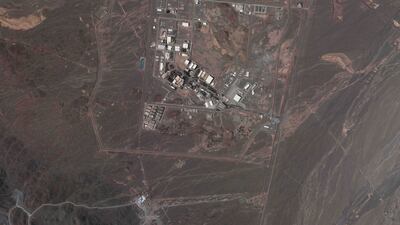
A satellite image of Iran's underground Natanz nuclear site in May 2022. Planet Labs PBC / AP -
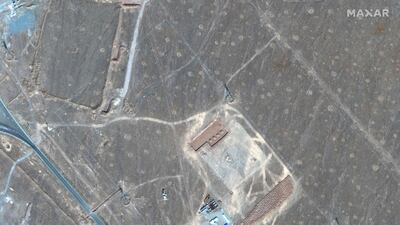
A satellite image in January 2020 of Iran's Fordow Fuel Enrichment Plant, north-east of the city of Qom. Maxar Technologies / AFP -
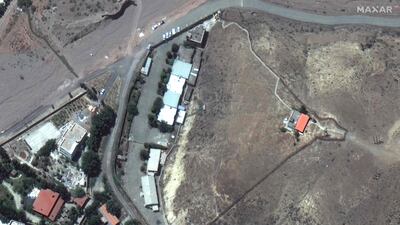
The Sanjarian nuclear centre, east of Tehran, in May 2021. Maxar Technologies / AFP


European officials have been adamant that Iran must give credible answers to the IAEA's questions, fearing that if the issue was swept under the carpet it could weaken the Nuclear Proliferation Treaty, the framework to halt the spread of nuclear weapons.
Ms Colonna said the US and its European partners had an identical position on the question of resolving an IAEA investigation.
Iranian President Ebrahim Raisi, who addresses world leaders at the UN on Wednesday, said on Sunday that Iran would be serious about reviving the nuclear deal if there were guarantees the US would not withdraw from it as it had done under President Donald Trump.
US and Israel pledge to deny Iran nuclear weapons - video
The US has offered certain guarantees for two and a half years, diplomats said, but was unable to go beyond that.
A source close to Iran’s nuclear team said Tehran had lost interest in reviving a deal that could only last two years.
"Our nuclear programme is advancing every day and this time is on our side. Let them be worried about it," the source said.

