German Chancellor Olaf Scholz on Monday said there was no reason for Iran not to sign the nuclear deal and that European countries would remain "patient".
But Mr Scholz admitted he did not expect an agreement in the immediate future.
He spoke after meeting Israeli Prime Minister Yair Lapid in Berlin. Mr Lapid insisted that restoring the 2015 agreement would be “a critical mistake".
Germany, along with France, Britain, Russia and China, is still a party to the deal and involved in talks on its revival that have dragged on for more than a year.
The European countries “have made proposals and there is no reason now for Iran not to agree to these proposals", Mr Scholz said.
"But we have to take note of the fact that this isn’t the case, so it certainly won’t happen soon, although it looked for a while like it would.
“We remain patient but we also remain clear: Iran must be prevented from being able to deploy nuclear weapons.”
He said that “a functioning international agreement to limit and monitor the Iranian nuclear programme is the right way” to do that.
But Mr Lapid said “it is time to move past the failed negotiations with Iran", which he said could not and would not achieve the goal of stopping Iran obtaining a nuclear weapon.
His office said he also shared intelligence with the German government.
“Removing sanctions and pouring hundreds of billions of dollars into Iran will bring waves of terrorism, not only to the Middle East, but also across Europe,” Mr Lapid said.
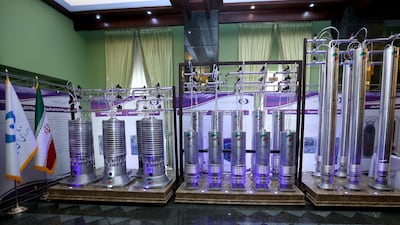
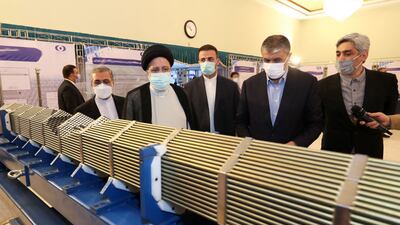
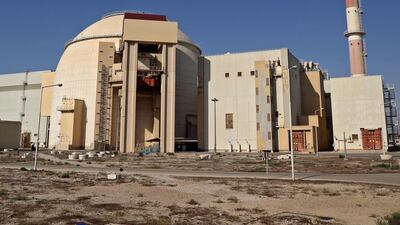
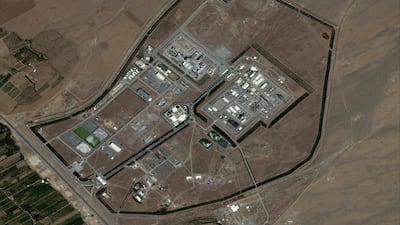
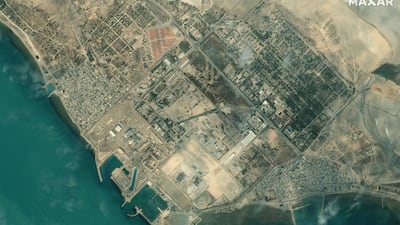
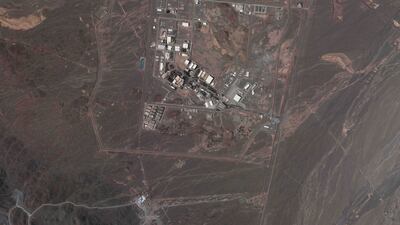
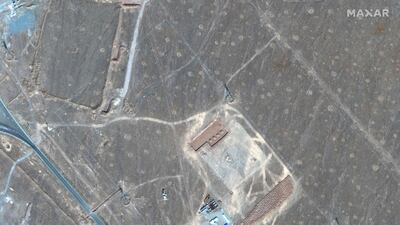
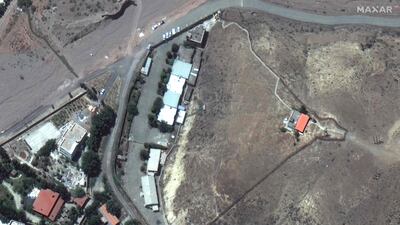
Iran's nuclear programme - in pictures
Israel, which encouraged the US to withdraw from the nuclear deal in 2018, has opposed a renewed agreement between Iran and the world powers.
It says lifting sanctions will allow Iran to funnel billions of dollars to hostile militant groups and says an improved deal must also address Iran’s regional military activities and support for hostile groups such as Hezbollah in Lebanon and other militias in Syria.
Israeli Defence Minister Benny Gantz on Monday said Iran had built at least 10 plants “for mid- and long-range, precise missiles and weapons” in neighbouring Syria, including one reportedly hit by Israel in a recent air strike.
Mr Gantz told the Jerusalem Post Conference in New York that Iran has produced “more and more advanced centrifuges, including at underground facilities where activities are prohibited”, and called for Tehran to be held accountable.
His remarks could not be independently verified.
The US pulled out of the nuclear accord under then President Donald Trump and reimposed sanctions on Iran, prompting Tehran to start backing away from the deal’s terms.
Iran this month responded to a final draft of a roadmap for parties to return to the tattered nuclear deal and bring the US back on board.
An investigation by the International Atomic Energy Agency into man-made uranium particles found at three undeclared sites in the country has become a key sticking point in the talks for renewing the agreement.
Iranian President, Ebrahim Raisi, has said that the IAEA investigation into the issue must be halted for the 2015 deal to be renewed.
The IAEA, the UN nuclear watchdog agency, has for years sought answers from Iran to its questions about the particles.
US and Israel pledge to deny Iran nuclear weapons - video
US intelligence agencies, western nations and the IAEA have said Iran ran an organised nuclear weapons programme until 2003. Iran long has denied ever seeking nuclear weapons.
Germany, France and Britain said in a statement at the weekend that “Iran must fully, and without delay, cooperate in good faith with the IAEA".
IAEA Director General Rafael Grossi said at the agency’s Vienna headquarters that he hoped Iran would start co-operating “as soon as possible".
“We are ready; we want this to happen,” Mr Grossi said.
“We are not in the business of aggravating or creating situations. We just want this issue to be clarified, so I really hope that they will start looking into this issue in a different way.”

Ten tax points to be aware of in 2026
1. Domestic VAT refund amendments: request your refund within five years
If a business does not apply for the refund on time, they lose their credit.
2. E-invoicing in the UAE
Businesses should continue preparing for the implementation of e-invoicing in the UAE, with 2026 a preparation and transition period ahead of phased mandatory adoption.
3. More tax audits
Tax authorities are increasingly using data already available across multiple filings to identify audit risks.
4. More beneficial VAT and excise tax penalty regime
Tax disputes are expected to become more frequent and more structured, with clearer administrative objection and appeal processes. The UAE has adopted a new penalty regime for VAT and excise disputes, which now mirrors the penalty regime for corporate tax.
5. Greater emphasis on statutory audit
There is a greater need for the accuracy of financial statements. The International Financial Reporting Standards standards need to be strictly adhered to and, as a result, the quality of the audits will need to increase.
6. Further transfer pricing enforcement
Transfer pricing enforcement, which refers to the practice of establishing prices for internal transactions between related entities, is expected to broaden in scope. The UAE will shortly open the possibility to negotiate advance pricing agreements, or essentially rulings for transfer pricing purposes.
7. Limited time periods for audits
Recent amendments also introduce a default five-year limitation period for tax audits and assessments, subject to specific statutory exceptions. While the standard audit and assessment period is five years, this may be extended to up to 15 years in cases involving fraud or tax evasion.
8. Pillar 2 implementation
Many multinational groups will begin to feel the practical effect of the Domestic Minimum Top-Up Tax (DMTT), the UAE's implementation of the OECD’s global minimum tax under Pillar 2. While the rules apply for financial years starting on or after January 1, 2025, it is 2026 that marks the transition to an operational phase.
9. Reduced compliance obligations for imported goods and services
Businesses that apply the reverse-charge mechanism for VAT purposes in the UAE may benefit from reduced compliance obligations.
10. Substance and CbC reporting focus
Tax authorities are expected to continue strengthening the enforcement of economic substance and Country-by-Country (CbC) reporting frameworks. In the UAE, these regimes are increasingly being used as risk-assessment tools, providing tax authorities with a comprehensive view of multinational groups’ global footprints and enabling them to assess whether profits are aligned with real economic activity.
Contributed by Thomas Vanhee and Hend Rashwan, Aurifer
ABU%20DHABI%20CARD
%3Cp%3E%3Cstrong%3E5pm%3A%20%3C%2Fstrong%3EWathba%20Stallions%20Cup%20%E2%80%93%20Handicap%20(PA)%20Dh70%2C000%20(Turf)%202%2C200m%0D%3Cbr%3E%3Cstrong%3E5.30pm%3C%2Fstrong%3E%3A%20Rub%20Al%20Khali%20%E2%80%93%20Maiden%20(PA)%20Dh80%2C000%20(T)%201%2C400m%0D%3Cbr%3E%3Cstrong%3E6pm%3A%20%3C%2Fstrong%3EAl%20Marmoom%20Desert%20%E2%80%93%20Maiden%20(PA)%20Dh80%2C000%20(T)%201%2C600m%0D%3Cbr%3E%3Cstrong%3E6.30pm%3A%20%3C%2Fstrong%3ELiwa%20Oasis%20%E2%80%93%20Handicap%20(PA)%20Dh80%2C000%20(T)%201%2C400m%0D%3Cbr%3E%3Cstrong%3E7pm%3A%20%3C%2Fstrong%3EAl%20Khatim%20Desert%20%E2%80%93%20Handicap%20(PA)%20Dh80%2C000%20(T)%201%2C600m%0D%3Cbr%3E%3Cstrong%3E7.30pm%3A%3C%2Fstrong%3E%20Al%20Quadra%20Desert%20%E2%80%93%20Handicap%20(TB)%20Dh80%2C000%20(T)%201%2C600m%3C%2Fp%3E%0A
Classification of skills
A worker is categorised as skilled by the MOHRE based on nine levels given in the International Standard Classification of Occupations (ISCO) issued by the International Labour Organisation.
A skilled worker would be someone at a professional level (levels 1 – 5) which includes managers, professionals, technicians and associate professionals, clerical support workers, and service and sales workers.
The worker must also have an attested educational certificate higher than secondary or an equivalent certification, and earn a monthly salary of at least Dh4,000.
Mercer, the investment consulting arm of US services company Marsh & McLennan, expects its wealth division to at least double its assets under management (AUM) in the Middle East as wealth in the region continues to grow despite economic headwinds, a company official said.
Mercer Wealth, which globally has $160 billion in AUM, plans to boost its AUM in the region to $2-$3bn in the next 2-3 years from the present $1bn, said Yasir AbuShaban, a Dubai-based principal with Mercer Wealth.
“Within the next two to three years, we are looking at reaching $2 to $3 billion as a conservative estimate and we do see an opportunity to do so,” said Mr AbuShaban.
Mercer does not directly make investments, but allocates clients’ money they have discretion to, to professional asset managers. They also provide advice to clients.
“We have buying power. We can negotiate on their (client’s) behalf with asset managers to provide them lower fees than they otherwise would have to get on their own,” he added.
Mercer Wealth’s clients include sovereign wealth funds, family offices, and insurance companies among others.
From its office in Dubai, Mercer also looks after Africa, India and Turkey, where they also see opportunity for growth.
Wealth creation in Middle East and Africa (MEA) grew 8.5 per cent to $8.1 trillion last year from $7.5tn in 2015, higher than last year’s global average of 6 per cent and the second-highest growth in a region after Asia-Pacific which grew 9.9 per cent, according to consultancy Boston Consulting Group (BCG). In the region, where wealth grew just 1.9 per cent in 2015 compared with 2014, a pickup in oil prices has helped in wealth generation.
BCG is forecasting MEA wealth will rise to $12tn by 2021, growing at an annual average of 8 per cent.
Drivers of wealth generation in the region will be split evenly between new wealth creation and growth of performance of existing assets, according to BCG.
Another general trend in the region is clients’ looking for a comprehensive approach to investing, according to Mr AbuShaban.
“Institutional investors or some of the families are seeing a slowdown in the available capital they have to invest and in that sense they are looking at optimizing the way they manage their portfolios and making sure they are not investing haphazardly and different parts of their investment are working together,” said Mr AbuShaban.
Some clients also have a higher appetite for risk, given the low interest-rate environment that does not provide enough yield for some institutional investors. These clients are keen to invest in illiquid assets, such as private equity and infrastructure.
“What we have seen is a desire for higher returns in what has been a low-return environment specifically in various fixed income or bonds,” he said.
“In this environment, we have seen a de facto increase in the risk that clients are taking in things like illiquid investments, private equity investments, infrastructure and private debt, those kind of investments were higher illiquidity results in incrementally higher returns.”
The Abu Dhabi Investment Authority, one of the largest sovereign wealth funds, said in its 2016 report that has gradually increased its exposure in direct private equity and private credit transactions, mainly in Asian markets and especially in China and India. The authority’s private equity department focused on structured equities owing to “their defensive characteristics.”
Call of Duty: Black Ops 6
Developer: Treyarch, Raven Software
Publisher: Activision
Console: PlayStation 4 & 5, Windows, Xbox One & Series X/S
Rating: 3.5/5
The biogs
Name: Zinah Madi
Occupation: Co-founder of Dots and links
Nationality: Syrian
Family: Married, Mother of Tala, 18, Sharif, 14, Kareem, 2
Favourite Quote: “There is only one way to succeed in anything, and that is to give it everything.”
Name: Razan Nabulsi
Occupation: Co-founder of Dots and Links
Nationality: Jordanian
Family: Married, Mother of Yahya, 3.5
Favourite Quote: A Chinese proverb that says: “Be not afraid of moving slowly, be afraid only of standing still.”
UAE gold medallists:
Omar Al Suweidi (46kg), Khaled Al Shehhi (50kg), Khalifa Humaid Al Kaabi (60kg), Omar Al Fadhli (62kg), Mohammed Ali Al Suweidi (66kg), Omar Ahmed Al Hosani (73), all in the U18’s, and Khalid Eskandar Al Blooshi (56kg) in the U21s.