


If reaching the milestone of six months of war in Ukraine were not bad enough, one fact is about to make things worse: winter is coming.
The multi-tiered nightmare unleashed since February 24 on Ukraine’s civilian population and the world’s food and energy markets is showing no sign of ending, with peace talks seemingly at a dead end.
Within Ukraine, living among the rubble of destroyed houses and damaged power supplies will not get any easier once the cold weather sets in, with charity workers warning that some will struggle to meet basic needs.
“Even if the conflict stopped today, the needs will still be there for months and years to come,” Birgitte Ebbesen, the European regional director for the International Federation of the Red Cross, told The National.
And beyond the war zone, there is much concern over whether the resolve of Europe and the West to support Ukraine — and its refugees — will survive a season of scarce energy supplies and soaring household bills.
Although some Ukrainians have returned across the border, it is thought that many are checking on their homes or visiting relatives rather than returning for good to a country where Russian missile strikes are a daily occurrence.
Ukraine crisis — in pictures
-
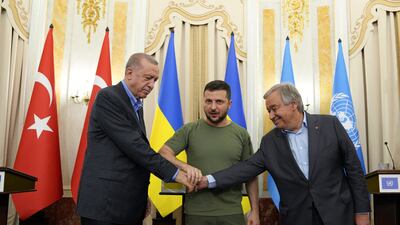
Turkish President Recep Tayyip Erdogan, Ukrainian President Volodymyr Zelenskyy and UN Secretary General Antonio Guterres shake hands after their meeting in Lviv, Ukraine. AP -

Russian missiles headed for Ukraine are launched from Russia's Belgorod region. AP -
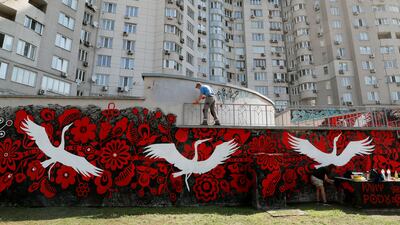
Street artists paint a mural on to a wall near a building in a residential area in Kyiv, Ukraine. EPA -
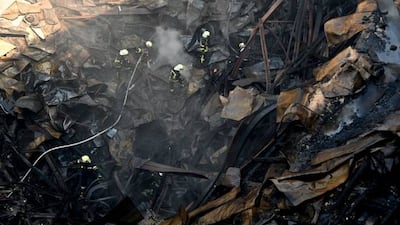
Firefighters put out flames and search through the rubble of the Culture Palace, which was destroyed by a Russian missile, in Ukraine's second-largest city of Kharkiv. Getty -
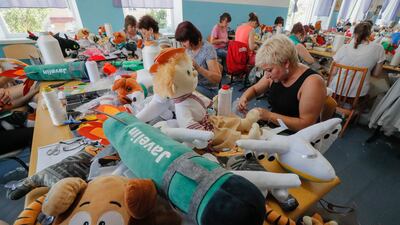
Seamstresses sew soft toys at the Kopytsia toy factory in Nizhyn, Ukraine. The factory makes toys that have became patriotic symbols for Ukrainians during Russia's invasion. EPA -
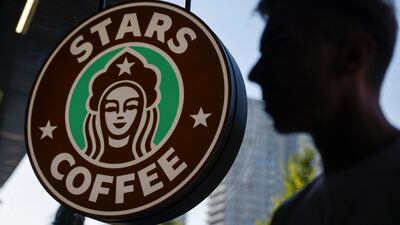
The logo of a new cafe called 'Stars Coffee', which opened in Moscow after Starbucks pulled out of Russia due to its invasion of Ukraine. Reuters -
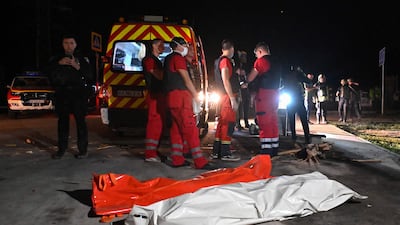
Rescue officials gather in front of the bodies of victims killed in a Russian missile strike on Kharkiv. AFP -
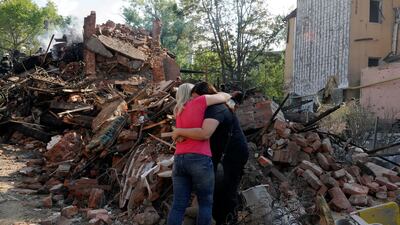
Women hug near the debris of a building that was destroyed after a rocket hit the Saltivka area in Kharkiv. EPA -
The letter 'Z', a symbol of support for Russia's invasion of Ukraine, is projected on to a building in Moscow. AFP -
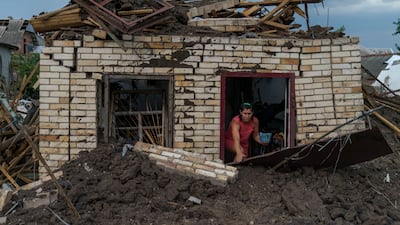
A woman recovers an item from the damaged home of her elderly neighbour after a Russian missile strike yesterday in Druzhkivka, in Ukraine's Donetsk enclave. AP -
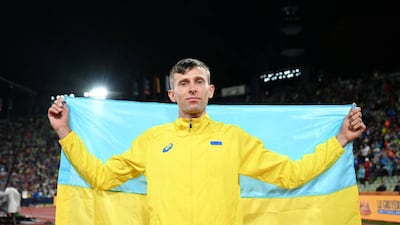
Bronze medalist Andriy Protsenko of Ukraine celebrates after the men's high jump final on day eight of the European Championships in Munich, Germany. Getty


Military quagmire
Ukraine’s resilience has impressed and inspired many people in Europe but the conflict with Russia has developed into a slow-moving war of attrition with no clear end in sight, and there are risks to both sides with the war dragging on.
President Volodymyr Zelenskyy urged G7 leaders to help Ukraine into a winning position by December, and the concern in Kyiv is that Russian troops will be harder to dislodge the longer they keep a foothold in Ukraine.
But there is also a feeling among western officials that Russia did not plan properly for a long campaign, with some of its troops struggling for fuel and apparently resorting to looting grocery stores in Ukraine.
“Winter is coming and it will be hard, and what we see now is a grinding war of attrition. This is a battle of wills and a battle of logistics,” Nato Secretary General Jens Stoltenberg told Mr Zelenskyy on Tuesday.

Both sides are pessimistic about peace talks, which have made no progress since March, and Mr Zelenskyy has given repeated warnings that they will become impossible if Russia keeps crossing red lines.
However, neither side’s ideal endgame — a Russian victory that bends Ukraine to the Kremlin’s will, or a Ukrainian offensive that restores control over the Crimean peninsula — is obviously within sight.
Ukraine’s western allies stopped short of embracing a Crimean offensive at a summit dedicated to the peninsula on Tuesday, instead saying they would reject any attempt to absorb further territory into Russia.
Amid concern they will lose interest, Ukraine’s allies have repeatedly been urged to see the war as a struggle for freedom and a necessary act of resistance to Russia’s imperialist designs.
“Ukrainians are fighting not just for their own sovereignty and independence, but also for the second liberation of Eastern Europe, finishing the process that began in 1989,” said Atlantic Council fellow Brian Whitmore.

Humanitarian crisis
It is a bleak picture for Ukrainian civilians. Millions have been displaced within Ukraine and some fled their homes with only what they could carry, leaving them without warm clothing or winter boots.
Many residential areas were damaged in missile strikes, and charity workers warn that even minor damage such as a broken window can have a major effect in cold weather.
“People are running out of resources and need our support increasingly,” said Ms Ebbesen. Many Ukrainians were glad to receive cash assistance so they could buy the clothes they need, she said.
Schools will return from the summer holidays next week with one in 10 buildings damaged or destroyed and about 1,000 children thought to have been killed during the conflict.

“Once again, as in all wars, the reckless decisions of adults are putting children at extreme risk,” said Unicef’s executive director Catherine Russell.
Millions of Ukrainians took refuge in neighbouring countries, especially Poland, Hungary, Slovakia and Romania, where they should at least be safe from Russian artillery.
But they too have plenty to be worried about, amid uncertainty over whether the generosity shown by their European neighbours will last through an expensive winter.
More than 1,000 Ukrainians were assessed as homeless or in danger of homelessness in Britain by the end of July, and most private hosts did not anticipate having to offer their rooms for more than six months.

The vast majority of Ukrainian refugees are women and children, and many are older or disabled — meaning those with dependent relatives may struggle to find a job in Europe, the Red Cross said.
“It will not be an easy winter for any of them,” said Ms Ebbesen. "As we know the fuel prices are increasing, and the rent may also be more expensive, so everybody will not be having enough resources."
And beyond these material problems, there is the deep emotional trauma suffered by millions of Ukrainians after witnessing a brutal war tear apart their homeland.
“The fear and grief that wars create leave deep internal scars — scars that hurt every bit as much, if not more, than physical scars,” said Isadora Quay of humanitarian charity Care.
“Left unaddressed, this fear and grief can have a profound long-term, negative impact and lead to a range of serious mental health issues or even suicide.”

Economic woes
No sooner had Europe emerged from the dark days of Covid-19 lockdown than it was thrust into another economic crisis, as an energy stand-off with Russia led to dwindling gas supplies, soaring prices and fears of a looming recession.
Economic forecasts for the winter, when gas consumption typically soars and fuel prices are predicted to surge even higher, are dire.
Inflation in Britain is tipped to rise above 18 per cent, while German businesses are as pessimistic as they have been since the early days of the pandemic in April 2020, the central bank said.
Plans have been drawn up for power to be rationed in a worst-case scenario where Russian gas dries up completely, after the Kremlin shut down exports to countries including Poland, Bulgaria and Finland.

Some European leaders have sought to invoke a spirit of wartime sacrifice. Estonian Prime Minister Kaja Kallas likes to say: “Gas might be expensive, but freedom is priceless.”
But many have called into question whether Europe can maintain its determination to isolate Russia as winter bites, with some in Germany urging ministers to take a second look at the mothballed Nord Stream 2 pipeline.
Janis Kluge of the German Institute for International and Security Affairs called for a communications strategy from Chancellor Olaf Scholz’s government to counter the narrative that sanctions are hurting Europe more than Russia.
Mr Scholz promised on Tuesday that Germany would stand by Mr Zelenskyy’s side “for as long as Ukraine needs our support”, while the head of the European Commission said sanctions were “critically undermining” Russia.
Ukraine Independence Day - in pictures
-
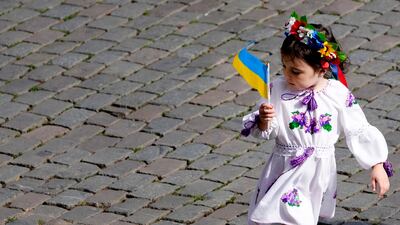
A young girl displays some patriotism during an event in central Brussels for Ukrainian Independence Day, which arrive six months to the day since Russia's invasion. AP -

A giant sculpture of a defiant hand with fingernails painted in the colours of Ukraine stands outside the Russian embassy in Prague, Czech Republic. AFP -
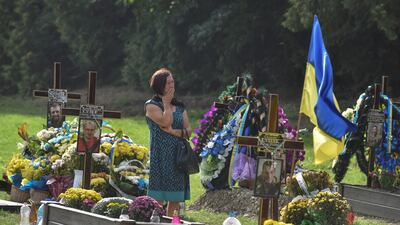
A woman visits the tomb of her relative, a Ukrainian serviceman who was killed in a fight against Russian troops, in Lviv. Reuters -

A vast Ukrainian flag is unfurled on Independence Day in the historical Grand Place of Brussels. AP -
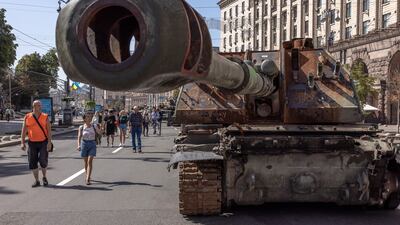
Russian tanks that were captured by the Ukrainian army are displayed on Khreshchatyk on Independence Day in central Kyiv. EPA -

A march on the Promenade des Anglais in Nice, south-eastern France. AFP -
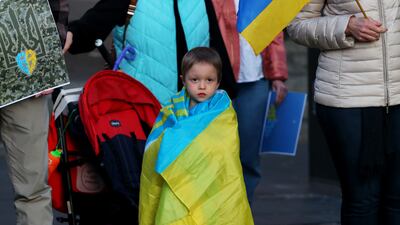
Ukrainians young and old gather at Circular Quay in Sydney. Getty Images -
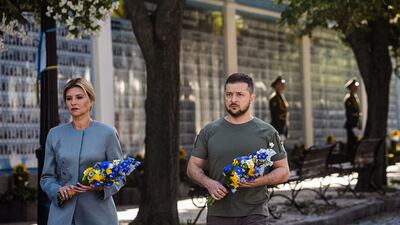
Ukrainian President Volodymyr Zelenskyy and his wife Olena attend a commemoration ceremony in Kyiv. AFP -

Ukrainians and supporters in Sydney marks the anniversary of the Declaration of Independence of 1991, which ended Soviet rule. Getty Images -
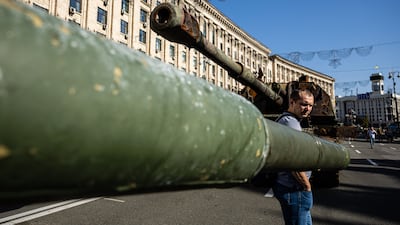
The main square in Kyiv has been turned into an open-air military museum for Ukrainian Independence Day. AFP -

Destroyed Russian military vehicles installed in central Kyiv, where authorities have banned mass gatherings in the capital for fear of Russian missile attacks. AP -
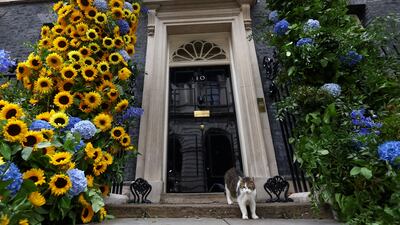
Larry the cat stands under a floral display to mark Ukraine's Independence Day outside No 10 Downing Street, central London. Reuters -

Ukrainians take part in a demonstration in the lead-up to Independence Day and six months since the Russian invasion began, in Valletta, Malta. Reuters -

The Academy Symphony Orchestra of the Luhansk Regional Philharmonic performs during a charity concert in support of the armed forces of Ukraine, in Lviv. Getty Images -
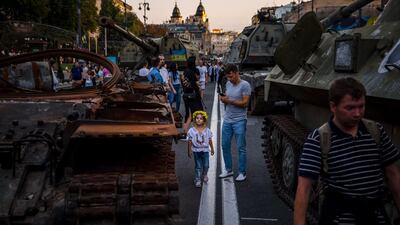
Central Kyiv is full of reminders of the continuing war on Independence Day. AFP -

Ukrainian and American flags raised on a street in New York to mark the occasion. AFP -

Dynamo Kyiv players wrapped in Ukrainian national flags before their second-leg Champions League play-off match against Benfica in Lisbon. EPA -
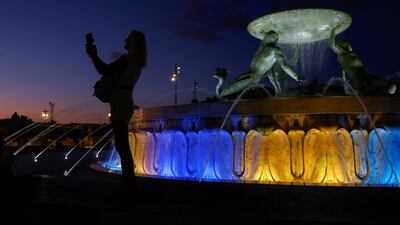
The Triton Fountain in Valletta is lit in Ukrainian colours. Reuters -

Ukrainians show support in the Maltese capital. Reuters -
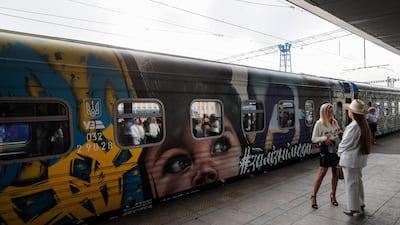
'The Train to Victory', sitting at Kyiv railway station, consists of seven carriages painted by Ukrainian artists, each dedicated to the occupied territories of Ukraine. The train was to arrive in the western city of Uzhgorod on Independence Day. EPA -
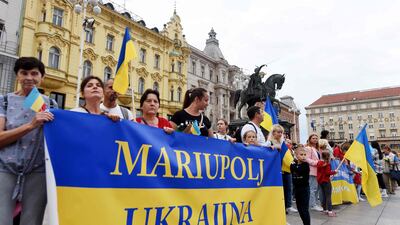
Support for Ukraine in Zagreb, Croatia. AFP -
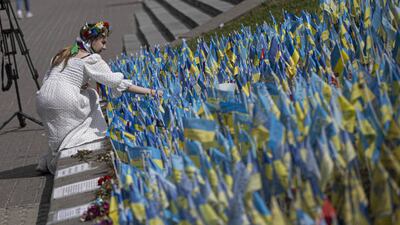
People arriving on Khreschatyk Street in Kyiv, where events to mark Ukraine's Independence Day are being held. Getty Images



