


Depending on who you ask, Europe is either living through a “hot strike summer” of workers standing up for their rights or a “summer of discontent” wrecking the holiday plans of millions.
There is no doubt that strikes are back in fashion. The walkouts on Britain’s railways are the worst for decades, telecoms workers downed tools for the first time since the 1980s, airline disputes across Europe are affecting the industry’s comeback from the pandemic, and doctors and teachers could be next out of the door.
Worse still, there is more to come. Further strike action is planned across the national rail networks, continuing a summer of disruption, with National Rail and workers’ unions locked in a long-running dispute over pay and conditions. Staff will walkout this weekend on Saturday and also on Thursday and next Saturday.
Alongside heatwaves reminiscent of Britain's great 'summer of 1976', the plethora of strikes also has a ring of the 1970s when workers downed tools and brought the UK to a halt, with bins and rubbish piled up in streets for weeks the most stark sign of a country in trouble.
Workers have much to be unhappy about: prices are soaring while wages stagnate, employers are cutting costs after the economic missile of Covid-19 and labour shortages are forcing people to work long and tiring hours.
Nurses, lawyers, bus drivers, railway workers, firefighters, airport staff, postal and telecoms workers and bin collectors are among the many workers to have walked out or threatened strikes as the cost-of-living crisis gathers pace. Some employers have been forced to concede hefty pay increases to defuse tension, a move criticised by Bank of England governor Andrew Bailey, who this month said non-unionised workers lacking any bargaining platform to demand higher wages would be worst affected should inflation soar out of control.
Trade unions have not made themselves popular among some European politicians who accuse them of holding people to ransom and insisting on privileges that their workers could live without.
But the unions insist that “we’re not here to annoy passengers”, as Eoin Coates, head of aviation at the European Transport Workers’ Federation, told The National. “We need to adapt to a post-Covid society.”
Strikes at European airports – in pictures
-
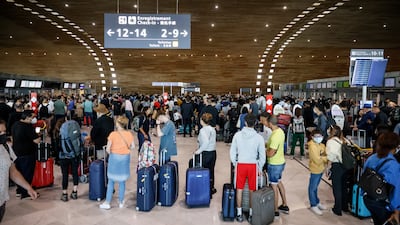
Passengers wait to check in at Charles de Gaulle airport, north of Paris. Flights from French airports faced disruptions on Friday as airport workers went on strike. AP -
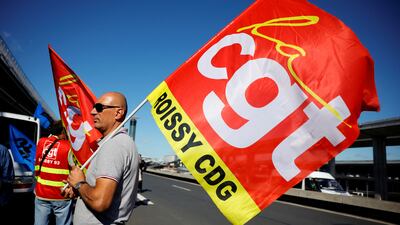
The airport employees have demanded wage increases that protect their incomes from rising inflation. Reuters -
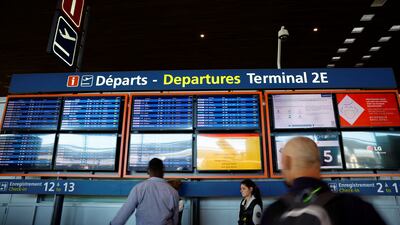
Passengers look at departure boards at Charles de Gaulle airport in Paris. Reuters -
Passengers affected by the strike, involving Ryanair employees, wait to change their ticket at El Prat airport in Barcelona, Spain. AFP -
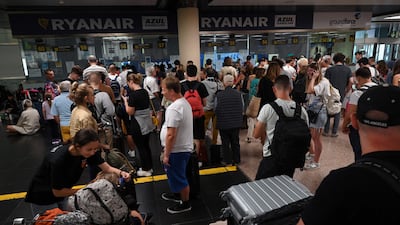
Passangers queue at El Prat airport in Barcelona. About thirty Ryanair flights were cancelled in Spain on Thursday, while 124 others were delayed, on the fourth day of a strike by the company's cabin crew. AFP -
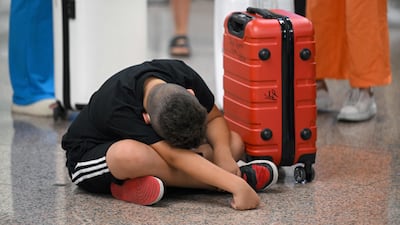
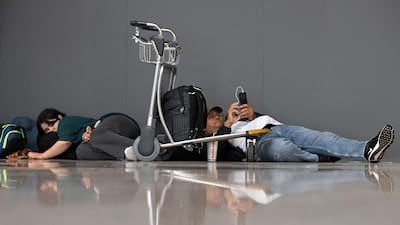
A young passengers tries to sleep at El Prat airport in Barcelona. AFP -
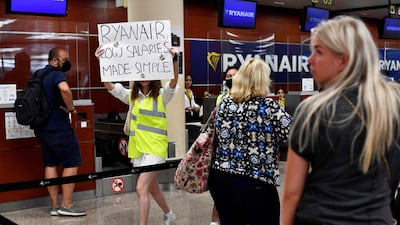
A woman holds a placard reading 'Ryanair, low salaries made simple' as she protests at El Prat airport in Barcelona. AFP -
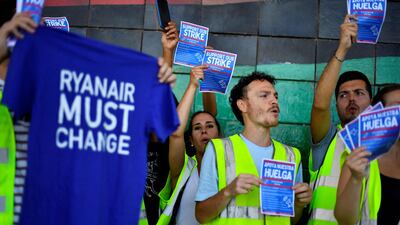
Ryanair employees hold flyers as they protest at El Prat airport. AFP -
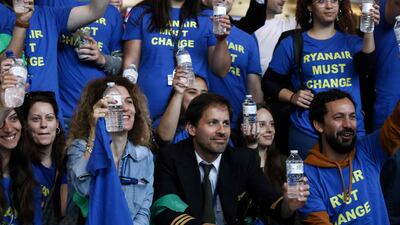
Ryanair cabin crew and pilots gather during a three-day-strike over labour conditions at Charleroi Airport in Belgium. AFP


Travel problems
The strikes across Europe are adding to the woes of the travel industry as long queues, cancellations and staff shortages spoil people’s hopes of a first hassle-free summer holiday in three years.
Lufthansa cancelled 1,000 flights after ground crew walked out in Frankfurt and Munich. EasyJet pilots voted for a nine-day strike, while Heathrow Airport was spared further chaos only after British Airways staff called off a walkout.
Norwegian Air agreed a 3.7 per cent pay rise and other benefits for its pilots, while Lufthansa offered a three-stage wage increase in a sign of what airlines are having to offer to keep unions at bay.
Mr Coates said there were two main causes of worker anger in the sector: the cost-of-living problems coming to a head throughout Europe and the workload that airport staff are facing after so many colleagues were laid off.
The shortages were illustrated by undercover footage at a British airport that showed passengers taking matters into their own hands and climbing on a carousel in an attempt to speed up the baggage-handling process.
“We’ve seen workers work longer hours than they’ve ever worked before. They have to deal with a lot more disruptive passengers, a lot more angry passengers,” Mr Coates said.
“We’re not here to cause more anger and more frustration. I think most passengers are angry about the lack of capacity at the airport.”
Unions' moment
Unions are certainly back in the limelight. Mick Lynch, the pugnacious boss of the National Union of Rail, Maritime and Transport Workers, has become something of a celebrity on the left for his TV appearances in which he regularly savages ministers and employers.
Hoping to capitalise on his appeal, an assortment of leftist groups and MPs this week launched a movement called Enough is Enough, promising to organise rallies and picket lines to demand hefty pay increases in line with runaway inflation.
“There’s always another crisis and it’s always workers who pay the price,” said Dave Ward, head of the Communication Workers Union and part of the emerging movement that regards the official Labour opposition as too soft.
“We’ve suffered the biggest pay squeeze in history and workers become all about working harder and faster for less. It’s time somebody else paid the price."
But comparisons between Mr Lynch and the once-mighty union barons of the 1970s and 1980s, such as miners’ strike leader Arthur Scargill, are prone to generating unfavourable opinions in political circles.
If a decade can be a bogeyman, the strike-filled 1970s are exactly that for Britain’s Conservatives, who are in the process of selecting the next prime minister and still boast proudly of having tamed the militant unions of that era.
Prominent Tories have complained about union tactics and claimed that rail workers are fighting in the trenches for arcane rights, such as restarting a lunch break if a manager so much as says hello.
Liz Truss, the front-runner in the leadership race, has promised to limit union powers by raising the ballot threshold required to force a strike and requiring a four-week notice period for industrial action.
“I will do everything in my power to make sure that militant action from trade unions can no longer cripple the vital services that hard-working people rely on,” she said.

Winter fears
The union action is playing out against the backdrop of a mounting energy crisis in Europe that will only add to people’s cost-of-living concerns.
In the fallout from the war in Ukraine, the Kremlin has slashed gas supplies to many European countries and even those, such as Britain, which do not import much directly from Russia are caught up in the knock-on effects.
More than a third of the UK’s National Health Service staff could be poised to strike after a union representing cleaners and porters turned down a 4 per cent pay rise it described as miserable.
As the winter price squeeze draws closer, leaders are concerned that picket lines will give way to violent protests.
Germany fears that extremists who took to the streets to oppose coronavirus lockdowns will exploit the cost-of-living crisis to solicit a fresh wave of support.
French President Emmanuel Macron is all too aware of his country’s reputation for rioting, especially after the long-running “yellow vests” protests that marred his first term in office.
Mr Coates said he was hopeful that dialogue between unions, employers and at times governments would calm the atmosphere but said he believed many customers were on the workers’ side.
“We all have the same issues,” he said. “From the general public, I would say the support has been very strong.”

