

The remains of 50 victims of the Srebrenica massacre were laid to rest Monday as thousands of people commemorated the 27th anniversary of the atrocity, which most Serbs and their leaders still refuse to recognise in ethnically divided Bosnia.
After a joint prayer, the remains of the most recently identified victims of Europe's worst massacre since the Second World War were buried alongside 6,671 others in a joint funeral at a memorial site outside the ill-fated town.
About 8,000 Bosnian Muslim men and boys from Srebrenica were killed by Bosnian Serb forces in July 1995 after they captured the eastern town. It was judged an act of genocide by the International Criminal Tribunal for the Former Yugoslavia.
-
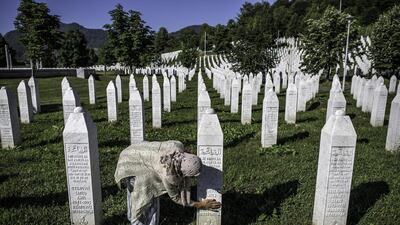
A Bosnian Muslim woman cleans a gravestone of a victim of the massacre at Srebrenica in July 1995, when more than 8,000 Bosnian Muslim men and boys were killed by the Bosnian Serb Army. Getty Images -
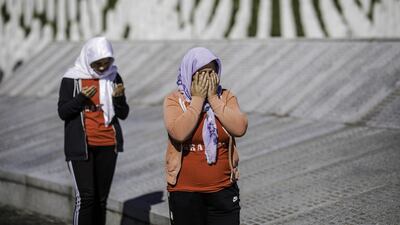
Bosnian Muslim women pray as they visit the cemetery for victims of Srebrenica genocide, in Potocari near Srebrenica, Bosnia and Herzegovina. Getty Images -
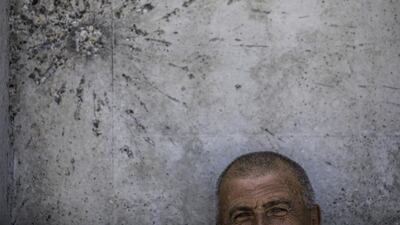
A man rests under a scar from a war-time projectile on the building where remains of victims of the Srebrenica genocide are placed in Potocari near Srebrenica, Bosnia and Herzegovina. Getty Images -

A Bosnian Muslim woman cleans a gravestone of her relative at the cemetery in Potocari near Srebrenica, Bosnia and Herzegovina. Getty Images -
![A man's shadow falls over ]the names of victims of Srebrenica genocide, at the cemetery in Potocari near Srebrenica, Bosnia and Herzegovina. Getty Images](https://www.thenationalnews.com/resizer/v2/TGFXHTWD6C6BGN3JNS5UKMBROI.jpg?smart=true&auth=3e43625f4cc520756ec030823dcad5b0c8ecedc696b2366976fa2e9070274545&width=400&height=225)
A man's shadow falls over ]the names of victims of Srebrenica genocide, at the cemetery in Potocari near Srebrenica, Bosnia and Herzegovina. Getty Images -
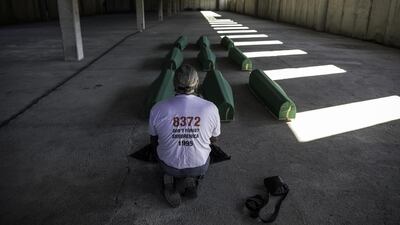
A Bosnian Muslim man prays by coffins of nine victims of the Srebrenica genocide whose remains discovered and identified since July 2019. Getty Images -
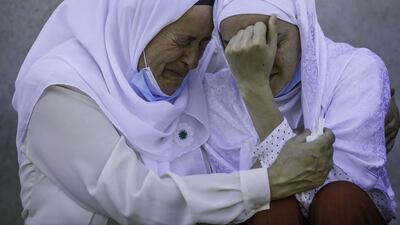
A daughter of a victim of Srebrenica genocide is hugged by her mother after seeing a coffin with remains of her father. Getty Images -
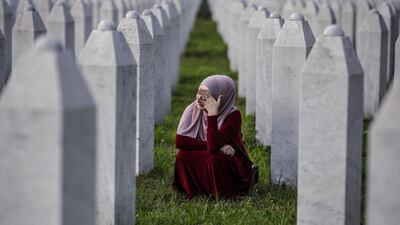
A Bosnian Muslim woman cries between graves of her father, two grandfathers and other close relatives, all victims of Srebrenica genocide, at the cemetery in Potocari near Srebrenica, Bosnia and Herzegovina. Getty Images -
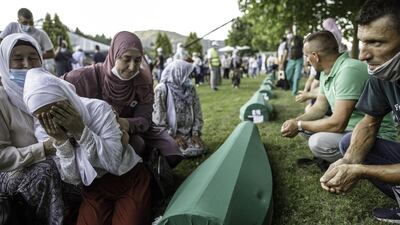
Bosnian Muslims cry over a coffin with the remains of a relative killed at Srebrenica in July 1995. Getty Images -
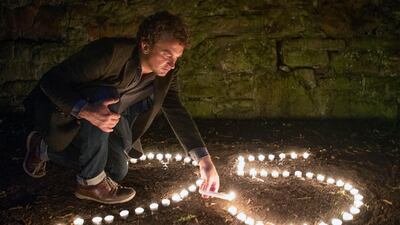
Bafta award-winning film director Samir Mehanovic, who came to the UK as an immigrant from the Bosnian war in 1995 and now lives in Scotland, lights candles to commemorate the 25th anniversary of the Srebrenica genocide, in Edinburgh, Scotland. AP Photo -
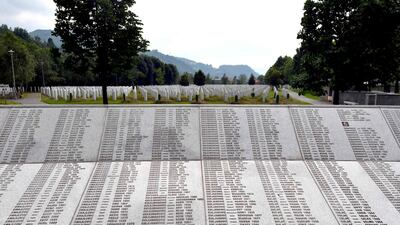
The Potocari memorial cemetery near Srebrenica. AFP -
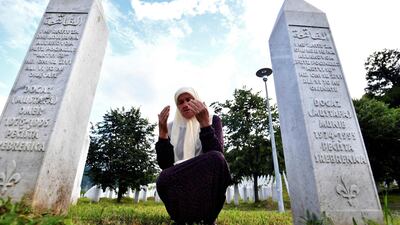
Bosnian Muslim Mejra Djogaz, 71, prays between the tombstones of Omer, 19, and Munib, 21, her two sons killed in the Srebrenica massacre, at the Potocari memorial cemetery. More than 6,600 victims lie at the cemetery while another 237 have been laid to rest at other sites. But more than 1,000 people have never been found. AFP -
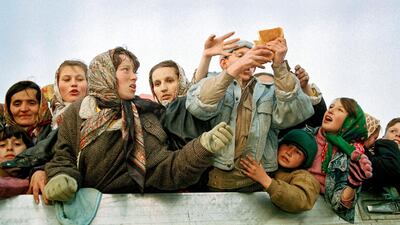
Refugees evacuated from the besieged Muslim enclave of Srebrenica struggle for bread on their arrival in Tuzla, Bosnia on March 29, 1993. AP Photo -

More than 2,000 evacuees from the besieged Muslim enclave of Srebrenica, packed on UN trucks en route to Tuzla, halt in Tojsici on March 29, 1993. AP Photo -

Refugees from Srebrenica look through the razor-wire at a UN base outside Tuzla on July 13, 1995. AP Photo


![A man's shadow falls over ]the names of victims of Srebrenica genocide, at the cemetery in Potocari near Srebrenica, Bosnia and Herzegovina. Getty Images](https://www.thenationalnews.com/resizer/v2/TGFXHTWD6C6BGN3JNS5UKMBROI.jpg?smart=true&auth=3e43625f4cc520756ec030823dcad5b0c8ecedc696b2366976fa2e9070274545&width=800&height=450)


The Netherlands on Monday offered its “deepest apologies” for the role played by Dutch peacekeepers in the genocide, meeting a long-standing demand by relatives of the victims.
Outgunned and outnumbered, Dutch peacekeepers were unable to prevent Bosnian Serb forces from overrunning the UN-declared “safe haven” at the tail end of the 1992-1995 Bosnian war.
Netherlands defence minister
“Only one party is to blame for the horrific genocide; the Bosnian Serb army,” Dutch Defence Minister Kajsa Ollongren said.
“But let me be clear: the international community failed to offer adequate protection to the people of Srebrenica and as part of that community the Dutch government shares responsibility for the situation in which that failure occurred. And for this we offer our deepest apologies.”
Dutch courts had already determined that the Netherlands was partly responsible for the fall of Srebrenica and compensation was paid to survivors.
The Dutch government resigned over the episode in 2002, with then-prime minister Wim Kok saying the government in that way accepted its responsibility for the massacre but not the blame. Relatives did not deem this enough and have been pushing for an apology for years.
Among those buried on Monday were Samir and Semir Hasanovic, 19-year-old twin brothers of Sebiba Avdic, who also lost her husband, father, another brother and several other close relatives in the atrocity.
“All I had is here,” she said, pointing towards the white tombstones marking the graves.

“I cannot speak any more. I turned into a stone,” said Ms Avdic, who now lives with her daughter in Switzerland.
“My pain is intense, as if only 27 days have passed, not 27 years … Once I had a family, now I have nothing.”
The EU's top diplomat Josep Borrell and enlargement commissioner Oliver Varhelyi paid tribute to the Srebrenica dead at a time when the Russian invasion of Ukraine shows “still today, we cannot take peace for granted”.
“It is more than ever our duty to remember the genocide of Srebrenica … to stand up to defend peace, human dignity and universal values,” the two leaders said in a statement before the ceremony.
“In Srebrenica, Europe failed and we are faced with our shame.”
The discovery of human remains at the site has become rare in recent years, even though about 1,200 people have yet to be found, the Missing Persons Institute of Bosnia-Herzegovina reported.
The identification process has been made more difficult by the bulldozing of the remains and their removal to mass graves by Bosnian Serb forces in a bid to conceal the extent of the slaughter.
Mass funerals for those identified are held each July 11, the date Bosnian Serb forces took the town, led by Gen Ratko Mladic, who has been jailed for life for war crimes.
The remains of one of the people buried on Monday were found spread across three separate mass graves, forensic experts said.
The remains of most of the others were found spread across two mass graves.
Ever since the brutal 1990s war that claimed about 100,000 lives, Bosnia has been divided along ethnic lines. One half of the country belongs to the Serb entity while the other is ruled by a Muslim-Croat federation.
More than a quarter of a century has passed but Mladic and Radovan Karadzic, the Bosnian Serb wartime president who has also been jailed for life, remain “heroes” in the eyes of many Serbs, with their pictures still adorning many walls.
Political leaders of Serbs living in Bosnia today and in neighbouring Serbia refuse to accept that a genocide took place at Srebrenica, preferring to call it a “major crime”.
Agencies contributed to this report

