


Sending unaccompanied Moroccan minors home after they entered the Ceuta enclave in May last year was illegal and violated their rights, a Spanish court has ruled.
The court found that Spanish authorities had “omitted all the essential steps and procedural safeguards” that must be complied with for repatriation.
More than 10,000 people surged across the frontier into Spain's tiny North African enclave in mid-May 2021 as Moroccan border guards looked the other way.
Among them were hundreds of unaccompanied minors, most of whom were sent home in days, but 820 children remained in Ceuta for months.
When the government of Prime Minister Pedro Sanchez began sending them back to Morocco in groups of 15, it sparked anger from his left-wing coalition, complaints from humanitarian agencies and a court case.
In mid-August, a court suspended the repatriations after a petition by two human rights groups, which said the minors were being sent back without any access to a lawyer or the chance to argue their cases.
The authorities in Ceuta as well as the central government's representative in the city appealed the ruling.
-
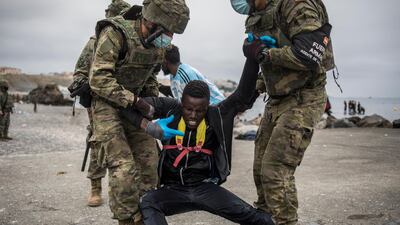
A man is held by soldiers of the Spanish Army at the border of Morocco and Spain at the Spanish enclave of Ceuta. A record 6,000 migrants entered Ceuta illegally on Monday, 1,500 of whom were minors. AP Photo -
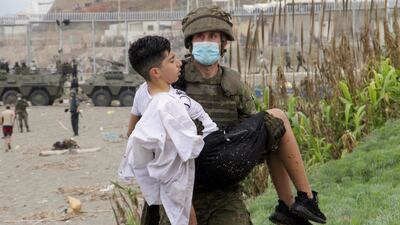
A Spanish soldier helps a migrant as troops are deployed along the coast in Ceuta. EPA -
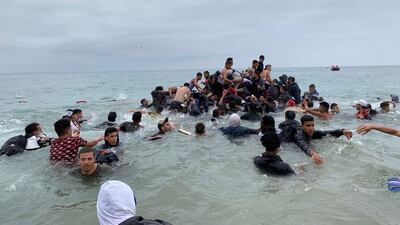
Migrants manage to grab onto a boat of the Moroccan authorities near the coast of Fnideq in an attempt to cross over to Ceuta. EPA -
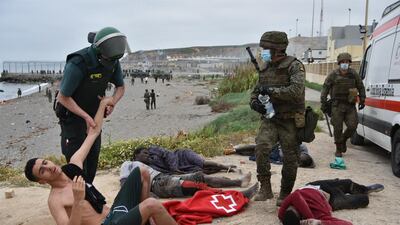
A Spanish Civil Guard holds onto a migrant who swam onto the Spanish enclave of Ceuta. AFP -
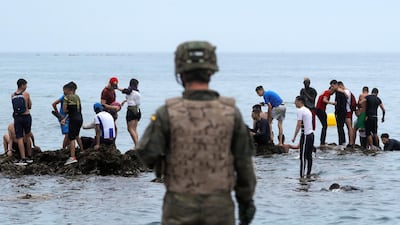
A Spanish soldier stands in front of Moroccan migrants. Reuters -

Red Cross members and Spanish soldiers carry a migrant into an ambulance. AFP -
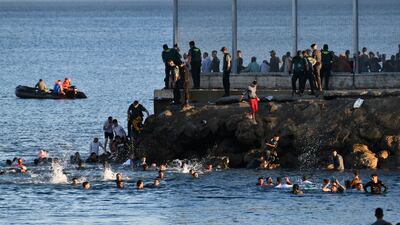
Spanish officers try to stop people swimming into Spanish territory at Ceuta. AP Photo -
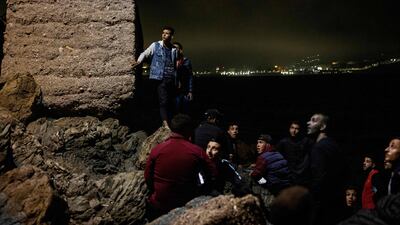
Moroccan migrants climb up a rocky cliffside in the northern town of Fnideq as they attempt to cross the border from Morocco to Ceuta. AFP -

Moroccan migrants walk into shallow waters in the northern town of Fnideq. AFP -

Two migrants are met by a Spanish civil guard in Ceuta. Reuters -
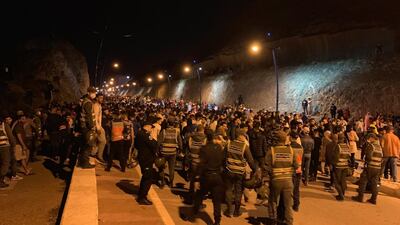
Hundreds of young Moroccans wait to cross the border with Spain. EPA -

About 3,000 Moroccan citizens illegally entered Spain's north African enclave of Ceuta. AFP -
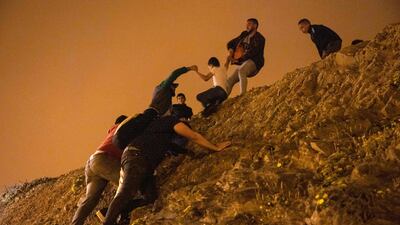
Spain says it will return anyone from the country who illegally enters its north African enclave by water. AFP


On Thursday, Andalusia's top court, which has jurisdiction in the enclave, confirmed the court's original decision.
“The actions of the administration made it impossible to follow up on the repatriations that it implemented,” it said.
“Its own actions, which lacked the minimum procedural guarantees required, resulted in an actual situation of risk to the physical or moral integrity of the unaccompanied minors who were sent back.”
The “massive, sudden and illegal” entry of migrants into Ceuta “in no way allows Spain” to sidestep the law, it concluded.
Ceuta and Melilla, Spain's two North African enclaves, have the European Union's only land borders in Africa, making them a magnet for people desperate to escape grinding poverty.
Last week, at least 23 African migrants were killed when about 2,000 people tried to cross the fence into Melilla in what was by far the worst death toll in years of attempts to cross into the Spanish enclaves.

