

Live updates: follow the latest news on Russia-Ukraine
The West is divided over how best to tackle Russia’s aggression in Ukraine, President Volodymyr Zelenskyy said on Wednesday.
Mr Zelenskyy renewed calls for heavy weapons from foreign partners, saying the billions of dollars' worth already put up were not enough to help Ukraine's outgunned forces.
“Unity is about weapons," he said during a panel discussion on Ukraine at the World Economic Forum. "My question is, is this unity there in practice? I can't see it. Our huge advantage over Russia would be when we are truly united."
As Mr Zelenskyy spoke to leaders in Davos, Russia accused Ukraine of setting mines at its ports, claiming this was worsening a world food crisis.
Mr Zelenskyy said Ukraine was grateful for US support but urged Europe to step up its efforts.
“We are on the European continent and we need the support of a united Europe,” he said. “Hungary is not as united as the rest of EU.”
-

Service members of pro-Russian troops drive a tank past a destroyed residential building in the town of Popasna in the Luhansk region, Ukraine. Reuters -
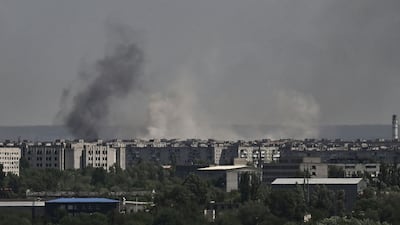
Smoke and dirt rise from the city of Severodonetsk during shelling in the eastern Ukrainian region of Donbas. AFP -
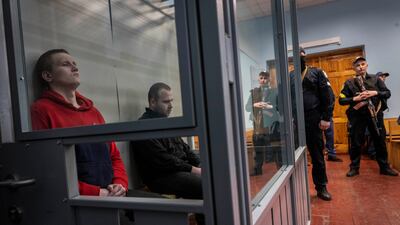
Russian soldiers Alexander Alexeevich Ivanov and Alexander Vladimirovich Bobykin, left, attend their trial hearing in Kotelva, northeastern Ukraine. AP Photo -
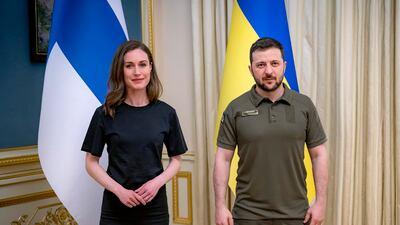
Ukrainian President Volodymyr Zelenskyy, right, meets with Finnish Prime Minister Sanna Marin in Kyiv, Ukraine. AP -
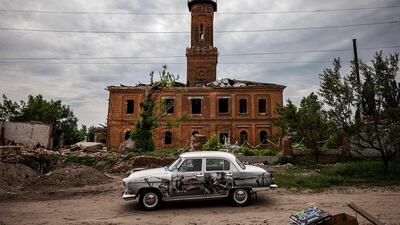
A man drives a GAZ-21 Volga car past a damaged building in Kharkiv, eastern Ukraine, on the 92nd day of the Russian invasion of Ukraine. AFP -
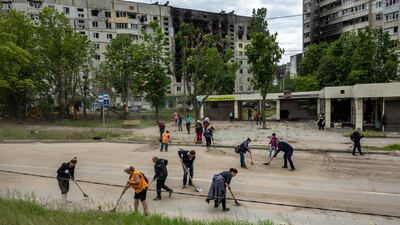
Public transit workers sweep up shrapnel in Kharkiv, Ukraine. Getty Images -
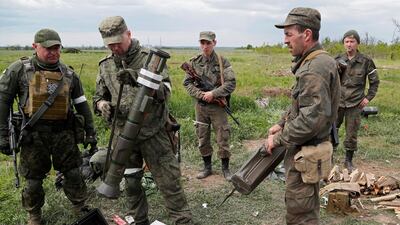
Pro-Russian troops inspect an AT4 anti-tank launcher outside the town of Svitlodarsk in the Donetsk region, Ukraine. Reuters -
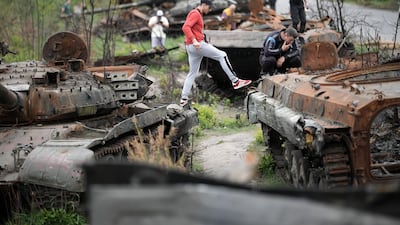
People inspect destroyed Russian tanks and armoured vehicles in Irpin, Ukraine. Getty Images -

A local resident pets a cat next to a destroyed house in Vilkhivka village, near Kharkiv, Ukraine. AFP -
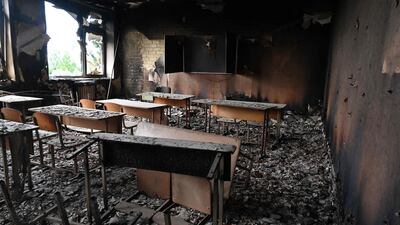
The remains of a school in Vilkhivka village, near Kharkiv. AFP -
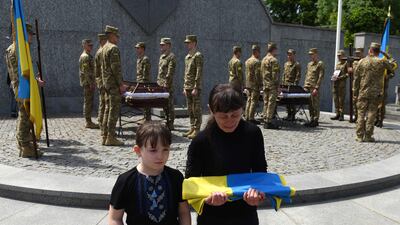
Widow and daughter of Andriy Vertiev, a Ukrainian serviceman, killed during the Russian invasion of Ukraine, attend his funeral at Lychakiv cemetery, Lviv, Ukraine. AFP -
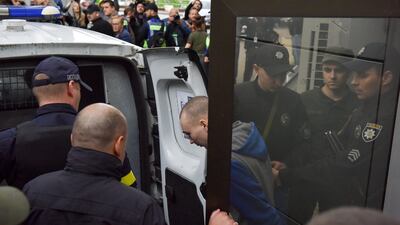
Russian serviceman Vadim Shishimarin, centre, leaves a court hearing in Kyiv. EPA -
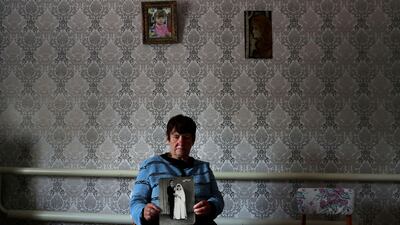
Kateryna Shelikhova, widow of Oleksandr Shelipov, 62, who was shot dead by a Russian soldier. Reuters -
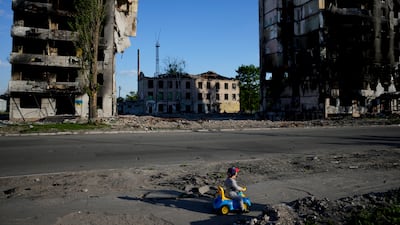
A child plays against a backdrop of buildings ruined by shelling in Borodyanka, Ukraine. AP -
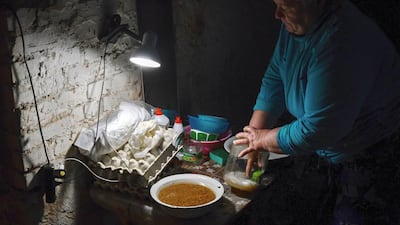
A Ukrainian woman in the basement of a building used as bomb shelter in Soledar, Donetsk region. AP -
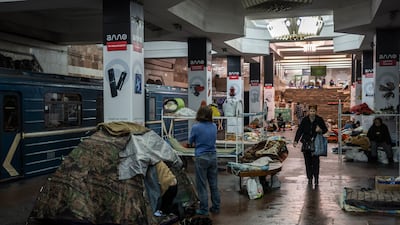
Residents live in a subway station used as temporary shelter in Kharkiv. AP -
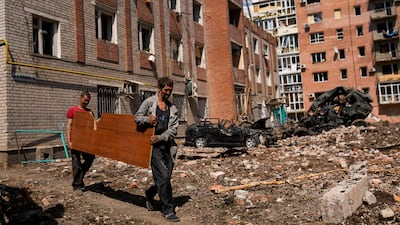
Men with salvageable material from damaged buildings after Russian bombing in Bakhmut, eastern Ukraine. AP -
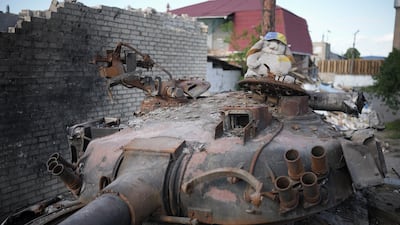
A cuddly toy adorns a destroyed Russian battle tank near damaged homes in Hostomel, Ukraine. Getty Images -
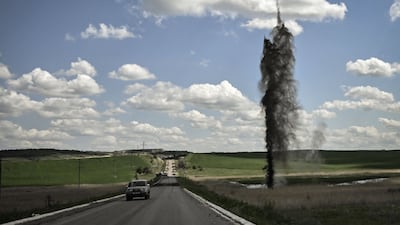
A mortar explodes next to a road leading to the city of Lysychansk, in the eastern Ukrainian region of Donbas. AFP -
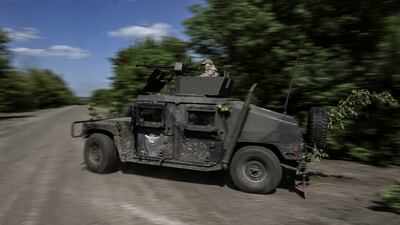
A Ukrainian army vehicle moves towards the front line at a checkpoint near Lysychansk. AFP -
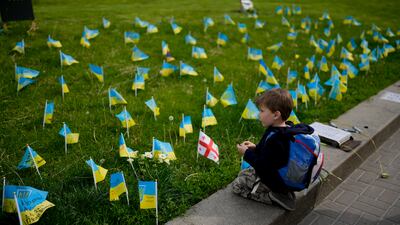
A boy looks at flags honouring soldiers killed while fighting Russian troops, in Kyiv city centre. AP -
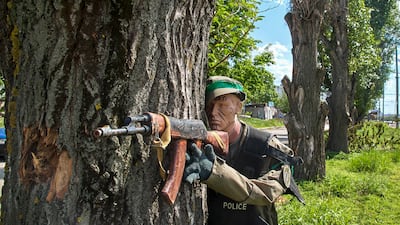
A mannequin with a fake gun is placed as bait on a roadside in the Nord Saltivka district of Kharkiv. EPA -
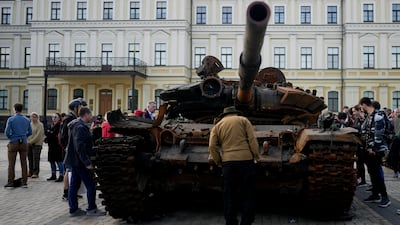
A man looks at a destroyed Russian tank placed as a symbol of war, in central Kyiv. AP -
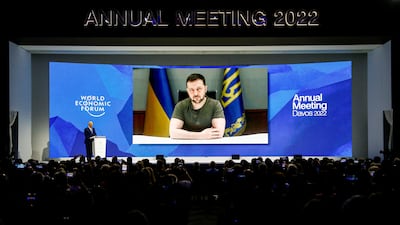
Ukraine's President Volodymyr Zelenskyy on a screen at the opening ceremony for the World Economic Forum in Davos, Switzerland. Reuters -
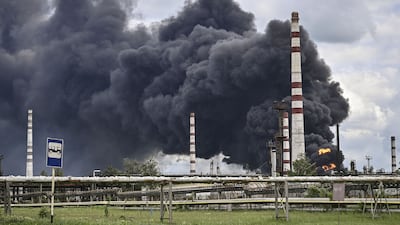
Smoke billows from an oil refinery after an attack outside the city of Lysychansk, in the eastern Ukrainian region of Donbas. AFP -
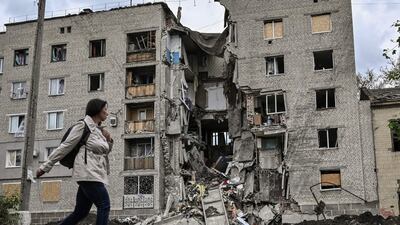
A woman walks by a destroyed apartment building in Bakhmut, Donbas region. AFP -
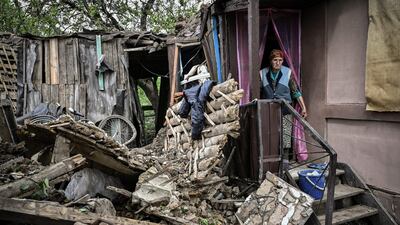
An elderly woman stands inside her heavily damaged house after it was hit by a missile in Bakhmut. AFP -
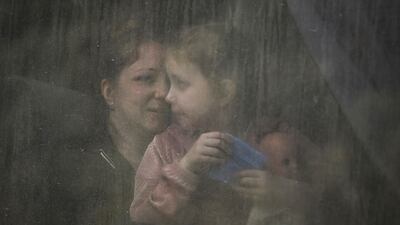
A mother with her daughter sit inside a bus as they leave Bakhmut. AFP -
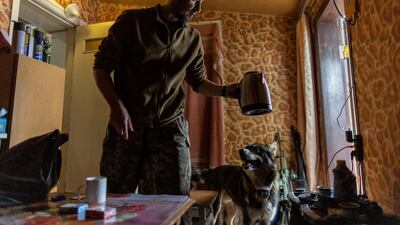
A Ukrainian soldier prepares coffee as he takes a break near an artillery position in the breakaway enclave of Donetsk, in the Donbas region. Reuters -
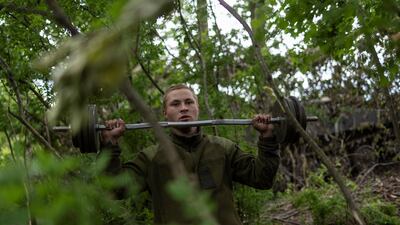
A Ukrainian soldier exercises near Donetsk. Reuters -
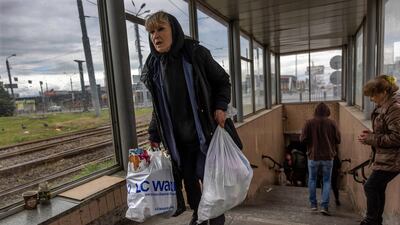
A woman displaced by incessant Russian shelling leaves a metro station where people had been living underground for months in Kharkiv, Ukraine. Getty -

A heavily damaged home spa near Ruski Tyshky village in Ukraine. Getty -

The wreckage of a Ukrainian military helicopter is transported in Kharkiv. Getty -
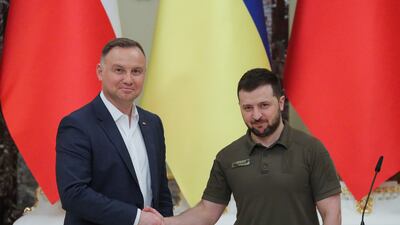
Ukrainian President Volodymyr Zelenskyy and Polish President Andrzej Duda in Kyiv. EPA -
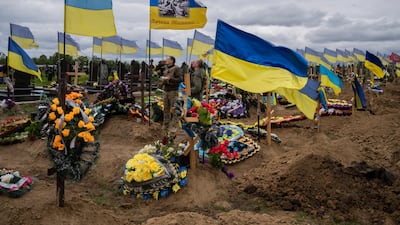
Two Ukrainian national guard soldiers pay their respects at a cemetery in Kharkiv. AP -
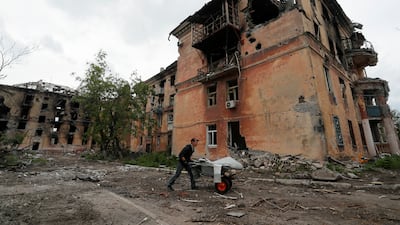
A man pushes a wheelbarrow past a heavily damaged apartment building near Azovstal Iron and Steel Works in Mariupol. Reuters -
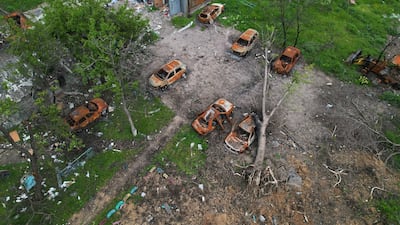
The burnt out shells of cars in a residential area near Azovstal Iron and Steel Works in Mariupol. Reuters -
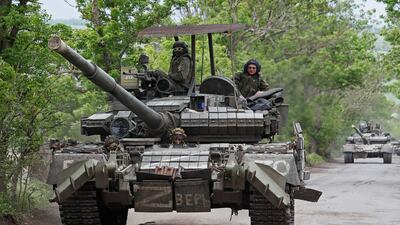
Pro-Russian troops drive a tank in Ukraine's Donetsk region. Reuters -
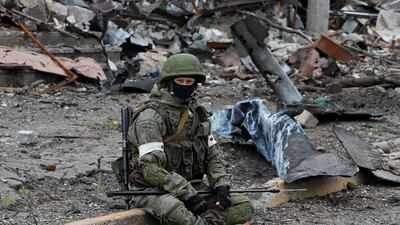
A Russian soldier takes a break during an operation to demine the territory of Azovstal steel plant in Mariupol. Reuters -
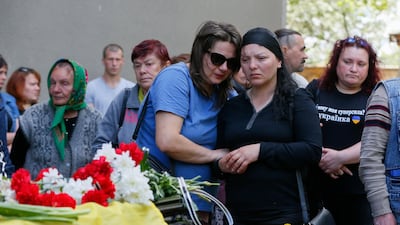
Relatives and friends attend the funeral of a Ukrainian soldier killed in action, in the Odessa region city of Rozdilna. EPA -
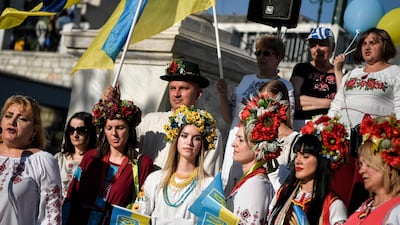
Ukrainians wearing traditional clothing listen to their national anthem as they take part in the celebration of 'Vyshyvanka Day', an annual celebration of Ukrainian folk traditions, in Athens. AFP


He highlighted a lack of consensus over Sweden and Finland's bid to join Nato, which has been called into question by Turkey.
“Is there this unity regarding the accession of Finland and Sweden to Nato? No, no," he said. "So, is there a strong joint West? No.”
Turkish President Tayyip Erdogan has said he will launch a new military operation along his country's southern borders, raising the stakes in a spat with the two Nato hopefuls, which Ankara has long accused of harbouring members of the Kurdish militant PKK group.
Swedish Prime Minister Magdalena Andersson rejected such claims.
"We are not sending money to terrorist organisations, of course, nor any weapons," she said in Stockholm.
The Ukrainian president said hours earlier, in his daily address to the nation, that Russian forces “want to destroy everything” in eastern Ukraine, including the town of Soledar, a salt manufacturing centre.

Russia is now focused on expanding its gains in eastern Donbas, home to pro-Russian separatists, as well as the southern coast.
A swathe of southern Ukraine, meanwhile, is living under Russian occupation.
Mr Zelenskyy said the Kremlin should pull back its troops to their positions before the invasion to show it is ready to resume talks, even as Russia amassed forces for an offensive near the city of Zaporizhzhia and continued attacks in the Donbas region.
President Vladimir Putin has signed a decree simplifying a procedure to obtain a Russian passport for residents of the southern Ukrainian regions of Kherson, under the full control of Russian troops, and the partly-occupied Zaporizhzhia.
In Moscow, Russian Defence Minister Sergei Shoigu made it clear Russia was settling in for a long conflict.
“We will continue the special military operation until all the objectives have been achieved,” he said.
Tough sanctions imposed since Russia's invasion on February 24 are causing food shortages around the world, Moscow said.
Russian deputy foreign minister Andrey Rudenko said: “Solving the food problem requires a comprehensive approach, including the removal of sanctions that have been imposed on Russian exports and financial transactions."
Russia also demanded that Ukraine demine its ports.
The West argues it is Russia's offensive in Ukraine and blockade of ports that has pushed global food prices to an all-time high, sparking fears of worsening hunger, particularly in Africa.
Vital supplies such as water are running short in Ukraine itself as Moscow's war grinds on.

