


Live updates: follow the latest news on Russia-Ukraine
President Vladimir Putin praised troops “defending Russia” in Ukraine as he addressed the nation during the 77th Victory Day parade in Moscow’s Red Square.
He evoked the memory of Soviet heroism in World War Two to inspire his army fighting in Ukraine, but offered no new road map to victory and acknowledged the cost in Russian soldiers' lives.
In his highly anticipated speech, he told soldiers they were “fighting for your people in Donbas, for the security of our motherland, Russia”.
He said Nato had sent troops into countries bordering Russia, which constituted an “unacceptable threat to us”, and had plotted acts of aggression towards Moscow.
Celebrated annually on May 9, Victory Day marks Russia's defeat of Nazi Germany during the Second World War. Mr Putin donned a ribbon of Saint George on the lapel of his coat. The black-and-orange ribbon is Russian military symbol traditionally used to commemorate the soldiers who died during the war.
Mr Putin told the thousands of troops gathered that Russian forces in Ukraine were continuing the battle against Nazism, but it was important “to do everything so that the horror of a global war does not happen again.”
He evoked the memory of Soviet heroism in the Second World War to urge his army towards victory in Ukraine but acknowledged the cost in Russian lives as he pledged to help the families of fallen soldiers.
Mr Putin compared the Russian troops fighting in Ukraine to “the heroes of the Great Patriotic War”, a term used in Russia to describe the conflict along many of the eastern fronts of the Second World War, during which the Soviet Union lost 27 million people.
“You are fighting for your motherland, its future,” he told troops fighting in Ukraine.
“The death of every soldier and officer is painful for us,” he added. “The state will do everything to take care of these families.”

Belarusian President Alexander Lukashenko, a close ally of Mr Putin, accused the West of supporting Nazi ideas and of being “at war with Russia” in Ukraine.
In a Victory Day speech in Minsk, Mr Lukashenko said Nazis are “flooding Ukraine with weapons, waging war on memorials, symbols and veterans”. He also accused “western elites” of elevating “Nazism to the rank of state ideology”.
Britain's Defence Secretary Ben Wallace hit out at the “absurdity” of Russian generals who flanked Mr Putin at the parade, “resplendent in their manicured parade uniforms and weighed down by their many medals”.
Mr Wallace, a former soldier, said “all professional soldiers should be appalled at the behaviour of the Russian Army”, and accused Moscow of staging an “illegal invasion” of Ukraine and carrying out war crimes.
Russia's ambassador to Poland was humiliated at a wreath-laying ceremony at a cemetery in Warsaw when protesters drenched him in red paint, which reportedly symbolised the blood spilt in Ukraine.
During the parade, Mr Putin said despite Moscow’s differences with other nations, it had always worked towards international security. He harked back to December 2021 — when fears were mounting in the West over a potential Russian invasion of Ukraine — saying the Kremlin had proposed solutions that were rejected by Nato.
Mr Putin accused the trans-Atlantic military alliance of “openly preparing another punitive operation” in the eastern Ukrainian region of Donbas, where Russian-backed separatists have been fighting Ukrainian soldiers since 2014. He also said Nato members had plotted “aggression against our historical lands including Crimea”, referring to the Black Sea peninsula that Russia annexed from Ukraine eight years ago.
“Nato didn’t want to hear us and this means that in reality they had quite different plans, and we saw that,” he said.
“There were calls in Kyiv about the possible acquisition of nuclear weapons. The Nato alliance began to move their troops into our neighbouring territories and they were creating an unacceptable threat to us right at our borders.”
He said as the “danger grew every day” Russia delivered a “preventive strike against the aggressor” which he said was the only correct response. Mr Putin said troops were engaged in “a clash with neo-Nazis and Banderavites” in Ukraine.
Supporters of the EuroMaidan movement that ousted the Russia-allied Ukrainian president Viktor Yanukovych are often referred to as “Banderavites”. The term is in reference to Ukrainian nationalist Stepan Bandera, whose movement fought against the Soviet Union during the Second World War.
The Russian leader finished his 11-minute speech with a rallying cry to the assembled soldiers: “Glory to our glorious armed forces. For Russia, For Victory, Hurrah!”
Mr Putin has repeatedly compare the war — which he casts as a battle against dangerous “Nazi”-inspired nationalists in Ukraine — to the challenge the former Soviet Union faced when Adolf Hitler invaded in 1941.
His speech, on day 75 of the invasion of Ukraine, was largely notable for what he did not say.
There had been speculation that Mr Putin would use his address to the nation to formally declare war in Ukraine, after weeks of describing the aggression towards Kyiv as a “special military operation”. This would allow Russia to order a mass mobilisation, potentially helping to jump-start the stalled campaign.
Such a move would also force the Russian population to confront the reality of the conflict, which has caused major casualties and which Mr Putin has sought so far to keep at arm’s length from the public.
Mr Putin failed to call the military action in Ukraine a war during his speech.
He did not mention Ukraine by name, gave no assessment of progress in the war and offered no indication of how long it might continue. There was no mention of the bloody battle for Mariupol, where Ukrainian defenders holed up in the ruins of the Azovstal steel plant are still defying Russia's assault.
About 11,000 troops marched across Red Square in Moscow, with nuclear missile launchers, tanks and air-defence systems due later.
A planned flyover by military jets and helicopters has been cancelled because of cloudy weather, state-run Tass news service reported, citing Kremlin spokesman Dmitry Peskov.
-
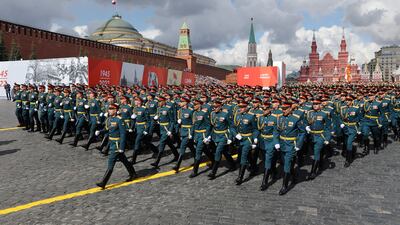
Thousands of Russian soldiers march during the Victory Day parade in Red Square in central Moscow, which marks the 77th anniversary of the Soviet Union's victory over Nazi Germany in the Second World War. Reuters -
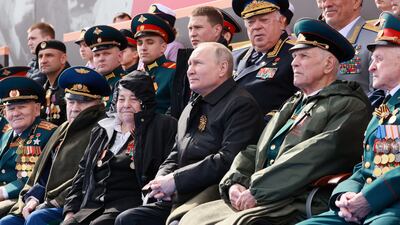
Russian President Vladimir Putin watches the Victory Day military parade in Red Square in central Moscow. Reuters -
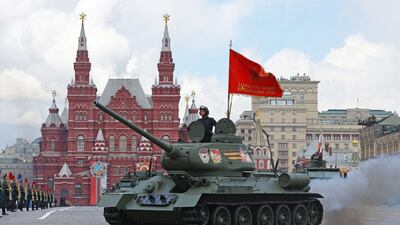
A T-34 Soviet-era tank powers along in Red Square. Reuters -
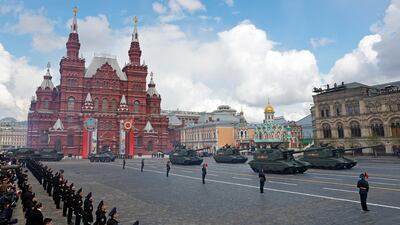
Russian armoured vehicles, including MSTA-S self-propelled howitzers, drive through Red Square. Reuters -
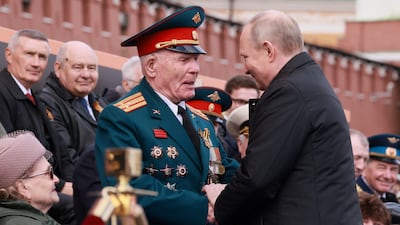
Vladimir Putin shakes hands with spectators before the parade in Moscow. Reuters -
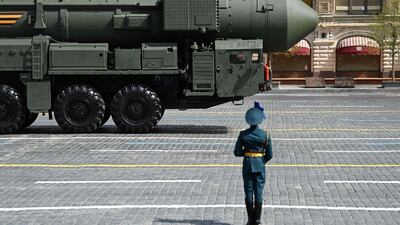
A Russian Yars intercontinental ballistic missile launcher parades through Red Square. AFP -
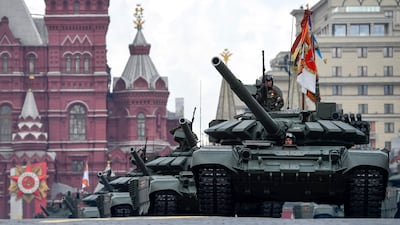
Russian T-72B3M tanks parade through Red Square. AFP -
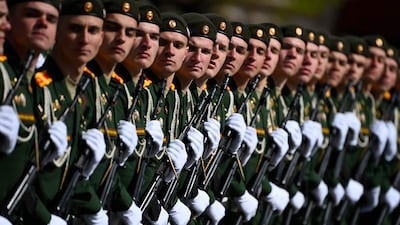
Russian servicemen march in Red Square. AFP -
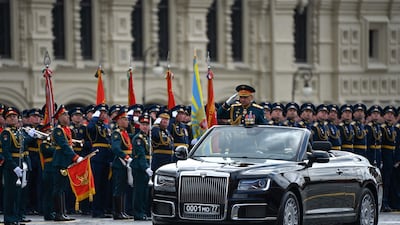
Russian Defence Minister Sergey Shoigu salutes soldiers as he is driven along Red Square in central Moscow. AFP -
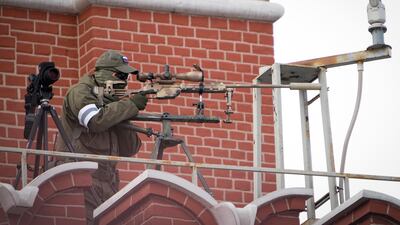
A security service officer aims his sniper rifle while securing the area in Moscow. AP Photo -
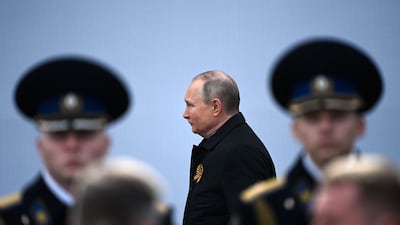
Vladimir Putin arrives to watch the Victory Day military parade at Red Square in central Moscow. AFP -
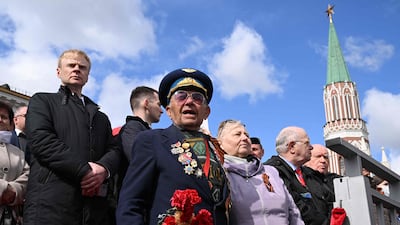
Veterans and guests watch the Victory Day military parade at Red Square in central Moscow. AFP -
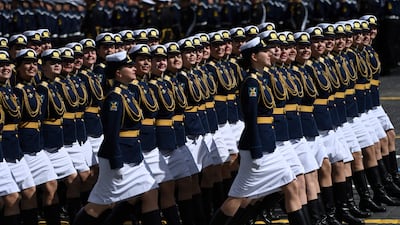
Russian servicewomen march on Red Square during the parade in central Moscow. AFP -
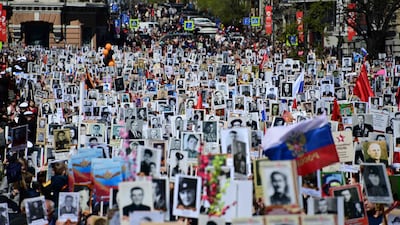
People carry portraits of their relatives who were Second World War soldiers as they take part in the Immortal Regiment march in the far eastern Russian city of Vladivostok. AFP -
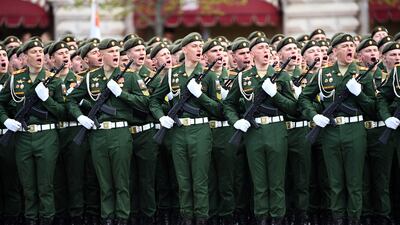
Russian servicemen shout during the Victory Day military parade in Red Square. AFP -
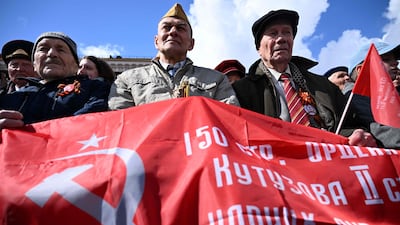
Military veterans watch the Victory Day parade in Red Square in Moscow. AFP -
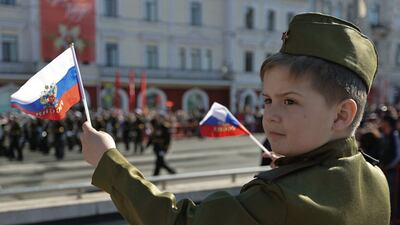
A boy wearing a Red Army-styled uniform watches a military parade in Vladivostok. Reuters


Ukrainian President Volodymyr Zelenskyy has said it is Russia that is staging a “bloody re-enactment of Nazism” in Ukraine.
Mr Wallace said President Putin wanted to intimidate the world with his show of military might in Moscow.
In a speech at the National Army Museum in Chelsea, south-west London, Mr Wallace said: “Really what President Putin wants is the Russian people and the world to be awed and intimidated by the ongoing memorial to militarism.
“I believe the ongoing and unprovoked conflict in Ukraine does nothing but dishonour those same soldiers.”
He accused leaders of Russia’s armed forces of “amorality and corruption”.
Discussing the Russian troops who died fighting the invading Nazis in the Second World War, he said: “I thought about the scale of the suffering across the Soviet Union, but also how the suffering was used then as it is now — to cover up the inadequacy of those ruling in safety and comfort from behind the Kremlin walls above and within the general staff nearby.
“Most Soviet conscripts hadn’t a chance. The suffering was often needless. In the absence of effective military leadership many of their best officers were purged by the NKVD (the People’s Commissariat for Internal Affairs) for counter-revolutionary crimes.
“For barrier troops executed swathes of retreating soldiers, deemed unpatriotic for failing to press on in the face of unassailable odds.
“Fear and sycophancy dictated behaviours then, and today’s Russian armed forces still carry that Soviet imprint — the imprint of amorality and corruption.”
Lesia Vasylenko, a Ukrainian MP, said life in Kyiv was beginning to return to normal, weeks after Russian troops pulled out of villages and towns surrounding the capital, having failed to take control of the city.
“Our goal is to carry on and we have to carry on with this war in the background,” she told BBC Radio 4’s Today programme.

