


French President Emmanuel Macron is facing a closer-than-expected fight to be re-elected in the French presidential elections after a shock poll showed him barely in front of far-right challenger Marine Le Pen in a potential final-round vote.
A poll from Harris Interactive showed Mr Macron beating Ms Le Pen by only three points, 51.5 per cent to 48.5 per cent, if they qualify for the final run-off in this Sunday’s first round of voting.
It is the closest result on record in a survey comparing the two candidates, who faced off in the second round of the 2017 election – when Mr Macron won by the far more convincing margin of 66 per cent to 34 per cent.
Other recent polls have shown Mr Macron, 44, with a larger but not invincible lead of six to eight points, after a bounce for the president following Russia’s invasion of Ukraine gave way to a burst of momentum for Ms Le Pen.
Ms Le Pen, the 53-year-old leader of the far-right National Rally who has sought to moderate her image in recent years, has focused on bread-and-butter issues such as the cost of living in France in the campaign’s final days.
Focusing on Ukraine, Mr Macron waited until the last moment to formally declare his candidacy and held his first major campaign rally on Saturday, eight days before the first round.
“I have been campaigning seriously, I've been in the field for six months ... others chose not to campaign, including the president of the republic,” said Ms Le Pen in a radio interview.
Supporters of mainstream parties have united in the past to keep Ms Le Pen and her father Jean-Marie Le Pen out of power but there are concerns that this “republican front” could be fraying.
“Marine Le Pen could be elected president,” said former prime minister Manuel Valls, who is supporting the centrist Mr Macron, in a guest article in French media. “It’s one minute to midnight.”
Mr Macron has sought to project statesmanship in his response to the Ukraine crisis, using France’s six-month presidency of the European Union to put himself at the centre of the bloc’s foreign and defence policy.
The Harris poll showed Mr Macron on course to win the first round with 26.5 per cent of the vote and Ms Le Pen in second with 23 per cent. The top two candidates qualify for the run-off two weeks later.
Left-wing candidate Jean-Luc Melenchon was in third with 17 per cent, while centre-right Valerie Pecresse and far-right Eric Zemmour were tied on 9.5 per cent after both lost steam following early surges in the polls.
Mr Macron would win far more comfortably against any of those candidates if Ms Le Pen failed to make the run-off, surveys suggest.
Environmentalist candidate Yannick Jadot and Socialist Party nominee Anne Hidalgo, the mayor of Paris, are some way off the pace in the 12-candidate field.
French presidential elections 2022 - in pictures
-
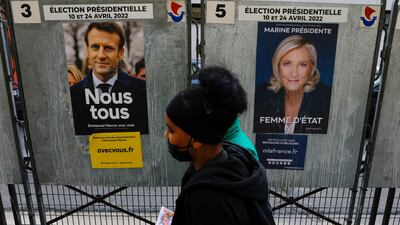
People walk past official campaign posters of French presidential election candidates Marine le Pen and French President Emmanuel Macron, in Paris, France. Reuters -
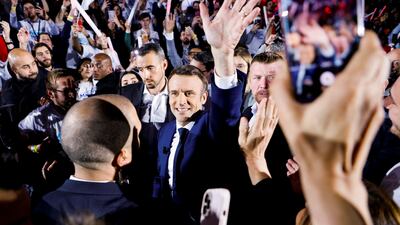
French President Emmanuel Macron, who is running for re-election in the 2022 French election, at a campaign rally in Nanterre, Paris. Reuters -
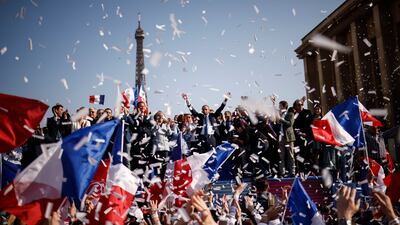
French far-right Reconquete party leader and 2022 presidential election candidate Eric Zemmour (C) throws his arms aloft at the end of a campaign rally at Trocadero in Paris. EPA -
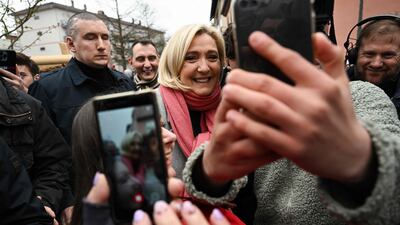
Far-right Rassemblement National party MP Marine Le Pen takes a selfie with supporters. AFP -
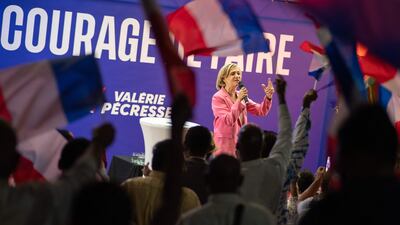
Les Republicains presidential candidate Valerie Pecresse delivers a speech on the campaign trail in the French Caribbean island of Guadeloupe. AFP -
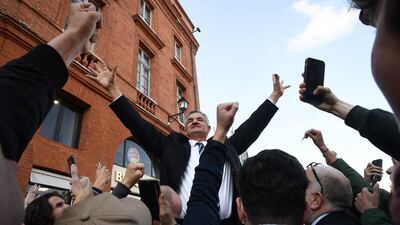
Ruralist party 'Resistons!' presidential candidate Jean Lassalle is surrounded by supporters before delivering a speech in Toulouse, southern France. AFP -

Official campaign posters of Marine le Pen and Emmanuel Macron pasted on bulletin boards near the Eiffel Tower in Paris. Reuters -
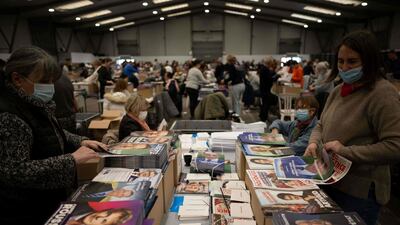
Hundreds of public servants prepare party political propaganda to be mailed, only days before the first round of the presidential election in France. AFP -
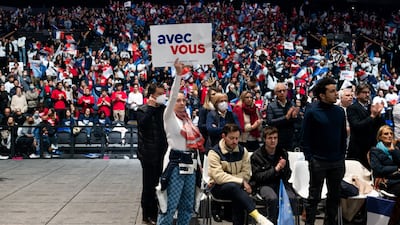
A supporter holds up a placard reading "With You" at an election campaign event for Emmanuel Macron in Paris. Bloomberg -
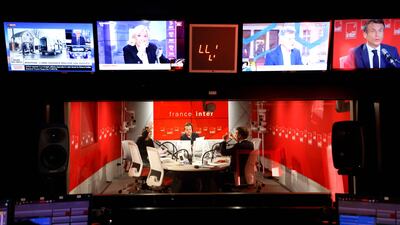
Emmanuel Macron speaks to journalists at the Maison de la Radio in Paris. AFP -
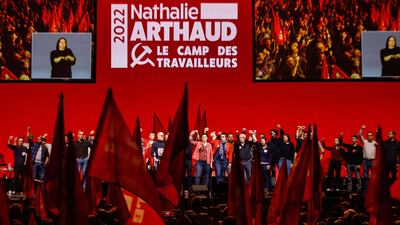
French far-left party Lutte Ouvriere (LO) presidential candidate Nathalie Arthaud (C) raises her hand at a rally at Zenith concert hall in Paris. AFP -
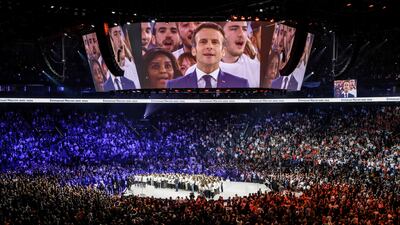
Emmanuel Macron sings the French national anthem as he appears on a giant screen at the end of his first campaign meeting at the Paris La Defence Arena in Nanterre. AFP -
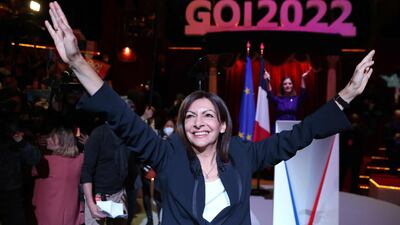
French Socialist Party presidential candidate Anne Hidalgo waves to supporters in Paris. AFP -

French leftist party La France Insoumise presidential candidate Jean-Luc Melenchon delivers a speech in Toulouse. AFP -
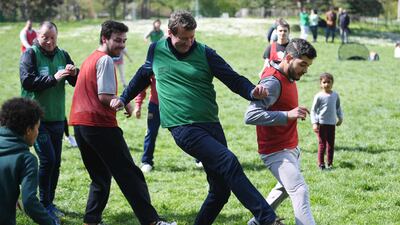
Europe Ecologie Les Verts presidential candidate Yannick Jadot plays football with youngsters at Andre-Malraux park in Nanterre. AFP -
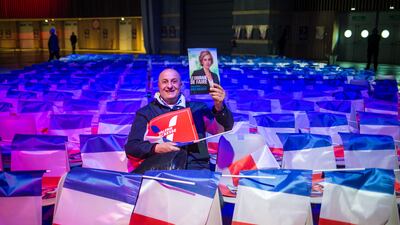
A supporter of Valerie Pecresse holds a campaign poster in Paris. EPA -
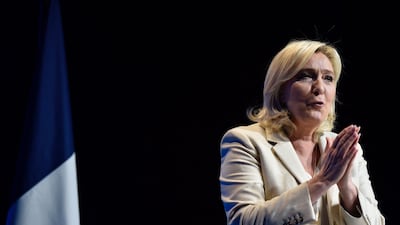
Marine Le Pen gives a speech during a campaign meeting in Stiring-Wendel. AFP -
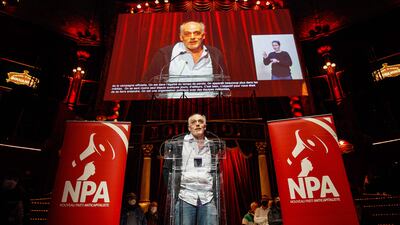
French far-left party Nouveau Parti Anticapitaliste presidential candidate Philippe Poutou delivers a speech at the Cirque d’Hiver in Paris. AFP -
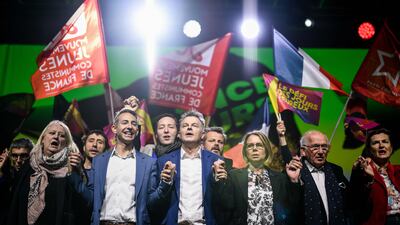
French Communist Party presidential candidate Fabien Roussel sings at the end of a campaign meeting at the Double Mixte venue in Villeurbanne. AFP -
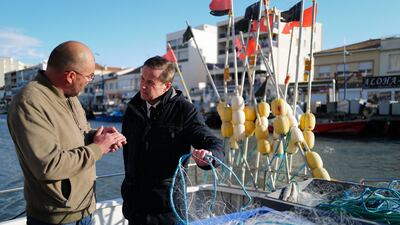
Far-right party Debout La France presidential candidate Nicolas Dupont-Aignan speaks to a fisherman in Palavas-les-Flots, southern France. AFP -
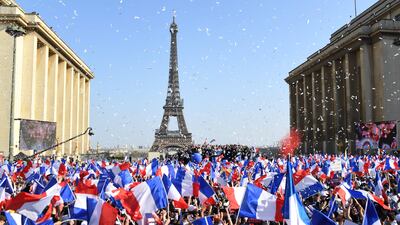
A campaign rally for Eric Zemmour in Paris. AFP



