


Citizens are being “blindly and helplessly” hit by Russian forces, a Greek diplomat has said as he warned the besieged Ukrainian city of Mariupol will probably be “completely destroyed” by the war.
Greece's consul general, who remained in the besieged Ukraine city of Mariupol during the bombardment, said the destruction would rank alongside Stalingrad and Aleppo.
Manolis Androulakis, the last EU diplomat to leave the city, described the harrowing scenes he witnessed after President Vladimir Putin’s troops launched a ferocious assault on the strategic location on the Sea of Azov.
“What I saw, I hope no one will ever see,” Mr Androulakis said after arriving in Athens. “Right now, civilians are hit blindly and helplessly.”
He urged people to “unite their voices to ask for a truce, a ceasefire”.

The diplomat, who has been hailed a hero in Greece, organised many successful evacuations of Greek expatriates before finally leaving on Tuesday.
"We tried to save as many expatriates as we could," Mr Androulakis said, adding that the "heroes are the people who stayed there and will try to make their lives from scratch".
“Mariupol will be included in a list of cities in the world that were completely destroyed by the war, such as Guernica, Stalingrad, Grozny, Aleppo,” Mr Androulakis told reporters at the airport.
Ukraine on Monday rejected calls to surrender Mariupol, where civilians are facing severe food and water shortages and coming under intense bombardment from Russian forces.
Iryna Vereshchuk, Ukraine’s Deputy Prime Minister, rejected a proposal for troops to lay down their arms in exchange for safe passage out of the city and the establishment of humanitarian corridors.
Mariupol residents were given until 5am to respond to the demand, which included them raising a white flag. Moscow did not make clear what action it would take if the offer were turned down.

“There can be no question of any surrender, laying down of arms,” Ms Vereshchuk told the Ukrainska Pravda news website.
“We have already informed the Russian side about this.”
She said she replied to the Russian request by writing: “Instead of wasting time on eight pages of letters, just open the corridor.”
Mariupol has suffered some of the heaviest bombardment since Russia launched its full-scale invasion of Ukraine on February 24. Many of its 400,000 residents remain trapped as fighting rages on the streets around them.
Ms Vereshchuk said more than 7,000 people were evacuated from Ukrainian cities through humanitarian corridors on Sunday, more than half from Mariupol. She said the government planned to send nearly 50 buses there on Monday for further evacuations starting at 9am.
Russia and Ukraine have made agreements throughout the war on humanitarian corridors to evacuate civilians, but have accused each other of frequent violations of those.
The crisis in Mariupol and other devastated Ukrainian cities is likely to feature heavily in discussions between EU leaders this week as they consider imposing tougher sanctions on Russia including an oil embargo.
-
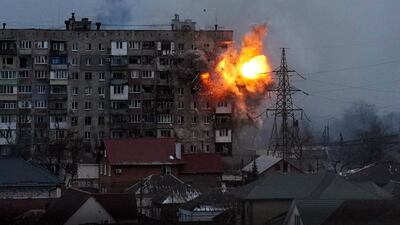
A shell fired by a Russian tank strikes an apartment building in the city of Mariupol in south-east Ukraine. AP Photo -

Ukrainian officials say Russian forces destroyed Mariupol's drama theatre where hundreds of people were sheltering. AP -

The theatre was located in the centre of Mariupol. EPA -

The remains of the theatre. Reuters -

Mariupol residents pass shells and discarded munitions cases as they try to flee the besieged port city on the north coast of the Sea of Azov at the mouth of the Kalmius river. Reuters -

A man pushes a bicycle along a destroyed street in Mariupol. AP Photo -

A woman walks past a burning apartment building after shelling. AP Photo -
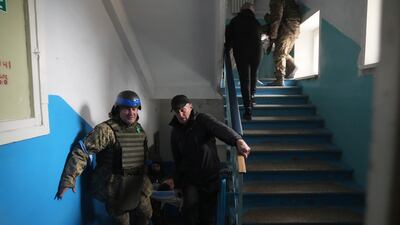
A Ukrainian serviceman and a civilian carry a wounded man who was injured by shelling in a hospital in Mariupol. AP Photo -
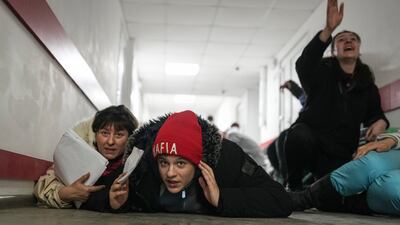
People lie on the floor of a hospital during shelling by Russian forces. AP Photo -
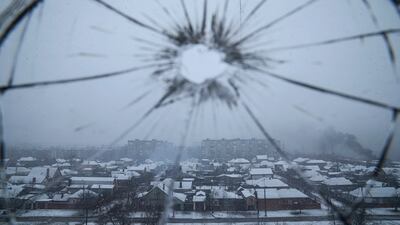
A hospital window is cracked from shelling. AP Photo -

A Ukrainian serviceman guards his position in Mariupol. AP Photo -
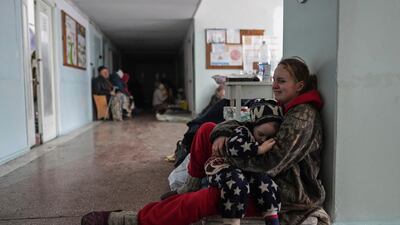
Anastasia Erashova cries as she hugs her child in a corridor of a hospital in Mariupol. AP Photo -

People settle in a bomb shelter. AP Photo -

Evacuees fleeing Ukraine-Russia conflict sit in the body of a cargo vehicle while waiting to leave Mariupol. Reuters -

A fire from a suspected Russian strike is seen on an apartment block on the eastern side of Mariupol. AP -

A soldier escapes from an armoured vehicle with a 'Z' marking that was attacked. Reuters -
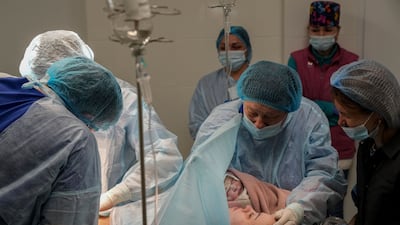
Medical workers hold newborn Alana close to her mother after a cesarean section at a hospital in Mariupol. AP Photo -
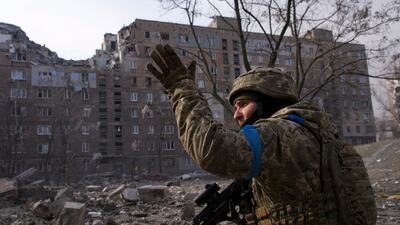
A Ukrainian serviceman guards his position in Mariupol. AP Photo -
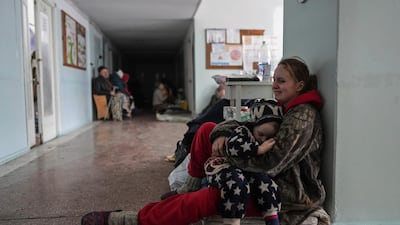
Anastasia Erashova cries as she hugs her child in a corridor of a hospital in Mariupol. AP Photo -

Premature babies left behind in hospital by their parents. AP Photo -

A service member of pro-Russian troops stands guard near a line of cars with evacuees leaving Mariupol. Reuters -
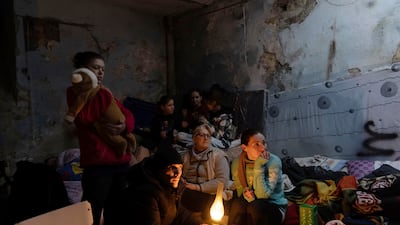
People settle in a bomb shelter in Mariupol. AP Photo -
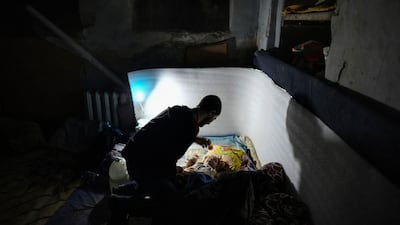
A man plays with a baby in a bomb shelter in Mariupol. AP Photo -

People use carts to transport their belongings in Mariupol. Reuters -
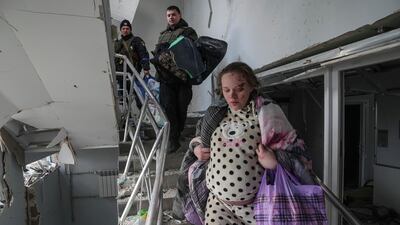
Mariana Vishegirskaya walks down stairs in a maternity hospital damaged by shelling in Mariupol. AP Photo -
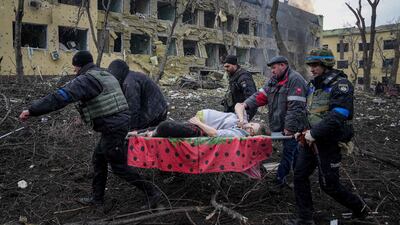
Ukrainian emergency employees and volunteers carry an injured pregnant woman from a maternity hospital. The baby was born dead. Half an hour later, the mother died too. AP Photo -
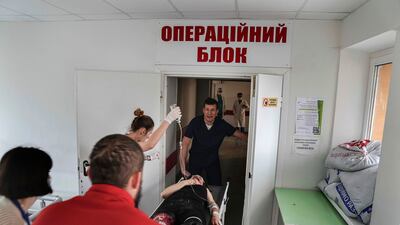
Oleksandr Konovalov, an ambulance paramedic, attends to an injured woman. AP Photo -

Ukrainian emergency employees work at a maternity hospital damaged by shelling in Mariupol. AP Photo


EU governments will take up the discussion among foreign ministers on Monday, before US President Joe Biden arrives in Brussels on Thursday for summits with Nato’s 30 allies, as well as the EU and in a Group of Seven (G7) format including Japan.
Igor Zhovkva, deputy head of Ukrainian President Volodymyr Zelenskyy’s office, said preventing civilians from leaving Ukrainian cities was part of Russia’s plan because they “want them to recognise the Russian occupation power”.
“They want to have some symbolic victory over [a] large city in Ukraine.
"Mariupol for them is a large city, a symbol city on the Sea of Azov and they want to have it.”
A Mariupol resident named Anastasia described how the city quickly descended into chaos after the Russians surrounded it and began pounding it with artillery.
As she and her family cowered in their apartment with their pets, the heating cut out, then the electricity and before long the taps were running dry and there was no internet access. The price of food rocketed, she said, and staples such as bread became “impossible to find”.
“After that people started looting and they destroyed shops completely and to me, in that moment, I realised that now the food that we have at home, it’s what we’re going to eat for I don’t know how many days,” she told BBC Radio 4’s Today programme.
Along with five relatives including her mother and sister, Anastasia began thumbing for a lift in the hope of escaping Mariupol.
“We were hitch-hiking on the road next to our house but it was not successful and that day there was huge shelling so we had to hide every five minutes – it was not safe at all so we just went home,” she said.
The following morning they tried again and managed to hitch a ride with a family travelling in a convoy of cars.
“I don’t know why we had big luck to meet them. They took us all, all six of us. We were sitting on each other inside – five, six people in a car. [We said] 'we don’t care where you go' just take us anywhere and there we will find a way somehow, we just need to be out of Mariupol'.”
Anastasia described how she felt “disgusted” by Russian soldiers who stopped them at checkpoints to rummage through bags, check passports and make a note of the men’s tattoos. Troops mocked Mariupol residents, she said, and were “laughing at the city that is destroyed”.
“I felt disgusted because for my safety. I couldn’t speak to them about my position but I would love to express all my feelings and say how much I hate them. They are not saving us from anything,” she said.

