


Live updates: follow the latest news on Russia-Ukraine
Ukraine said on Monday that up to 12 million people had been driven from their homes by the war with Russia as officials in central Europe said they were reaching full capacity to look after refugees.
Mykhailo Podolyak, an adviser to Ukrainian President Volodymyr Zelenskyy, said between 11 million and 12 million people had been “forced to leave their cities being destroyed by Russian artillery”.
About 3.5 million of those people have left Ukraine for neighbouring countries, according to the UN, with Poland taking in the largest number followed by Romania, Moldova, Hungary and Slovakia.
“Just be aware of this figure. Russia destroys the lives of millions of people,” said Mr Podolyak. “Is this not a global humanitarian catastrophe yet?”
Ylva Johansson, the EU’s Home Affairs Commissioner, said the tally of refugees in the bloc already dwarfed the number who came during the heavy migration flows of 2015 and 2016.
“Of course, it’s put a lot of pressure on to societies,” she said on a visit to Estonia on Monday.
Many refugees have moved on from the border states to neighbouring countries such as Germany, the Czech Republic and others, with pressure growing on arrival hotspots such as Berlin and Prague.
Czech Interior Minister Vit Rakusan said the government would seek to extend a state of emergency to deal with the rush of people, as officials try to relocate new arrivals to cities outside Prague.
“The Czech Republic is balancing on the edge of capacities where we are able to provide comfortable living conditions,” said Mr Rakusan during a television debate. “Living in gyms, sleeping bags or campsites is not good for life.”
The Czech Parliament this week approved three laws making it easier for Ukrainian refugees to acquire work, health insurance, and allow schools to raise classroom capacities.
In Poland, whose Ukrainian community of around 1.5 million is the region's largest, refugees waited in line for a third day in front of the National Stadium, Warsaw, temporarily turned into an administration office to register new arrivals.
More than 2 million Ukrainians have crossed into Poland since the invasion by Russia. In Warsaw, officials say the flow of refugees has increased the city’s population by 17 per cent.
"We never know how many refugees will arrive," Warsaw city council spokeswoman Monika Beuth-Lutyk said.
"We have done everything we can and the next move is up to the government to implement a system and to build refugee towns."
-
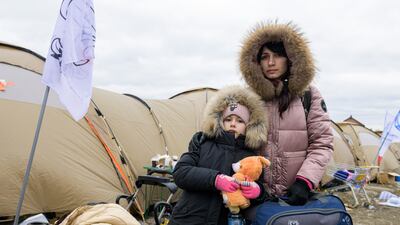
Mykhaila and her daughter from Loubny, central Ukraine, travelled by train to the Ukrainian city of Lviv then took a bus to Medyka on the Polish border, before walking across. Photo: DEC -
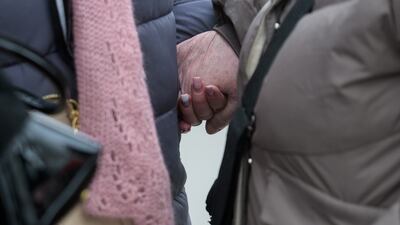
Women hold hands at the Medyka border crossing point, through which thousands of Ukrainian refugees have passed. Photo: DEC -
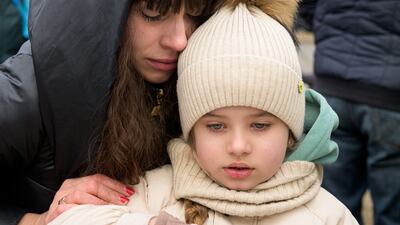
Angelika, 27, and her daughter Diana, 4, from Khmelnytskyi in Ukraine arrive at a reception centre on the outskirts of Przemysl, Poland. Photo: DEC -

Maria, 38, from Chernihiv, left Ukraine with a friend. They came to the Romanian border to wait for another friend before crossing. Photo: Panos Pictures -
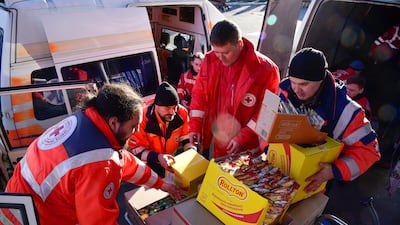
Ukrainian Red Cross staff and volunteers are providing food and other basic necessities to about 8,000 people sheltering in an underground station in Kyiv. Photo: Tebukhukhov Maksym -
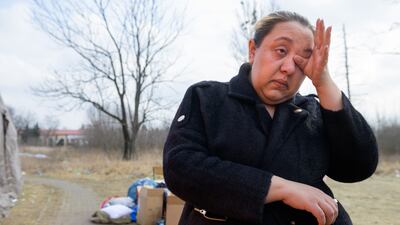
Kristina wipes away tears at Lwowska reception centre on the outskirts of Przemysl, Poland. Photo: DEC -
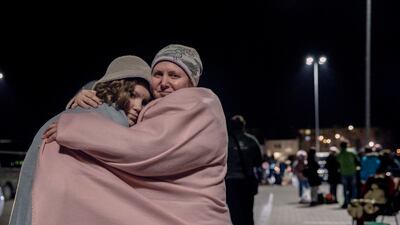
Ira, 45, and her daughter Olena, 12, outside a transit centre in Przemysl, Poland. Photo: Adrienne Surprenant -
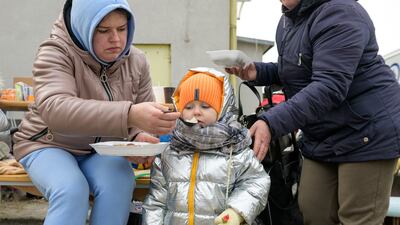
Veronika feeds her son Aleksander at the temporary refugee station in Medyka, eastern Poland. Photo: DEC


At the Medyka crossing, Poland's busiest along the 500-kilometre border with Ukraine, aid groups were preparing for a surge of refugees if humanitarian corridors allowed Ukrainians to escape.
An International Organisation for Migration spokesman said that thousands of people have crossed daily at Medyka alone. Polish border guards said 33,800 people were allowed through on Sunday.
"We don't know how many people and we don't know when they will arrive," IOM spokesman Jorge Galindo told Reuters.
In Berlin, the mayor Franziska Giffey demanded funds from the federal government to look after people being taken in at the former Tegel Airport, which closed in 2020 and has been turned into an arrival centre.
She said the centre had space to welcome about 10,000 people a day but that bus transfers to other parts of Germany needed to be improved.

More than 200,000 people have arrived in Germany in an influx for which the country’s integration chief said it was better prepared than the migration crisis of 2015.
In Britain, Cabinet minister Sajid Javid said 9,500 visas have been issued to Ukrainians who have applied to join extended family members already living in the UK.
Under a separate scheme for Ukrainians with no links to the UK, 150,000 people have come forward as potential hosts who will be expected to accommodate people for at least six months.
Mr Javid said he expected that hundreds of thousands of Ukrainians would eventually arrive in the country.
Amid criticism that Britain is being too miserly towards refugees, Mr Javid defended remarks by Home Secretary Priti Patel that migration routes could be exploited by Russia to send covert agents into the UK.
“We know the Russians have done that,” Mr Javid told Sky News, referring to the nerve agent attack on a former Russian spy in Salisbury, England, in 2018.

