

Live updates: follow the latest news on Russia-Ukraine
Russian troops attacked and captured Europe’s largest nuclear power plant on Friday, setting part of the Ukrainian facility ablaze in an assault Ukraine's leader branded “nuclear terror” and said could endanger the continent.
Local authorities said no immediate radiation rise was detected and “essential” equipment was unaffected by the fire, but it remained unclear what the attacking forces planned next.
Ukrainian President Volodymyr Zelenskyy spoke with world leaders, including US President Joe Biden and British Prime Minister Boris Johnson, who called for a halt to fighting at the Zaporizhzhia nuclear plant.
What is the significance of the Zaporizhzhia plant?
The Zaporizhzhia power plant in the Ukrainian city of Enerhodar is home to six Soviet-designed 950-megawatt reactors built between 1984 and 1995, with a capacity of 5.7 gigawatts, enough to power more than four million homes.
It is located about 200km from the contested Donbas region and 550km south-east of Ukraine’s capital Kyiv.
The site accounts for about 20 per cent of the country’s electricity, according to its website.
The station at Zaporizhzhia supplies an estimated 40 per cent of the country’s nuclear power and, according to Mr Zelenskyy, houses six of Ukraine’s 15 reactors.
What happened on Friday morning?
The attack on the eastern city of Enerhodar and its Zaporizhzhia nuclear plant unfolded as the invasion entered its second week and another round of talks between the two sides yielded a tentative agreement to set up safe corridors to evacuate citizens and deliver humanitarian aid.
According to the Ukrainian government, a fire at the Zaporizhzhia nuclear plant started after Russian troops fired on the facility.
-
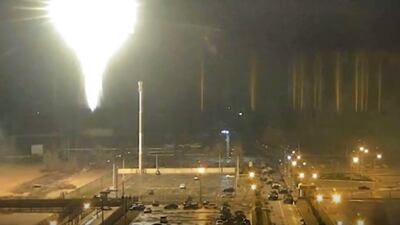
A bright flaring object lands near the nuclear plant in Enerhodar, Ukraine. AP -
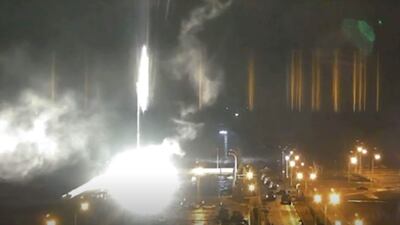
Russian forces shelled Europe’s largest nuclear plant early on Friday. AP -
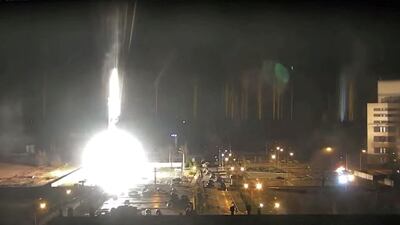
Surveillance camera footage shows a flare landing at the Zaporizhzhia nuclear power plant. Reuters -
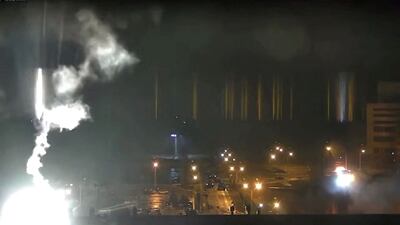
The flare lands at the plant. Reuters -

Multiple blasts at the plant were recorded. AFP -

Ukrainian President Volodymyr Zelenskiy makes a statement following the attack. Reuters -
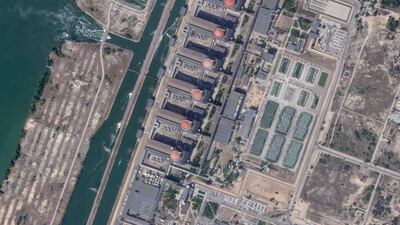
The Zaporizhzhia nuclear power plant. AP -

A power-generating unit at the Zaporizhzhia nuclear power plant. AP Photo


Andriy Tuz, a spokesman for the power plant, said early on Friday that firefighters were not able to get near the flames because they were being shot at, and Ukraine’s foreign minister tweeted a plea to the Russians to stop the assault and allow fire teams inside.
Ukrainian media later reported firefighters had been able to reach the site.
The Zaporizhzhia regional military administration then confirmed on social media that Russian forces seized the nuclear power plant during the assault.
Mr Tuz also told Ukrainian television shells were falling directly on the plant and had set fire to one of the facility’s six reactors.
That reactor is under renovation and not operating, but there is nuclear fuel inside, he said.
The International Atomic Energy Agency said the fire had not affected essential equipment and that Ukraine’s nuclear regulator reported no change in radiation levels.
How has the world reacted?
Knee-jerk losses in equity markets moderated as traders assessed the severity of the situation at the facility.
S&P 500 Index futures traded lower, while gold erased gains as demand for haven assets eased.
Bitcoin fell on Friday as reports of the attack drove risk aversion in financial markets.
The largest cryptocurrency dropped as much as 2.4 per cent to $41,093.
The second-largest, Ether, fell as much as 4.1 per cent to $2,691.
Most other top tokens were also down, according to pricing from CoinGecko.

Mariano Grossi, the IAEA’s director general, spoke with Ukrainian authorities about the nuclear power plant and warned of “severe danger” if its reactors were hit.
Confirmation from regulators that radiation levels around the site are normal, and reports that an initial fire was in an administrative building, suggest a major disaster isn’t imminent, Rose Gottemoeller, a former Nato deputy secretary general, told Bloomberg Television.
Is there a radiation threat?
The IAEA said the fire had not affected essential equipment and Ukraine’s nuclear regulator reported no change in radiation levels.
The American Nuclear Society concurred, saying the latest radiation levels remained within natural background levels.
“The real threat to Ukrainian lives continues to be the violent invasion and bombing of their country,” the group said.
Ukraine’s nuclear facilities have been a main point of concern after Russia’s military invaded the country last week and began bombarding cities with shells and missiles.
“If there is an explosion, it is the end of everything. The end of Europe,” Mr Zelenskyy warned. “Only immediate European action can stop Russian troops.”

