


Nato and Russian generals should hold regular meetings, move military drills away from borders and look at removing missiles from Europe, a group of diplomats has said in a proposal for a deal to avoid East West confrontation.
The suggestions sketched out by 75 experts, including former ambassadors to Russia and members of Nato and Russian militaries, were described as potential areas of common ground amid the stand-off over Ukraine.
Moscow and Nato both accuse the other side of threatening their security, as Russia masses troops on its western flank and countries formerly in the eastern bloc host forces from the US-led alliance.
Although there is no sign of agreement on the fundamental issue of Nato’s eastward expansion, Russian President Vladimir Putin indicated this week that he was willing to discuss secondary issues such as arms control.
In their proposals, the diplomats picked up themes raised by the US and Nato in written replies to Russia’s demands for two new security treaties.
They said Russia and Nato could agree to hold exercises at a “militarily meaningful distance from their borders”, or offer more transparency about the drills if this is not possible.
The findings emerged as Russian drills on the territory of its ally Belarus, and separate naval exercises, increase western nervousness about Mr Putin’s intentions.
The diplomats, made up of 26 Russians and 49 American and European contributors, said the two sides could also start negotiations on a package of measures to reduce risks at sea.
They said Nato and Russia could show goodwill by agreeing parallel steps without necessarily needing a formal agreement that might prove difficult in the current political environment.
Nato’s supreme allied commander, a US-appointed general, should hold regular meetings with Russia’s chief of the general staff, diplomats said.
Practical co-operation between Nato and Russia was suspended after the annexation of Crimea in 2014, but the expert panel said regular dialogue could help lower tension and establish whether drills were too provocative.
-

Russian tanks return from a shooting range in the Voronezh region. Russia said some of its forces near the Ukraine border would be returning to their bases after completing exercises. EPA -

Russian President Vladimir Putin meets German Chancellor Olaf Scholz in Moscow to discuss the Ukraine crisis. Reuters -
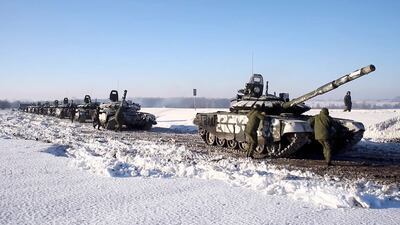
Russian tanks make their way through snow back to their bases. EPA -
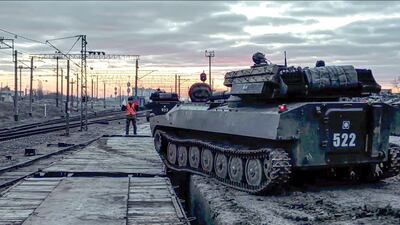
Russian armoured vehicles are loaded on to railway platforms after the end of military drills in southern Russia. AP -
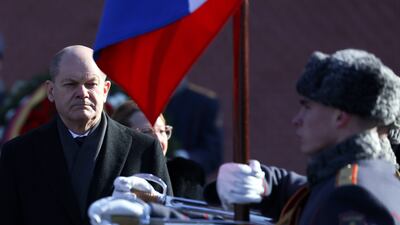
Chancellor Scholz attends a wreath-laying ceremony at the Tomb of the Unknown Soldier in Moscow. EPA -
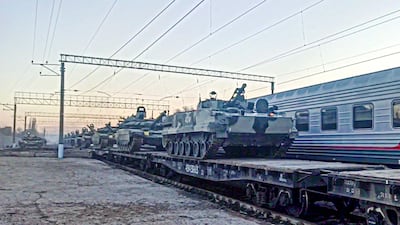
“The units of the southern and western military districts, having completed their tasks, have already begun loading on to rail and road transport,” Russia's Defence Ministry spokesman Igor Konashenkov said. AP -

Britain's Foreign Secretary Liz Truss arrives at 10 Downing Street to attend a meeting of the UK's Cobra emergency committee. AFP -

Russian military vehicles are loaded on to railway freight carriages in Crimea. EPA -
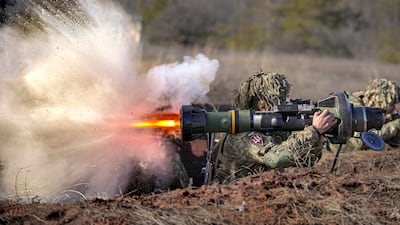
A Ukrainian soldier fires an anti-tank weapon during an exercise in eastern Ukraine. AP


Missile talks
The US individually was urged to pursue dialogue with Russia on cyber-security and to offer limits on intermediate-range missiles in Europe, a theme Mr Putin said he was willing to discuss.
Washington’s written response to Russia said the US wanted to build on the New START treaty, which was extended last year until 2026 and is the only remaining arms control pact between the former Cold War superpowers.
The US pulled out of a treaty on intermediate-range missiles in 2019 after accusing Russia of repeated violations.
But the diplomats proposed negotiations on a “zero option” for the deployment of such missiles in Europe, an idea first proposed in the 1980s by former US president Ronald Reagan.
One of the experts on the panel, Jack Matlock, was a US ambassador to the Soviet Union during that late period of the Cold War.
The panel also included former ambassadors to Nato and Ukraine, former Russian foreign minister Igor Ivanov, retired military officers from both sides and former defence ministers from Sweden and Poland.
It did not suggest any agreement on the central issue of Nato membership, with Russia insisting that Ukraine must not be allowed to join but western powers saying this is none of the Kremlin’s business.
But taken together, the panel’s recommendations would “materially contribute not just to a reduction of Russia-Nato tension but a reduction of Russia-Nato risk,” said a statement from the European Leadership Network, which facilitated the contacts between the two sides.
The proposals “are modest, but they can be implemented tomorrow and would be a start on making Europe safer,” it said.

