Outgoing German Chancellor Angela Merkel arrives to take her seat during a session at the Bundestag. AFP

Farewell to the 'Queen of Europe': Angela Merkel era ends in Germany


Tim Stickings
  • English
  • Arabic

After a long goodbye, Angela Merkel finally reached the end on Wednesday of her 16-year term as Germany’s first female chancellor, Europe’s most powerful leader and one of the world’s most durable crisis managers.

Mrs Merkel, 67, hands over to Olaf Scholz with high approval ratings at home and much admiration abroad for her longevity, her personal integrity and her calm, consensus-seeking style.

But critics accuse her of lacking vision, sidestepping deep-rooted problems and opening the door to a resurgent far right.

Her four election victories made her the dominant figure in European politics, withstanding crises that felled other leaders and earning her the nickname “Queen of Europe".

She helped steer the EU through troubles from the 2008 financial crash and the eurozone debt saga to the 2015 refugee crisis, the stormy years of Donald Trump’s presidency and the coronavirus pandemic.

“She did a lot to hold Europe together,” Annette Schavan, a former education minister under Mrs Merkel, told The National.

“Angela Merkel has a great ability to integrate. Her stamina and her patience led to a good result in many a complicated situation.”

  • After a long goodbye, Angela Merkel finally reached the end on Wednesday of her 16-year term as Germany’s first female chancellor, Europe’s most powerful leader and one of the world’s most durable crisis managers. Getty Images
    After a long goodbye, Angela Merkel finally reached the end on Wednesday of her 16-year term as Germany’s first female chancellor, Europe’s most powerful leader and one of the world’s most durable crisis managers. Getty Images
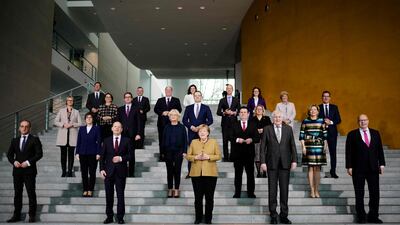
  • Mrs Merkel poses with ministers and other members of her government after a cabinet meeting in Berlin on November 24, 2021. AFP
    Mrs Merkel poses with ministers and other members of her government after a cabinet meeting in Berlin on November 24, 2021. AFP
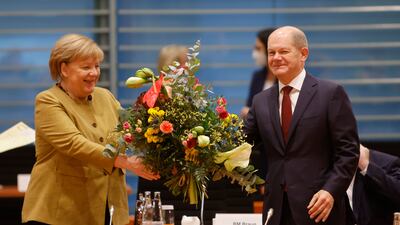
  • Mrs Merkel receives a bouquet of flowers from Olaf Scholz as she arrives for probably her last weekly cabinet meeting on November 24. Getty Images
    Mrs Merkel receives a bouquet of flowers from Olaf Scholz as she arrives for probably her last weekly cabinet meeting on November 24. Getty Images
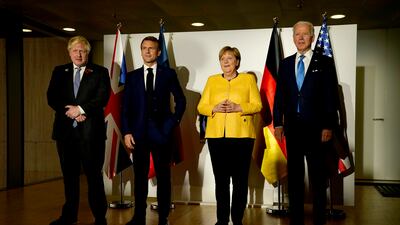
  • From right to left, US President Joe Biden, Ms Merkel, French President Emmanuel Macron and British Prime Minister Boris Johnson pose before a meeting on the sidelines of the G20 summit in Rome, in October 2021. AP
    From right to left, US President Joe Biden, Ms Merkel, French President Emmanuel Macron and British Prime Minister Boris Johnson pose before a meeting on the sidelines of the G20 summit in Rome, in October 2021. AP
  • Mrs Merkel visiting flood-ravaged areas to survey the damage and meet survivors in July 2021, in Schuld, near Bad Neuenahr-Ahrweiler. Getty Images
    Mrs Merkel visiting flood-ravaged areas to survey the damage and meet survivors in July 2021, in Schuld, near Bad Neuenahr-Ahrweiler. Getty Images
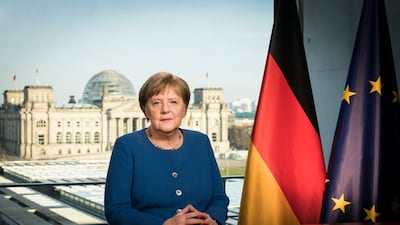
  • Mrs Merkel addressing the nation via a video statement about the continuing Covid-19 pandemic, on March 18, 2020. It was the first time in her 15-year tenure as chancellor that Mrs Merkel addressed citizens directly via a televised statement other than her New Year's Eve message. Getty Images
    Mrs Merkel addressing the nation via a video statement about the continuing Covid-19 pandemic, on March 18, 2020. It was the first time in her 15-year tenure as chancellor that Mrs Merkel addressed citizens directly via a televised statement other than her New Year's Eve message. Getty Images
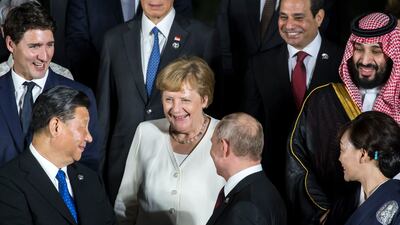
  • Mrs Merkel speaks to China's President Xi Jinping and Russia's President Vladimir Putin during a group photo session in front of Japan's Osaka Castle, at the G20 summit in June 2019. Getty Images
    Mrs Merkel speaks to China's President Xi Jinping and Russia's President Vladimir Putin during a group photo session in front of Japan's Osaka Castle, at the G20 summit in June 2019. Getty Images
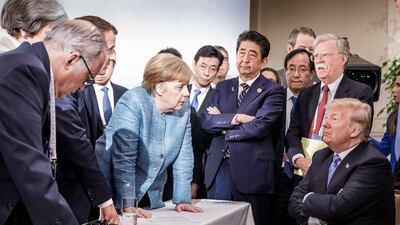
  • Mrs Merkel deliberates with former US president Donald Trump on the sidelines of the June 2018 G7 summit in Canada. Getty Images
    Mrs Merkel deliberates with former US president Donald Trump on the sidelines of the June 2018 G7 summit in Canada. Getty Images
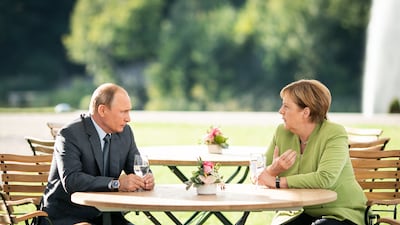
  • Mrs Merkel and Mr Putin meet at Schloss Meseberg palace, the German government retreat, in August 2018. Getty Images
    Mrs Merkel and Mr Putin meet at Schloss Meseberg palace, the German government retreat, in August 2018. Getty Images
  • Mrs Merkel wears safety goggles during a visit to the European Astronauts Centre in Cologne, in 2016. Getty Images
    Mrs Merkel wears safety goggles during a visit to the European Astronauts Centre in Cologne, in 2016. Getty Images
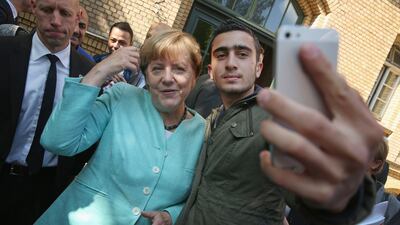
  • Mrs Merkel poses for a selfie with Anas Modamani, a refugee from Syria, as she visited the AWO Refugium Askanierring shelter for migrants and refugees in September 2015, in Berlin. Getty Images
    Mrs Merkel poses for a selfie with Anas Modamani, a refugee from Syria, as she visited the AWO Refugium Askanierring shelter for migrants and refugees in September 2015, in Berlin. Getty Images
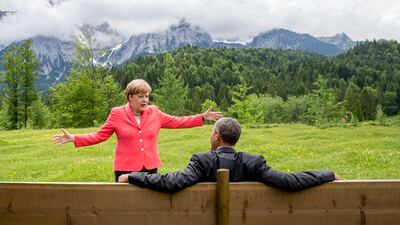
  • Mrs Merkel speaks with former US president Barack Obama during a G7 summit in 2015. AP Photo
    Mrs Merkel speaks with former US president Barack Obama during a G7 summit in 2015. AP Photo
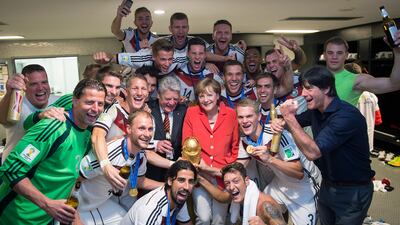
  • Mrs Merkel and German President Joachim Gauck celebrate with the German national football team after its 1-0 victory in the 2014 FIFA World Cup Brazil Final match against Argentina in 2014. Getty Images
    Mrs Merkel and German President Joachim Gauck celebrate with the German national football team after its 1-0 victory in the 2014 FIFA World Cup Brazil Final match against Argentina in 2014. Getty Images
  • Mrs Merkel waves at an election campaign rally for federal elections in Dusseldorf, in 2013. Getty Images
    Mrs Merkel waves at an election campaign rally for federal elections in Dusseldorf, in 2013. Getty Images
  • Mrs Merkel smiles as she sits in the chancellor's chair for the first time at the German lower house of parliament in November 2005. Getty Images
    Mrs Merkel smiles as she sits in the chancellor's chair for the first time at the German lower house of parliament in November 2005. Getty Images
  • Mrs Merkel raises her fists at the Lower Saxony Christian Democratic Party's annual general meeting in 2005. Getty Images
    Mrs Merkel raises her fists at the Lower Saxony Christian Democratic Party's annual general meeting in 2005. Getty Images
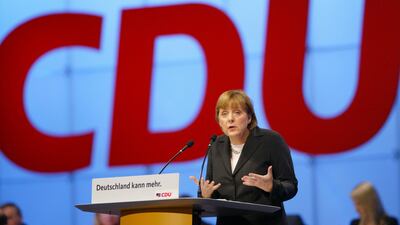
  • Mrs Merkel speaks at the CDU party congress in December 2003, in Leipzig. Getty Images
    Mrs Merkel speaks at the CDU party congress in December 2003, in Leipzig. Getty Images

Mrs Merkel took office in 2005 after a messy election result put her Christian Democrats (CDU) in a power-sharing coalition with their main rivals, the Social Democrats (SPD).

It made her Germany’s first female chancellor and the first to have grown up in the former communist East, where she worked as a physicist.

She would govern with the SPD for 12 of her 16 years in power, winning re-election with relative ease in 2009, 2013 and 2017.

At the peak of her powers, she fell just short of an absolute majority in 2013, when Germany’s strong finances helped made it the envy of debt-ridden countries such as Greece, Italy and Spain.

Mrs Merkel’s signature hand gesture, in the shape of a diamond, became a symbol of her reassuring style and the stability she offered in tumultuous times.

Once asked in a TV debate whether she was not more suited to the SPD, she was sometimes accused of lacking deep political beliefs and preferring to muddle through from day to day.

“The latter is not entirely untrue, and in light of dynamic and ever more rapidly changing political circumstances, is almost a requirement for political survival,” said Mrs Merkel’s former vice chancellor Sigmar Gabriel, from the SPD.

“But that doesn’t contradict the fact that Angela Merkel very much followed an inner moral compass.”

Angela Merkel and her former deputy Sigmar Gabriel, a Social Democrat. AFP

Refugee crisis

This moral compass came to the fore during the 2015 refugee crisis, Mr Gabriel said, when Mrs Merkel opened Germany’s doors to hundreds of thousands of people fleeing war in Iraq and Syria.

It was the most explosive decision of her chancellorship and spurred the rise of the far-right Alternative for Germany (AfD), which entered parliament for the first time in 2017.

Mrs Merkel’s insistence that “we will manage it” became a punchline as integration issues mounted. But she said last month that her prediction had proved correct.

She sought consensus in foreign policy, urging dialogue with Russia despite its tensions with the EU.

Her final months in office brought out glowing tributes from the many leaders she worked with over 16 years – with former US president Barack Obama praising her for “taking the high ground for so many years”.

But her desire for consensus did not always bring results, as she acknowledged recently when she described divisions in the EU as “unfinished business” for her successor.

At other times, she read the political winds and moved accordingly, for example by U-turning on nuclear energy and moving to phase it out in Germany by 2022.

Although her moderate positions won support from untypical CDU voters, they left room to the party’s right which was exploited by the AfD, said Mr Gabriel.

A series of spectacular gains for the AfD at the CDU’s expense were the trigger for Mrs Merkel’s announcement in 2018 that she would not seek a fifth term.

At this year’s election, the CDU struggled to emerge from her shadow and slumped to its worst ever result, sending it into opposition.

Leaders of the new three-party coalition have spoken warmly of Mrs Merkel personally but complained that too little was done to modernise Germany and tackle climate change.

“She kept this country, and Europe with it, stable and on track under ever more difficult circumstances,” said Mr Gabriel.

But she “tried to protect the German people from change more than she prepared them for it”, he said.

Long goodbye

Mrs Merkel’s three-year farewell was dominated by the coronavirus crisis, in which her cautious approach, drawing on her background as a scientist, won her many admirers.

In a rare invocation of her East German background, she assured the public that she understood the pain of restricted travel and would not be imposing this unless it was absolutely necessary.

Germany emerged from the first wave with remarkably few cases and deaths, but this success did not last into subsequent outbreaks.

Angela Merkel’s signature hand gesture, in the shape of a diamond, became a symbol of her reassuring style and the stability she offered in tumultuous times. Reuters

She hands over power to the SPD's Olaf Scholz amid an alarming winter resurgence, complicated by the protracted transfer of power that followed September's election.

Nonetheless, an early December poll showed she was still the most popular politician in Germany, with 68 per cent approving of her work.

David McAllister, a CDU politician and MEP who was once tipped as her successor, said Mrs Merkel had become a role model for many people.

“Especially at European level, her strength was to mediate and moderate in a calm manner with the objective to reach a consensus that works for all sides,” he said.

“After 16 years, a political era will end.”

Three trading apps to try

Sharad Nair recommends three investment apps for UAE residents:

  • For beginners or people who want to start investing with limited capital, Mr Nair suggests eToro. “The low fees and low minimum balance requirements make the platform more accessible,” he says. “The user interface is straightforward to understand and operate, while its social element may help ease beginners into the idea of investing money by looking to a virtual community.”
  • If you’re an experienced investor, and have $10,000 or more to invest, consider Saxo Bank. “Saxo Bank offers a more comprehensive trading platform with advanced features and insight for more experienced users. It offers a more personalised approach to opening and operating an account on their platform,” he says.
  • Finally, StashAway could work for those who want a hands-off approach to their investing. “It removes one of the biggest challenges for novice traders: picking the securities in their portfolio,” Mr Nair says. “A goal-based approach or view towards investing can help motivate residents who may usually shy away from investment platforms.”
Ten tax points to be aware of in 2026

1. Domestic VAT refund amendments: request your refund within five years

If a business does not apply for the refund on time, they lose their credit.

2. E-invoicing in the UAE

Businesses should continue preparing for the implementation of e-invoicing in the UAE, with 2026 a preparation and transition period ahead of phased mandatory adoption. 

3. More tax audits

Tax authorities are increasingly using data already available across multiple filings to identify audit risks. 

4. More beneficial VAT and excise tax penalty regime

Tax disputes are expected to become more frequent and more structured, with clearer administrative objection and appeal processes. The UAE has adopted a new penalty regime for VAT and excise disputes, which now mirrors the penalty regime for corporate tax.

5. Greater emphasis on statutory audit

There is a greater need for the accuracy of financial statements. The International Financial Reporting Standards standards need to be strictly adhered to and, as a result, the quality of the audits will need to increase.

6. Further transfer pricing enforcement

Transfer pricing enforcement, which refers to the practice of establishing prices for internal transactions between related entities, is expected to broaden in scope. The UAE will shortly open the possibility to negotiate advance pricing agreements, or essentially rulings for transfer pricing purposes. 

7. Limited time periods for audits

Recent amendments also introduce a default five-year limitation period for tax audits and assessments, subject to specific statutory exceptions. While the standard audit and assessment period is five years, this may be extended to up to 15 years in cases involving fraud or tax evasion. 

8. Pillar 2 implementation 

Many multinational groups will begin to feel the practical effect of the Domestic Minimum Top-Up Tax (DMTT), the UAE's implementation of the OECD’s global minimum tax under Pillar 2. While the rules apply for financial years starting on or after January 1, 2025, it is 2026 that marks the transition to an operational phase.

9. Reduced compliance obligations for imported goods and services

Businesses that apply the reverse-charge mechanism for VAT purposes in the UAE may benefit from reduced compliance obligations. 

10. Substance and CbC reporting focus

Tax authorities are expected to continue strengthening the enforcement of economic substance and Country-by-Country (CbC) reporting frameworks. In the UAE, these regimes are increasingly being used as risk-assessment tools, providing tax authorities with a comprehensive view of multinational groups’ global footprints and enabling them to assess whether profits are aligned with real economic activity. 

Contributed by Thomas Vanhee and Hend Rashwan, Aurifer

The National's picks

4.35pm: Tilal Al Khalediah
5.10pm: Continous
5.45pm: Raging Torrent
6.20pm: West Acre
7pm: Flood Zone
7.40pm: Straight No Chaser
8.15pm: Romantic Warrior
8.50pm: Calandogan
9.30pm: Forever Young

COMPANY%20PROFILE
%3Cp%3E%3Cstrong%3ECompany%3A%20%3C%2Fstrong%3EGrowdash%0D%3Cbr%3E%3Cstrong%3EStarted%3A%20%3C%2Fstrong%3EJuly%202022%0D%3Cbr%3E%3Cstrong%3EFounders%3A%20%3C%2Fstrong%3ESean%20Trevaskis%20and%20Enver%20Sorkun%0D%3Cbr%3E%3Cstrong%3EBased%3A%20%3C%2Fstrong%3EDubai%2C%20UAE%0D%3Cbr%3E%3Cstrong%3EIndustry%3A%20%3C%2Fstrong%3ERestaurant%20technology%0D%3Cbr%3E%3Cstrong%3EFunding%20so%20far%3A%3C%2Fstrong%3E%20%24750%2C000%0D%3Cbr%3E%3Cstrong%3EInvestors%3A%20%3C%2Fstrong%3EFlat6Labs%2C%20Plus%20VC%2C%20Judah%20VC%2C%20TPN%20Investments%20and%20angel%20investors%2C%20including%20former%20Talabat%20chief%20executive%20Abdulhamid%20Alomar%2C%20and%20entrepreneur%20Zeid%20Husban%3C%2Fp%3E%0A
Updated: December 08, 2021, 2:08 PM