

Dressed in a pink winter jumpsuit and a knitted hat, Arias, 2, sits on a flattened cardboard box at a makeshift camp in the woods near the Belarus-Poland border.
Arias doesn't play, he doesn't carry any toys. He doesn't smile, he cries frequently.
He has barely any food or water, save for an apple given to him by a Belarusian KGB agent shortly before a group of Polish volunteers entered the camp after learning of the alarming conditions, where temperatures routinely drop below 0°C at night and do not reach double figures by day.
Arias's father Hiwa and mother Shamam were schoolteachers from Kurdistan. The family are among the thousands of migrants trying to make their way to Europe via Belarus, struggling for survival in tent settlements dotted close to the Kuznica border crossing in north-eastern Poland.
At least 10 people have died since the beginning of the humanitarian and political crisis unfolding in the woodlands where thousands of migrants are stranded.
Minsk has been accused by Western leaders of deliberately provoking a new refugee crisis in Europe by encouraging migrants to pass through its borders and cross into EU territory.
Meanwhile, Warsaw has pushed back thousands of asylum seekers approaching its borders after passing new legislation in mid-October, contrary to international law and convention. About 20,000 border police have been sent to the Polish frontier and pleas for help have gone out to the UK, EU and Nato.
Poland in September introduced a state of emergency on the border. Journalists, aid agencies and even volunteer medics are forbidden from entering the three-kilometre emergency zone. Some within the local community having stepped in to help migrants they have found on the Polish side. Activists in and outside the exclusion zone are trying to help however they can, offering food and clothes or giving lifesaving information. Communication is done over telephone with migrants in the forest wherever battery life and reception coverage permits.

Sanna Filgarowicz, a Polish volunteer human rights activist, has been in touch with several asylum seekers in the past few weeks. She has not been into the exclusion zone but has spent up to 17 hours a day on her phone, “helping from a distance” by passing along important survival information to those sleeping outside. She is also collecting and documenting evidence of human rights violations.
Relaying what she’s seen and heard to The National, it is clear she is deeply affected. “All day I get a lot of films, information, requests for help … this experience is heart-breaking. A lot of suffering, a lot of trauma, a lot of despair and hope,” she said.
Arias's family, in particular, are always on her mind. Hiwa has been in touch with Sanna over messenger apps since early November.
The family arrived in Belarus on a flight at the end of October and after a spending about a week in Minsk, travelled on towards the border with another group of migrants they had met.
Sanna will not divulge too much about the circumstances that made Arias’s family leave their country for fear of getting them in trouble with authorities should they be repatriated.
“I haven’t ask them directly about their story but I know that they are scared to go back," she said.
For 10 days, Arias, Hiwa and Shamam have been going nowhere, except in circles around a cold, wet forest. With temperatures dropping and the political stand-off frozen, the situation is deteriorating for those trapped in the middle.
A family existing in fear and despair
Thursday, November 4
Hiwa messages Sanna:
“I wish I have a life like yours, a calm life, my wife and I were teachers in Iraqi Kurdistan…”
“I want to save my son from there so that he can live a normal life when he grows up”
“I understand that you can do nothing but help us, it’s so good that you do not hate us”
“What I want the people of Europe to know … is that we are nothing less than them and we are human and we have hearts and we have mothers and fathers and children”
Sunday, November 7
Hiwa and his family set off from Minsk towards Poland. They reached the Sylvan area near the Belarusian-Polish border in the afternoon and spent their first night in the forest that evening.
“My wife and son slept but I cannot sleep. I see people feel sad,” writes Hiwa that evening as they camp outdoors.
"It is silent and all you can hear is the terrifying wailing of a child. I don’t know how to sleep. What will happen tomorrow? I hope that I can provide my child with a different future to my life. I am afraid for them, I want them to be healthy, nothing else,” he writes over WhatsApp.
Monday, November 8
Hiwa’s family tried crossing the Belarusian border to apply for asylum in Poland but they were denied entry. They ended up in the wild woodland in Belarus camped out beside barbed wire running along the Polish border. The area is holding an estimated 3,000 to 4,000 people.
Hiwa’s family attempted to turn back into Minsk but were denied re-entry. They are effectively trapped in the forest.
“Is there any news about what Poland intends to do with us? Or Germany?” asks Hiwa early in the morning. Border troops have built up heavily this week and Poland, along with other members of the EU, have signalled that they will not take any migrants in to claim asylum.
Without shelter and in day-time temperature highs of 8°C and rain, panic over their future begins to set in.
“We just feel cold. It’s very cold and we can’t sleep, no one is sleeping. We have a sleeping bag but when we put it on the ground it is so cold”
One of the activists on the WhatsApp group gives Hiwa advice on how to keep warm outdoors, telling them to put twigs and leaves on the ground to act as insulation.
“We put it under the sleeping bag but it is still so cold,” comes the reply.
Hiwa begins to worry about basic survival.
“In this area there is no water, no lake or ponds. We can eat grass if we have to save our life but for water, we can’t,” writes Hiwa.
He has been rationing the amount of water he can give his son by using a bottle cap.

“Are they letting us die here?” one of the other migrants in the group with Hiwa asks Sanna over WhatsApp.
“What should we do?”
Besides the thirst and cold, there’s sleeplessness to contend with as military presence ratchets up.
“Polish soldiers put the light on us every 5 minutes. There’s a helicopter every 5 minutes above us, no one can sleep,” writes Hiwa.
The following evening is calmer, he reports. “They released us from that torment.”
Hiwa is feeling the cold and the thirst.
“When I get to a safe place I will drink so much water until I can’t drink any more."
That day the Belarusian authorities pass around a bottle of water for each family. “It will be helpful for today. I can hold myself not to eat but I can’t hold myself not to drink water.”
“I miss those times when I used to sit and eat my favourite food until I’m full. I promise whenever I [get out] I will invite you to make Kurdish food for you."

Wednesday, November 10
Contact becomes less frequent as the days go by but the assistance and advice from activists appears to be helping.
“Today we made a shelter so it is better now,” writes Hiwa after following Sanna’s instructions on how to build shelter from woods and leaves.
Thursday, November 11
Temperatures have dropped at night and the official death toll stands at 10 from suspected hypothermia and exhaustion. Unofficially, migrant accounts suggest a higher number. Rumours are passing through the camp that a child died overnight in the forest and panic is rising.
“We are fine during the day but it gets colder at night. All night I wake Arias up to check if he is still alive. I don’t want to see anyone die or frozen when I get up,” writes Hiwa.
Friday, November 12
“I don’t want to complain all the time but I barely slept last night, we put Arias in the sleeping bag and me and Shamam were around him without a sleeping bag. We go to the fire to warm up and then go back to Arias so he will not wake up. We sleep when our friend wakes up in the morning.”
“Today they brought a lot of food: chicken, milk, biscuit, blankets, clothes, fish, meat. A lot of it was food.”
Saturday, November 13
The body of a young Syrian man is found in the woods.
An information war is playing out in the woods and rumours are swirling that Poland will let the migrants through the border and that Germany will also grant safe passage and asylum to the migrants. Neither of these are true but those in the forest do not know that.
“They said now that they will open the way tomorrow, is there any news like that? Do you know anything about that news? Please search,” implores Hiwa to Sanna.
“Everyone here is happy and singing thinking it is true.”
Sanna is afraid there will be some “provocation” overnight at the border if people try to make their way there and they are not let in.
Sunday, November 14
“We are fine Sanna, thank you. My battery is not charged. Sorry I cannot contact you,” writes Hiwa by way of explaining his infrequent communication.
That was the last time Sanna heard from Hiwa, though she is still in touch with other migrants travelling alongside, so is up-to-date on his well-being.
“They’re sleeping on the road near the border pass now,” she tells The National. “It is harder because it is colder and it is more difficult to make fire on the road.”
Belarus border crisis latest – in pictures
-
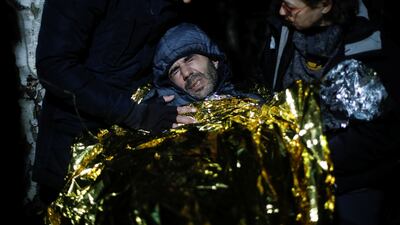
Kader, 39, a Syrian migrant from Homs, looks exhausted as he is rescued by NGO workers during the migrant crisis at the Belarus border, near Topczykaly, Poland. Reuters -
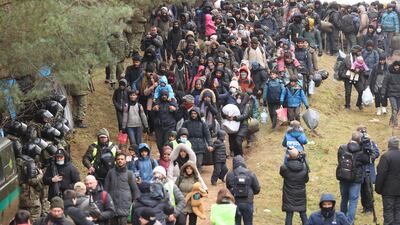
Migrants gather near the Polish border in Kuznica. AFP -
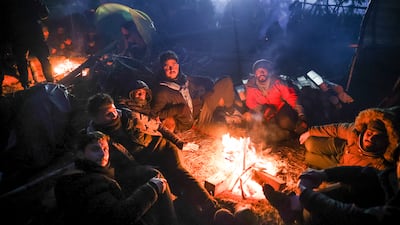
Migrants warm themselves near a fire in Grodno, Belarus. AP Photo -
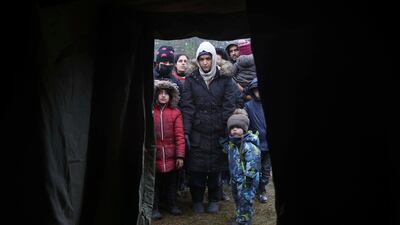
Migrants queue to receive humanitarian aid as they gather at the border near Grodno. AP Photo -
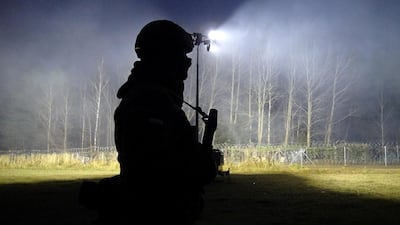
Polish soldiers patrol the border near Kuznica, Poland. Reuters -
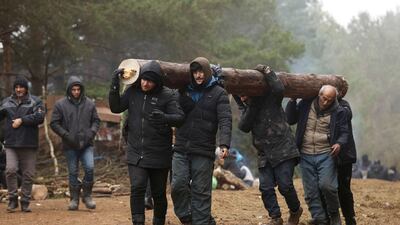
A group of migrants carry a tree trunk delivered by the Belarusian officials for firewood to a camp on the border in the Grodno region. AFP -
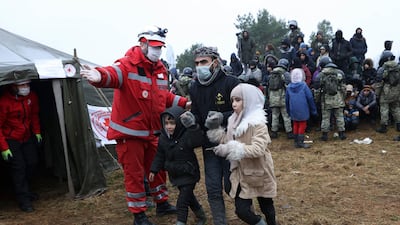
Members of the Belarusian Red Cross show the way to migrants during the distribution of humanitarian aid in a camp in the Grodno region. AFP -
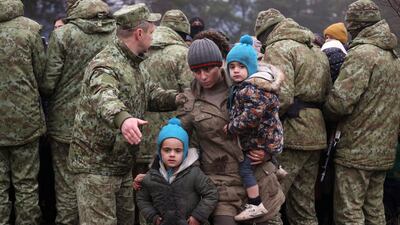
A group of migrants waits alongside Belarusian military personnel as humanitarian aid is distributed. AFP -
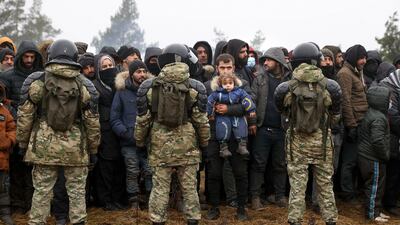
Migrants gather in front of Belarusian servicemen at the border. AP Photo



