• Dignitaries including Norwegian Prime Minister Erna Solberg, Crown Prince Haakon Magnus and Crown Princess Mette-Marit lay floral tributes at the memorial service for the victims of mass killer Anders Breivik on the island of Utoya, Norway, on July 22, 2021. AP
    Dignitaries including Norwegian Prime Minister Erna Solberg, Crown Prince Haakon Magnus and Crown Princess Mette-Marit lay floral tributes at the memorial service for the victims of mass killer Anders Breivik on the island of Utoya, Norway, on July 22, 2021. AP
  • Crown Prince Haakon (2nd L) and Princess Ingrid Alexandra (3rd L) lay flowers, 10 years after the right-wing extremist killed 77 people in a terrorist attack. AP
    Crown Prince Haakon (2nd L) and Princess Ingrid Alexandra (3rd L) lay flowers, 10 years after the right-wing extremist killed 77 people in a terrorist attack. AP
  • Norwegian police keep watch during the memorial service on Utoya, 10 years to the day since Breivik killed 77 people, most of whom were visiting a summer youth camp on the island. AFP
    Norwegian police keep watch during the memorial service on Utoya, 10 years to the day since Breivik killed 77 people, most of whom were visiting a summer youth camp on the island. AFP
  • Flowers are placed at the July 22 memorial. Breivik is likely to spend the rest of his life in prison. EPA
    Flowers are placed at the July 22 memorial. Breivik is likely to spend the rest of his life in prison. EPA
  • Then-Norwegian prime minister Erna Solberg, Crown Prince Haakon Magnus and Crown Princess Mette-Marit attend the memorial service in the Government Quarter in Oslo, close to where Breivik set off a lethal bomb before he caught a ferry to Utoya and carried out a mass shooting. EPA
    Then-Norwegian prime minister Erna Solberg, Crown Prince Haakon Magnus and Crown Princess Mette-Marit attend the memorial service in the Government Quarter in Oslo, close to where Breivik set off a lethal bomb before he caught a ferry to Utoya and carried out a mass shooting. EPA
  • Crown Princess Mette-Marit attends the memorial service on Utoya. EPA
    Crown Princess Mette-Marit attends the memorial service on Utoya. EPA
  • People gather at a memorial outside Oslo Cathedral. Reuters
    People gather at a memorial outside Oslo Cathedral. Reuters
  • Crown Prince Haakon Magnus with Bishop Jan Otto Myrseth during the commemorative service in Hole Church. AP
    Crown Prince Haakon Magnus with Bishop Jan Otto Myrseth during the commemorative service in Hole Church. AP
  • A wreath of roses is placed outside Oslo Cathedral. AFP
    A wreath of roses is placed outside Oslo Cathedral. AFP
  • The sombre occasion gets under way in Oslo Cathedral. AP
    The sombre occasion gets under way in Oslo Cathedral. AP
  • Nato Secretary General Jens Stoltenberg, who was prime minister of Norway at the time of the massacre, speaks at Oslo Cathedral. EPA
    Nato Secretary General Jens Stoltenberg, who was prime minister of Norway at the time of the massacre, speaks at Oslo Cathedral. EPA

Norway mourns Breivik's victims 10 years on with warning hatred is still alive


Tim Stickings
  • English
  • Arabic

Norway on Thursday marked 10 years since Anders Behring Breivik’s far-right massacre with solemn ceremonies to remember the dead and a vow to resist the hatred that inspired the attack.

Church bells rang out across the country in honour of the 77 people murdered by Breivik on July 22, 2011 in an atrocity that shook the nation and the world.

In Oslo, where Breivik began his attack by setting off a bomb that killed eight people, mourners including Norway’s King Harald paid their respects at a cathedral service where 77 roses were arranged in the shape of a heart.

Emotional survivors read aloud the names of the victims in a televised broadcast to mark the anniversary.

The prime minister at the time, current Nato chief Jens Stoltenberg, warned listeners in a speech at the cathedral that extremism was still a danger.

“Ten years ago, we met hatred with love,” Mr Stoltenberg said. “But the hatred is still present.”

Current Prime Minister Erna Solberg said empathy and tolerance were essential in combating extremism.

“The most important preparedness, we have to build within each of us,” she said. “We must not let hate stand unopposed.”

Norway's Prime Minister Erna Solberg, left, called for empathy and tolerance on the 10th anniversary of Breivik's attack. Reuters

On the island of Utoya, where Breivik shot dead 69 people at a Labour Party youth camp, a minute's silence was held at a separate memorial event.

Norway's Crown Prince Haakon told mourners that nobody could comprehend the ordeal that the teenagers went through on the island.

"None of us can truly understand how frightened those who were here must have felt," he said. "All we can do is to listen and try to grasp the pain that still resides in everyone who lived through the attack."

Disguised as a police officer, Breivik took a ferry to the island where he hunted down distraught young people and murdered them in a 72-minute shooting rampage.

Some people who heard the gunfire rushed from a nearby campsite to help, only for Breivik to fire on them as well.

Many survivors face psychological trauma from the events of that day, suffering from anxiety, depression and sleeping problems, and worry about the continuing threat of extremism.

“The deadly racism and right-wing extremism are still alive and well in our midst,” said survivor Astrid Eide Hoem.

“They live on the internet, they live around the dinner table, they live in people that many listen to.”

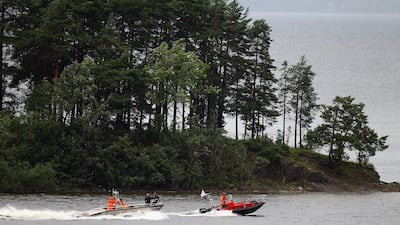
  • Norwegian Red Cross members searching off Utoya island on July 24 2011, two days after the shootings. July 22 will be 10 years since 77 people were killed in the terrorist attack.
    Norwegian Red Cross members searching off Utoya island on July 24 2011, two days after the shootings. July 22 will be 10 years since 77 people were killed in the terrorist attack.
  • Extensive searches were carried out for missing children off Utoya Island in the days after the massacre.
    Extensive searches were carried out for missing children off Utoya Island in the days after the massacre.
  • Floral tributes after the deadly Utoya island attack.
    Floral tributes after the deadly Utoya island attack.
  • The school hut on Utoya photographed in 2011.
    The school hut on Utoya photographed in 2011.
  • Friends and loved ones gather at Oslo Cathedral to mourn the victims, in July 2011.
    Friends and loved ones gather at Oslo Cathedral to mourn the victims, in July 2011.
  • Rescuers search the waters of Utoya island in July 2011.
    Rescuers search the waters of Utoya island in July 2011.
  • Flowers and messages of condolence Oslo Cathedral on July 25, 2011.
    Flowers and messages of condolence Oslo Cathedral on July 25, 2011.
  • Mourners gather to observe a minute's silence opposite Utoya island on July 25, 2011.
    Mourners gather to observe a minute's silence opposite Utoya island on July 25, 2011.
  • Mourners in 2011 at Oslo Cathedral.
    Mourners in 2011 at Oslo Cathedral.
  • Norwegian police at the scene of the atrocity on Utoya island in, 2011.
    Norwegian police at the scene of the atrocity on Utoya island in, 2011.

Breivik was in 2012 sentenced to 21 years in prison but it can be extended indefinitely and he is likely to spend the rest of his life behind bars.

Norway’s intelligence service said this week that his far-right beliefs were “still a driving force for right-wing extremists” at home and abroad.

Breivik’s hate-filled manifesto inspired the New Zealand terrorist Brenton Tarrant and the Norway massacre is often glorified by online extremists.

This week, vandals scrawled 'Breivik was right' on a memorial for a man who was killed by neo-Nazis in 2001.

Some of the bereaved relatives from the 2011 attack said that time had not healed all the wounds from Breivik’s massacre.

Lisbeth Kristine Roeyneland, whose daughter Synne was killed, asked what the victims would think of those they left behind.

“I think they would be sad to know that there still are survivors and bereaved with great needs,” she said.

“I also think they would be proud of us. Proud of how we reacted in the days after the terrorist attack and how our state under the rule of law firmly stood its ground in the face of brutality.”


Updated: July 22, 2021, 2:53 PM