

Sporadic demonstrations broke out in Syria’s Druze heartland over the past week – a reaction to an enormous deterioration in living standards.
The protests in Suweida governorate on the border with Jordan comprise dozens of people each, but they indicate that regime control over outlying regions is lessening amid a worsening economy and no signs of reconstruction.
Groups of mostly young demonstrators gathered to express their dissatisfaction at the economy and shortage of basic supplies, condemning business figures close to Mr Al Assad but not the president himself, or political aspects of the regime.
-
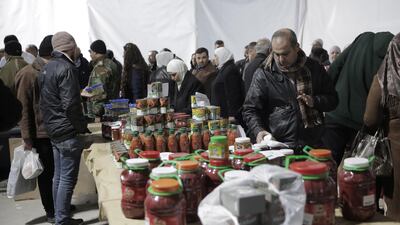
People buy government-subsidized staples at a supermarket in Damascus, Syria, as part of a campaign entitled 'Please reduce your prices'. EPA -
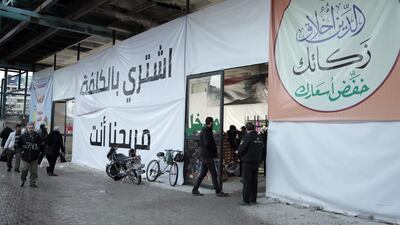
People buy government-subsidized staples at a supermarket in Damascus, Syria, as part of a campaign entitled 'Please reduce your prices'. EPA -

People buy government-subsidized staples at a supermarket in Damascus, Syria, as part of a campaign entitled 'Please reduce your prices'. EPA -

People buy government-subsidized staples at a supermarket in Damascus, Syria, as part of a campaign entitled 'Please reduce your prices'. EPA -
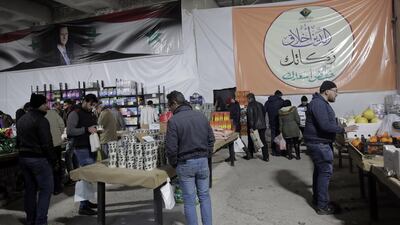
People buy government-subsidized staples at a supermarket in Damascus, Syria, as part of a campaign entitled 'Please reduce your prices'. EPA -
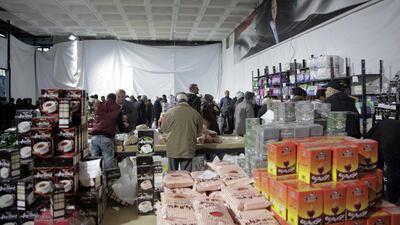
People buy government-subsidized staples at a supermarket in Damascus, Syria, as part of a campaign entitled 'Please reduce your prices'. EPA


YouTube footage showed dozens of young people in Suweida in front of a branch of Syriatel, a telecoms monopoly owned by Mr Al Assad’s cousin, Rami Makhlouf.
The crowd chanted slogans against Mr Makhlouf and Thu Al Himma Shalish, another cousin of Mr Al Assad with his own set of monopolies.
“Makhlouf, Shalish: get off our backs. We want to live,” the demonstrators shouted.
The week-long protests come despite a regime drive to re-establish its grip on security, bolstered by the 2015 Russian intervention.
The unrest poses a challenge for Mr Al Assad's divide-and-conquer strategy, based on placating Syria’s minorities to pacify Sunni majority communities.
The killing of about 200 Druze conscripts in 2011 and 2012 in regime attacks on Homs and other rebel regions caused outrage in Suweida.
The deaths prompted the regime to grant a virtual exemption from conscription to the Suweida Druze, keeping them largely on the sidelines of the civil war.
-
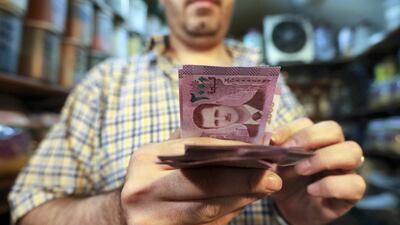
A merchant counts Syrian pound notes, bearing a portrait of the Syrian President Bashar Al Assad, at the Bzourieh market in the centre of the Syrian capital Damascus. AFP -
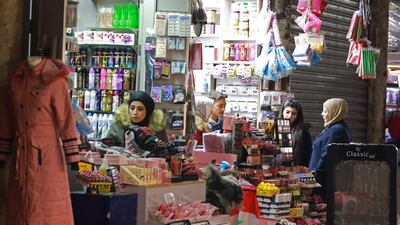
Syrians shop in the Hamidiya bazaar in the old city of Syria's capital Damascus. AFP -
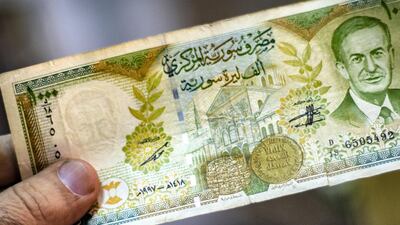
A merchant holds a Syrian pound note, bearing a portrait of late Syrian President Hafez Al Assad, at a market in the Kurdish-majority city of Qamishli in northeast Syria. AFP -
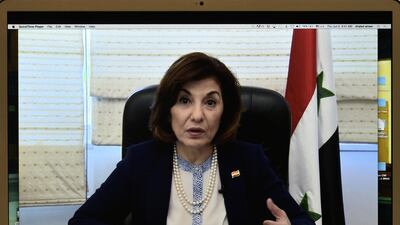
Bouthaina Shaaban, political and media adviser to the Syrian President Bashar Al Assad, speaks via Skype during a press conference. AFP -
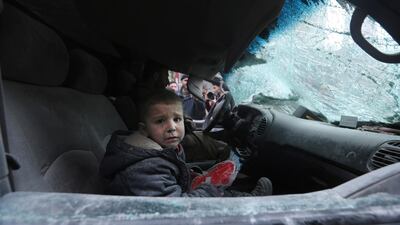
A boy cries in a damaged car after government airstrikes in the town of Ariha, in Idlib province, Syria. AP Photo -
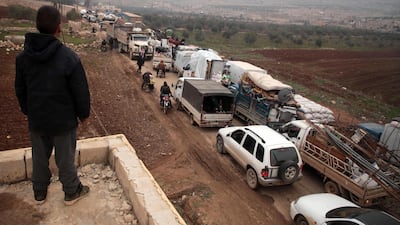
Syrians fleeing towns and villages in the countryside of the northern province of Aleppo drive through the town of Ghazaouia toward safer areas to seek refuge from reported bombing by pro-regime forces. AFP -

A Syrian girl, displaced from the western countryside of Aleppo province, hangs laundry out to dry by an encampment at the site of ancient ruins for refuge from the rain, near the town of Atareb. AFP -

Syrians demonstrate against the regime of Bashar Al Assad in the northwestern Idlib province, Syria's last major opposition bastion. AFP -
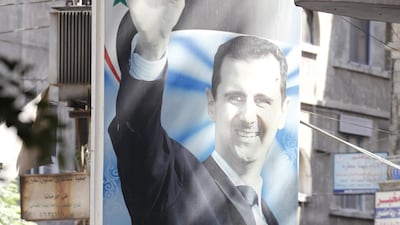
A poster bearing an image of Syrian President Bashar Al Assad is seen in Damascus. AFP -

Syrian regime forces sit by a marble mosaic monument depicting a picture of late President Hafez Al Assad, at the entrance of Harasta in Eastern Ghouta on the outskirts of Damascus, after a deal was struck with rebels in the area to evacuate the town. AFP


That the protests are Druze makes it difficult for the regime to portray the demonstrations as belonging to Al Qaeda or ISIS, as it had done in crushing the protest movement in Sunni-majority regions in early years of the revolt.
Mr Al Assad’s strategy may also have been undermined by the spectacular falls in the value of the Syrian pound since a financial crisis in Lebanon in October. Tougher US sanctions on the regime in December also raised pressure on the currency.
At 1,200 to the dollar, the pound has virtually collapsed compared with 50 pounds to the dollar just before the outbreak of the revolt in March 2011.
Mazen Ezzi, an independent political researcher originally from Suweida, said although their numbers are small, the demonstrations are significant because the area had been regarded as in favour life under Mr Al Assad rather than risking a rebel takeover.
Mr Ezzi told The National that although not many people took to the streets, "the Suweida mainstream cannot be but with the protests", considering the economic conditions.

He said a “rebalancing of power” among local Syrian societies such as in Suweida had occurred since the revolt, making people less fearful of state reprisals.
“The regime still has the firepower and can crackdown, but the fear barrier has been broken and the people have become armed,” Mr Ezzi said.
Several of the Suweida protesters have been arrested, held briefly and released, he said.
“It is no longer that easy for the security apparatus to kidnap someone and hold him, because there will be reprisals from the community,” Mr Ezzi said.
The Druze comprise 3 per cent of Syria’s 19.5 million population, according to the CIA Factbook. An estimated 400,000 of those 600,000 live in Suweida, with the Jaramana suburb of Damascus being the other main Druze centre.
Members of the Druze sect took to the streets in the initial, non-violent phase of the 2011 revolt against five decades of Assad family rule.
Most prominent among them was Muntaha Al Atrash, daughter of Sultan Basha Al Atrash, who led the Great Syrian Revolt against French rule from 1925 to 1927.
Ms Atrash was among women activists who held the first sustained pro-democracy demonstration in March 2011 in Marjeh Square in Damascus.
Security forces broke up the protest with batons and arrested a dozen women. They spared Ms Atrash, whose lineage makes her near untouchable.
But the community grew wary of the revolt when it became armed and militants began dominating rebel ranks.
The weakening of central authority reopened old land disputes between the Druze in Suweida and Sunnis based in the neighbouring governorate of Deraa, leading to mutual killings and kidnappings.
In June 2015, members of the Al Qaeda-linked Jabhat Al Nusra, led by Libyan and Tunisian militants, killed more than 20 Druze villagers in the northern governorate of Idlib.
Three years later ISIS members went on a rampage in Suweida, killing more than 200 Druze.
Some in Suweida blamed the regime for abandoning the defences of the city to bolster the Sunni terrorism scenario it has espoused to keep minorities on its side.

