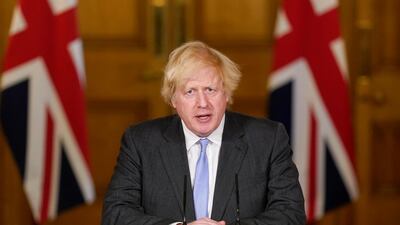
Prime Minister Boris Johnson announces a further easing of Britain's months-long coronavirus lockdown at a media briefing on June 23, 2020. 10 Downing Street via AP

Coronavirus: Third of people in UK have enjoyed lockdown, report reveals


Nicky Harley
  • English
  • Arabic

A third of people surveyed in Britain say they have enjoyed the coronavirus lockdown period.

The UK's largest survey of adults' well-being and mental health during the Covid-19 pandemic found that those aged 30-59, those with higher incomes and those living with others have enjoyed the period the most, according to the University College London (UCL) Covid-19 social study.

More than 70,000 people have been questioned weekly over the past 14 weeks as part of the project.

It also shows that 46 per cent of people overall have not been enjoying it.

According to the research, 17 per cent of people have not been enjoying lockdown "at all", and only 4 per cent have been enjoying it "very much".

Lead author Dr Daisy Fancourt, from UCL's Institute of Epidemiology and Health Care, said lower-income households have struggled with lockdown more than others.

"Our study shows that the majority of people are either not enjoying the lockdown or have mixed feelings about it," she said.

"This is especially true amongst groups with a lower household income, who may be living in accommodation which is overcrowded or lacking in outside space, and those living alone, who may be feeling more isolated than those living with others.

"Of the third of people who report enjoying lockdown, a large number have higher household incomes and live with others or children, suggesting these people may have been less affected by the economic and social restrictions."

Researchers say the findings suggest that those enjoying the lockdown may have been less affected by the economic and social restrictions.

A third of those questioned said they would not miss lockdown.

The study also looked at behavioural changes, and found that four in 10 UK adults said they had gained weight.

Cheryl Lloyd, education programme head at the Nuffield Foundation, said: "Given that low earners have been most at risk of the negative social and economic consequences of the pandemic it is unsurprising that they have been less likely to enjoy lockdown than those on higher incomes.

"It is essential the policy response takes steps to reduce inequalities and minimise the longer-term scarring effects of the pandemic on low earners."

The survey also found that young people were found to be more likely to change their eating and diet behaviours than older adults.

_______________

Coronavirus around the world

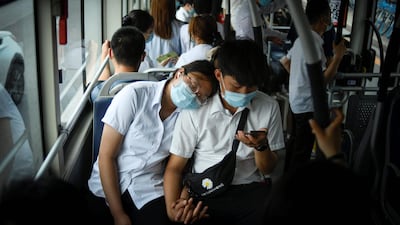
  • A couple wearing face mask ride on a bus during rush hour in Beijing. China reported 12 new cases of Covid-19 on June 24, including seven domestic cases in Beijing. AFP
    A couple wearing face mask ride on a bus during rush hour in Beijing. China reported 12 new cases of Covid-19 on June 24, including seven domestic cases in Beijing. AFP
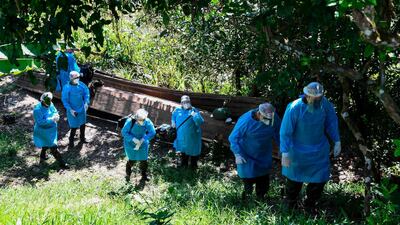
  • The medical team of the Brazilian Armed Forces arrives at the Cruzeirinho village, near Palmeiras do Javari, Amazonas state, northern Brazil,, to assist indigenous population amid the Covid-19 pandemic. AFP
    The medical team of the Brazilian Armed Forces arrives at the Cruzeirinho village, near Palmeiras do Javari, Amazonas state, northern Brazil,, to assist indigenous population amid the Covid-19 pandemic. AFP
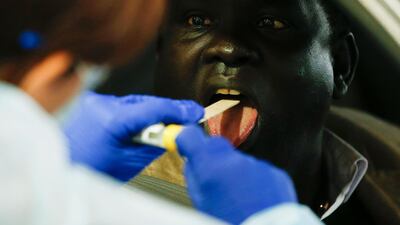
  • A man undergoes a swab test at a drive-through Covid-19 testing facility at the Melbourne Showgrounds in Melbourne, Australia. EPA
    A man undergoes a swab test at a drive-through Covid-19 testing facility at the Melbourne Showgrounds in Melbourne, Australia. EPA
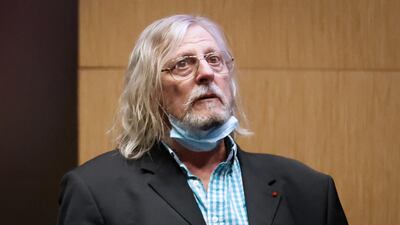
  • Didier Raoult, French medicine professor and director of the IHU Infectious Diseases of Marseille, wears a face mask as he attends a hearing by the National Assembly's coronavirus inquiry commission in Paris concerning the use of hydroxichloroquine as a treatment for the coronavirus. AFP
    Didier Raoult, French medicine professor and director of the IHU Infectious Diseases of Marseille, wears a face mask as he attends a hearing by the National Assembly's coronavirus inquiry commission in Paris concerning the use of hydroxichloroquine as a treatment for the coronavirus. AFP
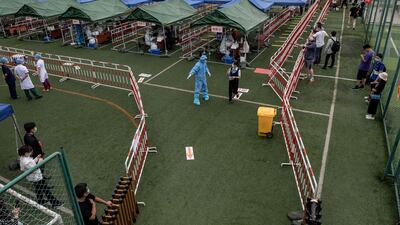
  • People wearing face masks gather at an outdoor area during a mass testing for the coronavirus at the Xinjiekou urban forest park testing site in Beijing. AFP
    People wearing face masks gather at an outdoor area during a mass testing for the coronavirus at the Xinjiekou urban forest park testing site in Beijing. AFP
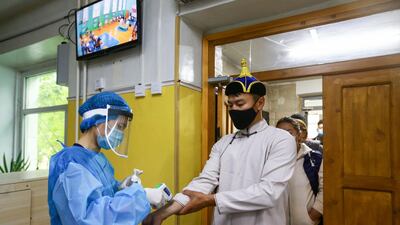
  • A man wearing a face mask has his body temperature checked as he arrives to vote at a polling station in Ulaanbaatar, the capital of Mongolia. AFP
    A man wearing a face mask has his body temperature checked as he arrives to vote at a polling station in Ulaanbaatar, the capital of Mongolia. AFP
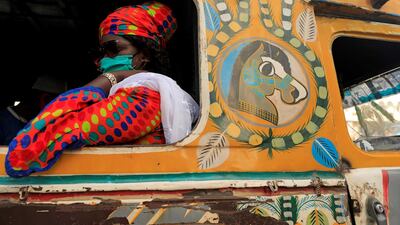
  • A passenger wearing a face mask sits on bus called "Car Rapide", amid the outbreak of the coronavirus disease in Dakar, Senegal. Reuters
    A passenger wearing a face mask sits on bus called "Car Rapide", amid the outbreak of the coronavirus disease in Dakar, Senegal. Reuters
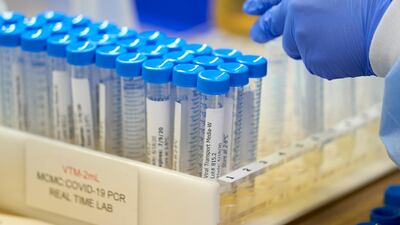
  • A lab at Methodist Dallas Medical Centre prepares viral transport media for samples before collecting samples for coronavirus in Dallas, Texas. Reuters
    A lab at Methodist Dallas Medical Centre prepares viral transport media for samples before collecting samples for coronavirus in Dallas, Texas. Reuters
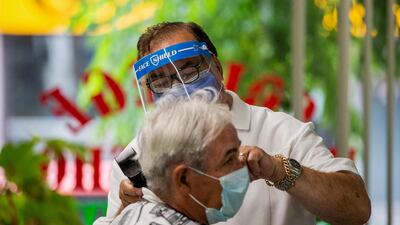
  • Joaquim Correia of College Barber Shop dresses a customer's hair as the provincial phase 2 of reopening from the coronavirus restrictions begins in Toronto, Ontario, Canada. Reuters
    Joaquim Correia of College Barber Shop dresses a customer's hair as the provincial phase 2 of reopening from the coronavirus restrictions begins in Toronto, Ontario, Canada. Reuters
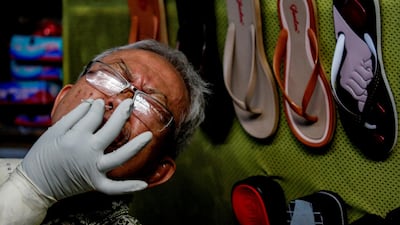
  • A vendor reacts as a healthcare worker in protective gear collects a swab sample to be tested for the coronavirus at a traditional market in Jakarta, Indonesia. Reuters
    A vendor reacts as a healthcare worker in protective gear collects a swab sample to be tested for the coronavirus at a traditional market in Jakarta, Indonesia. Reuters
The specs

Engine: 3.0-litre six-cylinder MHEV

Power: 360bhp

Torque: 500Nm

Transmission: eight-speed automatic

Price: from Dh282,870

On sale: now

Mercer, the investment consulting arm of US services company Marsh & McLennan, expects its wealth division to at least double its assets under management (AUM) in the Middle East as wealth in the region continues to grow despite economic headwinds, a company official said.

Mercer Wealth, which globally has $160 billion in AUM, plans to boost its AUM in the region to $2-$3bn in the next 2-3 years from the present $1bn, said Yasir AbuShaban, a Dubai-based principal with Mercer Wealth.

Within the next two to three years, we are looking at reaching $2 to $3 billion as a conservative estimate and we do see an opportunity to do so,” said Mr AbuShaban.

Mercer does not directly make investments, but allocates clients’ money they have discretion to, to professional asset managers. They also provide advice to clients.

“We have buying power. We can negotiate on their (client’s) behalf with asset managers to provide them lower fees than they otherwise would have to get on their own,” he added.

Mercer Wealth’s clients include sovereign wealth funds, family offices, and insurance companies among others.

From its office in Dubai, Mercer also looks after Africa, India and Turkey, where they also see opportunity for growth.

Wealth creation in Middle East and Africa (MEA) grew 8.5 per cent to $8.1 trillion last year from $7.5tn in 2015, higher than last year’s global average of 6 per cent and the second-highest growth in a region after Asia-Pacific which grew 9.9 per cent, according to consultancy Boston Consulting Group (BCG). In the region, where wealth grew just 1.9 per cent in 2015 compared with 2014, a pickup in oil prices has helped in wealth generation.

BCG is forecasting MEA wealth will rise to $12tn by 2021, growing at an annual average of 8 per cent.

Drivers of wealth generation in the region will be split evenly between new wealth creation and growth of performance of existing assets, according to BCG.

Another general trend in the region is clients’ looking for a comprehensive approach to investing, according to Mr AbuShaban.

“Institutional investors or some of the families are seeing a slowdown in the available capital they have to invest and in that sense they are looking at optimizing the way they manage their portfolios and making sure they are not investing haphazardly and different parts of their investment are working together,” said Mr AbuShaban.

Some clients also have a higher appetite for risk, given the low interest-rate environment that does not provide enough yield for some institutional investors. These clients are keen to invest in illiquid assets, such as private equity and infrastructure.

“What we have seen is a desire for higher returns in what has been a low-return environment specifically in various fixed income or bonds,” he said.

“In this environment, we have seen a de facto increase in the risk that clients are taking in things like illiquid investments, private equity investments, infrastructure and private debt, those kind of investments were higher illiquidity results in incrementally higher returns.”

The Abu Dhabi Investment Authority, one of the largest sovereign wealth funds, said in its 2016 report that has gradually increased its exposure in direct private equity and private credit transactions, mainly in Asian markets and especially in China and India. The authority’s private equity department focused on structured equities owing to “their defensive characteristics.”

The Little Things

Directed by: John Lee Hancock

Starring: Denzel Washington, Rami Malek, Jared Leto

Four stars

Ziina users can donate to relief efforts in Beirut

Ziina users will be able to use the app to help relief efforts in Beirut, which has been left reeling after an August blast caused an estimated $15 billion in damage and left thousands homeless. Ziina has partnered with the United Nations High Commissioner for Refugees to raise money for the Lebanese capital, co-founder Faisal Toukan says. “As of October 1, the UNHCR has the first certified badge on Ziina and is automatically part of user's top friends' list during this campaign. Users can now donate any amount to the Beirut relief with two clicks. The money raised will go towards rebuilding houses for the families that were impacted by the explosion.”

COMPANY%20PROFILE
%3Cp%3E%3Cstrong%3EName%3A%20%3C%2Fstrong%3EEjari%3Cbr%3E%3Cstrong%3EBased%3A%20%3C%2Fstrong%3ERiyadh%2C%20Saudi%20Arabia%3Cbr%3E%3Cstrong%3EFounders%3A%20%3C%2Fstrong%3EYazeed%20Al%20Shamsi%2C%20Fahad%20Albedah%2C%20Mohammed%20Alkhelewy%20and%20Khalid%20Almunif%3Cbr%3E%3Cstrong%3ESector%3A%20%3C%2Fstrong%3EPropTech%3Cbr%3E%3Cstrong%3ETotal%20funding%3A%20%3C%2Fstrong%3E%241%20million%3Cbr%3E%3Cstrong%3EInvestors%3A%20%3C%2Fstrong%3ESanabil%20500%20Mena%2C%20Hambro%20Perks'%20Oryx%20Fund%20and%20angel%20investors%3Cbr%3E%3Cstrong%3ENumber%20of%20employees%3A%20%3C%2Fstrong%3E8%3C%2Fp%3E%0A
How Beautiful this world is!
Skoda Superb Specs

Engine: 2-litre TSI petrol

Power: 190hp

Torque: 320Nm

Price: From Dh147,000

Available: Now

UAE currency: the story behind the money in your pockets
THE BIO

Favourite author - Paulo Coelho 

Favourite holiday destination - Cuba 

New York Times or Jordan Times? NYT is a school and JT was my practice field

Role model - My Grandfather 

Dream interviewee - Che Guevara

In-demand jobs and monthly salaries
  • Technology expert in robotics and automation: Dh20,000 to Dh40,000 
  • Energy engineer: Dh25,000 to Dh30,000 
  • Production engineer: Dh30,000 to Dh40,000 
  • Data-driven supply chain management professional: Dh30,000 to Dh50,000 
  • HR leader: Dh40,000 to Dh60,000 
  • Engineering leader: Dh30,000 to Dh55,000 
  • Project manager: Dh55,000 to Dh65,000 
  • Senior reservoir engineer: Dh40,000 to Dh55,000 
  • Senior drilling engineer: Dh38,000 to Dh46,000 
  • Senior process engineer: Dh28,000 to Dh38,000 
  • Senior maintenance engineer: Dh22,000 to Dh34,000 
  • Field engineer: Dh6,500 to Dh7,500
  • Field supervisor: Dh9,000 to Dh12,000
  • Field operator: Dh5,000 to Dh7,000