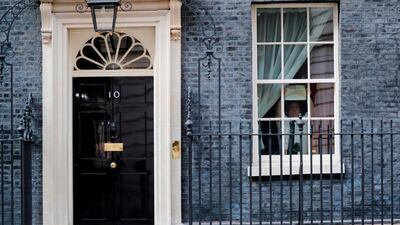
UK Prime Minister Boris Johnson is out of intensive care but still in hospital.
Mr Johnson was admitted to hospital early this week with persistent coronavirus symptoms.
“The Prime Minister has been moved this evening from intensive care back to the ward, where he will receive close monitoring during the early phase of his recovery," a Downing Street spokesman said.
“He is in extremely good spirits.”
Earlier on Thursday, a spokesman said Mr Johnson's health "continues to improve" but there was no hint that he might be about to be moved from the intensive care unit.
The UK government prepares to extend a nationwide lockdown.
"He continues to take positive steps forward and is in good spirits," Foreign minister Dominic Raab said at a daily Downing Street briefing.
The spokesman said Mr Johnson was not working and had received "standard oxygen treatment".
Mr Johnson is the most high-profile world leader to suffer from the coronavirus and his transfer to intensive care on Monday was unprecedented for a prime minister during a national emergency in modern times.
While much of the focus in Britain has been on his health, there is also concern over the number of people infected with the virus.
On Thursday, the government announced an increase of 765 deaths in England, taking the total to 7,248.
Health officials said they expected the number of deaths to continue rising for two weeks after pressure on intensive care units eased.
"We're not there yet," said Patrick Vallance, the government's chief scientific adviser.
Senior ministers met to discuss extending strict social distancing measures introduced on March 23.
Mr Raab, who is standing in for Mr Johnson, led the "war cabinet", as he has done since Monday. He said he had not spoken to Mr Johnson after taking on his role.
"It's still too early to lift the measures that we have put in place," he said. The end of the first three-week lockdown is due to end on Monday.
"We don't expect to say more on this until the end of next week," Mr Raab said.
Asked if the government considered giving police extra powers, the Downing Street spokesman said: "For now our focus is on ensuring that the steps that we already have in place are properly enforced."
In Scotland, First Minister Nicola Sturgeon said on Thursday that the lockdown was likely to continue "for some weeks to come".
Ms Sturgeon said there was "no prospect" of the measures being lifted in the coming days.
Meanwhile, ministers warned the public to follow social distancing rules ahead of the Easter weekend, for which high temperatures are forecast.

UAE currency: the story behind the money in your pockets
How Voiss turns words to speech
The device has a screen reader or software that monitors what happens on the screen
The screen reader sends the text to the speech synthesiser
This converts to audio whatever it receives from screen reader, so the person can hear what is happening on the screen
A VOISS computer costs between $200 and $250 depending on memory card capacity that ranges from 32GB to 128GB
The speech synthesisers VOISS develops are free
Subsequent computer versions will include improvements such as wireless keyboards
Arabic voice in affordable talking computer to be added next year to English, Portuguese, and Spanish synthesiser
Partnerships planned during Expo 2020 Dubai to add more languages
At least 2.2 billion people globally have a vision impairment or blindness
More than 90 per cent live in developing countries
The Long-term aim of VOISS to reach the technology to people in poor countries with workshops that teach them to build their own device
Mercer, the investment consulting arm of US services company Marsh & McLennan, expects its wealth division to at least double its assets under management (AUM) in the Middle East as wealth in the region continues to grow despite economic headwinds, a company official said.
Mercer Wealth, which globally has $160 billion in AUM, plans to boost its AUM in the region to $2-$3bn in the next 2-3 years from the present $1bn, said Yasir AbuShaban, a Dubai-based principal with Mercer Wealth.
“Within the next two to three years, we are looking at reaching $2 to $3 billion as a conservative estimate and we do see an opportunity to do so,” said Mr AbuShaban.
Mercer does not directly make investments, but allocates clients’ money they have discretion to, to professional asset managers. They also provide advice to clients.
“We have buying power. We can negotiate on their (client’s) behalf with asset managers to provide them lower fees than they otherwise would have to get on their own,” he added.
Mercer Wealth’s clients include sovereign wealth funds, family offices, and insurance companies among others.
From its office in Dubai, Mercer also looks after Africa, India and Turkey, where they also see opportunity for growth.
Wealth creation in Middle East and Africa (MEA) grew 8.5 per cent to $8.1 trillion last year from $7.5tn in 2015, higher than last year’s global average of 6 per cent and the second-highest growth in a region after Asia-Pacific which grew 9.9 per cent, according to consultancy Boston Consulting Group (BCG). In the region, where wealth grew just 1.9 per cent in 2015 compared with 2014, a pickup in oil prices has helped in wealth generation.
BCG is forecasting MEA wealth will rise to $12tn by 2021, growing at an annual average of 8 per cent.
Drivers of wealth generation in the region will be split evenly between new wealth creation and growth of performance of existing assets, according to BCG.
Another general trend in the region is clients’ looking for a comprehensive approach to investing, according to Mr AbuShaban.
“Institutional investors or some of the families are seeing a slowdown in the available capital they have to invest and in that sense they are looking at optimizing the way they manage their portfolios and making sure they are not investing haphazardly and different parts of their investment are working together,” said Mr AbuShaban.
Some clients also have a higher appetite for risk, given the low interest-rate environment that does not provide enough yield for some institutional investors. These clients are keen to invest in illiquid assets, such as private equity and infrastructure.
“What we have seen is a desire for higher returns in what has been a low-return environment specifically in various fixed income or bonds,” he said.
“In this environment, we have seen a de facto increase in the risk that clients are taking in things like illiquid investments, private equity investments, infrastructure and private debt, those kind of investments were higher illiquidity results in incrementally higher returns.”
The Abu Dhabi Investment Authority, one of the largest sovereign wealth funds, said in its 2016 report that has gradually increased its exposure in direct private equity and private credit transactions, mainly in Asian markets and especially in China and India. The authority’s private equity department focused on structured equities owing to “their defensive characteristics.”
Who's who in Yemen conflict
Houthis: Iran-backed rebels who occupy Sanaa and run unrecognised government
Yemeni government: Exiled government in Aden led by eight-member Presidential Leadership Council
Southern Transitional Council: Faction in Yemeni government that seeks autonomy for the south
Habrish 'rebels': Tribal-backed forces feuding with STC over control of oil in government territory
Pharaoh's curse
British aristocrat Lord Carnarvon, who funded the expedition to find the Tutankhamun tomb, died in a Cairo hotel four months after the crypt was opened.
He had been in poor health for many years after a car crash, and a mosquito bite made worse by a shaving cut led to blood poisoning and pneumonia.
Reports at the time said Lord Carnarvon suffered from “pain as the inflammation affected the nasal passages and eyes”.
Decades later, scientists contended he had died of aspergillosis after inhaling spores of the fungus aspergillus in the tomb, which can lie dormant for months. The fact several others who entered were also found dead withiin a short time led to the myth of the curse.
Crime%20Wave
%3Cp%3EHeavyweight%20boxer%20Fury%20revealed%20on%20Sunday%20his%20cousin%20had%20been%20%E2%80%9Cstabbed%20in%20the%20neck%E2%80%9D%20and%20called%20on%20the%20courts%20to%20address%20the%20wave%20of%20more%20sentencing%20of%20offenders.%26nbsp%3B%3C%2Fp%3E%0A%3Cp%3ERico%20Burton%2C%2031%2C%20was%20found%20with%20stab%20wounds%20at%20around%203am%20on%20Sunday%20in%20Goose%20Green%2C%20Altrincham%20and%20subsequently%20died%20of%20his%20injuries.%3C%2Fp%3E%0A%3Cp%3E%26nbsp%3B%E2%80%9CMy%20cousin%20was%20murdered%20last%20night%2C%20stabbed%20in%20the%20neck%20this%20is%20becoming%20ridiculous%20%E2%80%A6%20idiots%20carry%20knives.%20This%20needs%20to%20stop%2C%E2%80%9D%0D%20Fury%20said.%20%E2%80%9CAsap%2C%20UK%20government%20needs%20to%20bring%20higher%20sentencing%20for%20knife%20crime%2C%20it%E2%80%99s%20a%20pandemic%20%26amp%3B%20you%20don%E2%80%99t%20know%20how%20bad%20it%20is%20until%20%5Bit%E2%80%99s%5D%201%20of%20your%20own!%3C%2Fp%3E%0A
The candidates
Dr Ayham Ammora, scientist and business executive
Ali Azeem, business leader
Tony Booth, professor of education
Lord Browne, former BP chief executive
Dr Mohamed El-Erian, economist
Professor Wyn Evans, astrophysicist
Dr Mark Mann, scientist
Gina MIller, anti-Brexit campaigner
Lord Smith, former Cabinet minister
Sandi Toksvig, broadcaster
The%20Afghan%20connection
%3Cp%3EThe%20influx%20of%20talented%20young%20Afghan%20players%20to%20UAE%20cricket%20could%20have%20a%20big%20impact%20on%20the%20fortunes%20of%20both%20countries.%20Here%20are%20three%20Emirates-based%20players%20to%20watch%20out%20for.%0D%3Cbr%3E%20%0D%3Cbr%3E%3Cstrong%3EHassan%20Khan%20Eisakhil%3C%2Fstrong%3E%0D%3Cbr%3EMohammed%20Nabi%20is%20still%20proving%20his%20worth%20at%20the%20top%20level%20but%20there%20is%20another%20reason%20he%20is%20raging%20against%20the%20idea%20of%20retirement.%20If%20the%20allrounder%20hangs%20on%20a%20little%20bit%20longer%2C%20he%20might%20be%20able%20to%20play%20in%20the%20same%20team%20as%20his%20son%2C%20Hassan%20Khan.%20The%20family%20live%20in%20Ajman%20and%20train%20in%20Sharjah.%0D%3Cbr%3E%20%0D%3Cbr%3E%3Cstrong%3EMasood%20Gurbaz%3C%2Fstrong%3E%0D%3Cbr%3EThe%20opening%20batter%2C%20who%20trains%20at%20Sharjah%20Cricket%20Academy%2C%20is%20another%20player%20who%20is%20a%20part%20of%20a%20famous%20family.%20His%20brother%2C%20Rahmanullah%2C%20was%20an%20IPL%20winner%20with%20Kolkata%20Knight%20Riders%2C%20and%20opens%20the%20batting%20with%20distinction%20for%20Afghanistan.%0D%3Cbr%3E%20%0D%3Cbr%3E%3Cstrong%3EOmid%20Rahman%3C%2Fstrong%3E%0D%3Cbr%3EThe%20fast%20bowler%20became%20a%20pioneer%20earlier%20this%20year%20when%20he%20became%20the%20first%20Afghan%20to%20represent%20the%20UAE.%20He%20showed%20great%20promise%20in%20doing%20so%2C%20too%2C%20playing%20a%20key%20role%20in%20the%20senior%20team%E2%80%99s%20qualification%20for%20the%20Asia%20Cup%20in%20Muscat%20recently.%0D%3Cbr%3E%3C%2Fp%3E%0A
At a glance
- 20,000 new jobs for Emiratis over three years
- Dh300 million set aside to train 18,000 jobseekers in new skills
- Managerial jobs in government restricted to Emiratis
- Emiratis to get priority for 160 types of job in private sector
- Portion of VAT revenues will fund more graduate programmes
- 8,000 Emirati graduates to do 6-12 month replacements in public or private sector on a Dh10,000 monthly wage - 40 per cent of which will be paid by government
Saturday's results
Women's third round
- 14-Garbine Muguruza Blanco (Spain) beat Sorana Cirstea (Romania) 6-2, 6-2
- Magdalena Rybarikova (Slovakia) beat Lesia Tsurenko (Ukraine) 6-2, 6-1
- 7-Svetlana Kuznetsova (Russia) beat Polona Hercog (Slovenia) 6-4. 6-0
- Coco Vandeweghe (USA) beat Alison Riske (USA) 6-2, 6-4
- 9-Agnieszka Radwanska (Poland) beat 19-Timea Bacsinszky (Switzerland) 3-6, 6-4, 6-1
- Petra Martic (Croatia) beat Zarina Diyas (Kazakhstan) 7-6, 6-1
- Magdalena Rybarikova (Slovakia) beat Lesia Tsurenko (Ukraine) 6-2, 6-1
- 7-Svetlana Kuznetsova (Russia) beat Polona Hercog (Slovenia) 6-4, 6-0
Men's third round
- 13-Grigor Dimitrov (Bulgaria) beat Dudi Sela (Israel) 6-1, 6-1 -- retired
- Sam Queery (United States) beat Jo-Wilfried Tsonga (France) 6-2, 3-6, 7-6, 1-6, 7-5
- 6-Milos Raonic (Canada) beat 25-Albert Ramos (Spain) 7-6, 6-4, 7-5
- 10-Alexander Zverev (Germany) beat Sebastian Ofner (Austria) 6-4, 6-4, 6-2
- 11-Tomas Berdych (Czech Republic) beat David Ferrer (Spain) 6-3, 6-4, 6-3
- Adrian Mannarino (France) beat 15-Gael Monfils (France) 7-6, 4-6, 5-7, 6-3, 6-2
How to book
Call DHA on 800342
Once you are registered, you will receive a confirmation text message
Present the SMS and your Emirates ID at the centre
DHA medical personnel will take a nasal swab
Check results within 48 hours on the DHA app under ‘Lab Results’ and then ‘Patient Services’
