Dense forest in Gabon, Central Africa. The UK government is launching a £500 million ($674m) package to protect five million hectares of rainforest. Reuters

Cop26 countries commit to food and agriculture transformation


  • English
  • Arabic

Dozens of countries have pledged to protect their farmland and revamp humanity’s food production in a drive to make the natural world an ally in the fight against climate change.

The promise by 45 countries on the sixth day of the Cop26 summit was described as necessary to reduce emissions from agriculture and restore the carbon sinks that help to rein in global warming.

They intend to spend billions of dollars to make farming more sustainable, including by improving soil health and developing climate-resilient crops.

To support these goals, the UK is putting its weight behind a $4 billion agricultural innovation plan spearheaded by the US and the UAE.

It will spend another £500 million ($675m) to protect the world’s rainforests and create jobs in sustainable agriculture and forestry - with activists alarmed at the continuing pace of deforestation despite the pledges being made in Glasgow.

Meanwhile, nearly 100 businesses have agreed to work towards “halting and reversing the decline of nature by 2030” by planting trees and sourcing more sustainable goods.

Companies including fashion brand Burberry, retailer Marks & Spencer and UK supermarket giants Co-op, Sainsbury’s, Tesco and Waitrose are committing to cut down their environmental impact.

UK Environment Secretary George Eustice said protecting nature was key to keeping alive the goal of the Paris Agreement to limit global warming to 1.5°C.

“Land can be a great source of emissions or a great carbon sink, depending on how we manage it,” Mr Eustice told delegates in Glasgow.

“We must all work to raise the ambition of our actions on sustainable land use and commodity trade.”

Agricultural emissions make up about a quarter of the world’s greenhouse gas output, the UK government said, including methane produced by livestock.

Cutting emissions and thereby limiting global temperature rises would have the additional benefits of protecting endangered species and reducing floods and droughts, said Patrick Vallance, the UK government's chief scientific adviser.

"The natural world is depending on us - let’s work together for our planet," he said.

Sheep graze on a beach in Scotland's Orkney Islands. Agriculture makes up a large share of the world's greenhouse gas emissions. AFP

Dozens of countries this week promised to clamp down on emissions of methane, which is many times more potent than CO2 at warming the planet.

In a separate pledge, more than 100 countries – covering more than 85 per cent of the world’s forests – said they would turn the tide on deforestation.

They are among a series of agreements at Cop26 that Britain has described as milestones on the journey to protecting the planet, but sceptics see as insufficient to tackle global warming.

Activists from Greenpeace raised the alarm over continued deforestation, saying the area of the Amazon rainforest cut down in October was more than four times the size of Glasgow.

“Signing or endorsing agreements does not change the reality of the forest floor,” said Greenpeace campaigner Romulo Batista.

“Deforestation and fires remain out of control and violence against indigenous peoples is only increasing.”

Former UK prime minister Theresa May, chairing part of Saturday’s talks, said the world needed to plant substantially more trees than were being felled.

She said humanity’s mismanagement of land and nature, the main theme of day six in Glasgow, was worsening the climate crisis.

“From the huge climate footprint of our cities, to the destruction of natural habitats for agriculture, we have taken our environment for granted,” she said.

“But nature can be our ally in this climate crisis. Nature is our best carbon capture storage. And with sustainable management of our critical ecosystems, we can keep the pathway to 1.5 alive.”

Greg Hands, a minister in the UK's energy department, said the UK's £500m package would protect rainforests and create thousands of green jobs.

The £500m is part of a wider UK government plan to spend at least £3 billion of climate finance on nature and biodiversity.

“If we are to keep the 1.5°C target in reach, we need to work with other nations to halt global deforestation, investing in the sustainable trading of commodities that will help communities thrive, while protecting our planet for generations to come,” said Mr Hands.

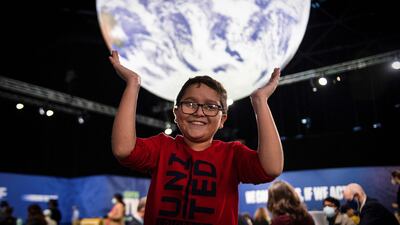
  • Colombian climate activist Francisco Javier Vera, 12, strikes a cheerful pose at the Cop26 summit, in Glasgow, Scotland. AFP
    Colombian climate activist Francisco Javier Vera, 12, strikes a cheerful pose at the Cop26 summit, in Glasgow, Scotland. AFP
  • A demonstrator stands in front of a police line at a Fridays For Future march in Glasgow. Getty Images
    A demonstrator stands in front of a police line at a Fridays For Future march in Glasgow. Getty Images
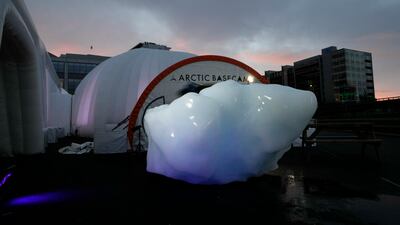
  • The melting remains of an iceberg delivered by members of Arctic Basecamp science campaign group to Glasgow. The four-tonne block of ice – originally part of a larger glacier – was brought from Greenland to highlight the climate crisis. AP Photo
    The melting remains of an iceberg delivered by members of Arctic Basecamp science campaign group to Glasgow. The four-tonne block of ice – originally part of a larger glacier – was brought from Greenland to highlight the climate crisis. AP Photo
  • From left, UN Framework Convention on Climate Change executive secretary Patricia Espinosa, Cop26 president Alok Sharma and Scotland's First Minister Nicola Sturgeon host the Unifying for Change: The Global Youth Voice event. Getty Images
    From left, UN Framework Convention on Climate Change executive secretary Patricia Espinosa, Cop26 president Alok Sharma and Scotland's First Minister Nicola Sturgeon host the Unifying for Change: The Global Youth Voice event. Getty Images
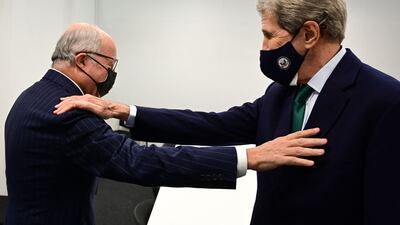
  • US climate envoy John Kerry, right, greets former French premier and foreign minister Laurent Fabius, who oversaw the 2016 Paris Agreement on climate change. AFP
    US climate envoy John Kerry, right, greets former French premier and foreign minister Laurent Fabius, who oversaw the 2016 Paris Agreement on climate change. AFP
  • British television personality and survival expert Bear Grylls, who is also chief ambassador of World Scouting, attends the summit. Reuters
    British television personality and survival expert Bear Grylls, who is also chief ambassador of World Scouting, attends the summit. Reuters
  • Tongan artist and activist Uili Lousi stands alongside 'Flare (Oceania) 2021', created by Irish artist John Gerrard. The real-time moving image shows a simulation of the seas around Tonga. PA
    Tongan artist and activist Uili Lousi stands alongside 'Flare (Oceania) 2021', created by Irish artist John Gerrard. The real-time moving image shows a simulation of the seas around Tonga. PA
  • Attendees walk towards the Cop26 venue. Bloomberg
    Attendees walk towards the Cop26 venue. Bloomberg
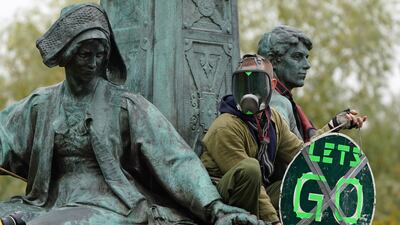
  • A demonstrator at the Fridays for Future march through Glasgow. PA
    A demonstrator at the Fridays for Future march through Glasgow. PA
TYPES%20OF%20ONLINE%20GIG%20WORK
%3Cp%3E%3Cstrong%3EDesign%2C%20multimedia%20and%20creative%20work%3A%20%3C%2Fstrong%3ELogo%20design%2C%20website%20design%2C%20visualisations%3C%2Fp%3E%0A%3Cp%3E%3Cstrong%3EBusiness%20and%20professional%20management%3A%20%3C%2Fstrong%3ELegal%20or%20management%20consulting%2C%20architecture%3C%2Fp%3E%0A%3Cp%3E%3Cstrong%3EBusiness%20and%20professional%20support%3A%20%3C%2Fstrong%3EResearch%20support%2C%20proofreading%2C%20bookkeeping%3C%2Fp%3E%0A%3Cp%3E%3Cstrong%3ESales%20and%20marketing%20support%3A%20%3C%2Fstrong%3ESearch%20engine%20optimisation%2C%20social%20media%20marketing%3C%2Fp%3E%0A%3Cp%3E%3Cstrong%3EData%20entry%2C%20administrative%2C%20and%20clerical%3A%20%3C%2Fstrong%3EData%20entry%20tasks%2C%20virtual%20assistants%3C%2Fp%3E%0A%3Cp%3E%3Cstrong%3EIT%2C%20software%20development%20and%20tech%3A%20%3C%2Fstrong%3EData%20analyst%2C%20back-end%20or%20front-end%20developers%3C%2Fp%3E%0A%3Cp%3E%3Cstrong%3EWriting%20and%20translation%3A%20%3C%2Fstrong%3EContent%20writing%2C%20ghost%20writing%2C%20translation%3C%2Fp%3E%0A%3Cp%3E%3Cstrong%3EOnline%20microtasks%3A%20%3C%2Fstrong%3EImage%20tagging%2C%20surveys%3C%2Fp%3E%0A%3Cp%3E%3Cem%3ESource%3A%20World%20Bank%3C%2Fem%3E%3C%2Fp%3E%0A
At a glance

Fixtures All matches start at 9.30am, at ICC Academy, Dubai. Admission is free

Thursday UAE v Ireland; Saturday UAE v Ireland; Jan 21 UAE v Scotland; Jan 23 UAE v Scotland

UAE squad Rohan Mustafa (c), Ashfaq Ahmed, Ghulam Shabber, Rameez Shahzad, Mohammed Boota, Mohammed Usman, Adnan Mufti, Shaiman Anwar, Ahmed Raza, Imran Haider, Qadeer Ahmed, Mohammed Naveed, Amir Hayat, Zahoor Khan

Mercer, the investment consulting arm of US services company Marsh & McLennan, expects its wealth division to at least double its assets under management (AUM) in the Middle East as wealth in the region continues to grow despite economic headwinds, a company official said.

Mercer Wealth, which globally has $160 billion in AUM, plans to boost its AUM in the region to $2-$3bn in the next 2-3 years from the present $1bn, said Yasir AbuShaban, a Dubai-based principal with Mercer Wealth.

Within the next two to three years, we are looking at reaching $2 to $3 billion as a conservative estimate and we do see an opportunity to do so,” said Mr AbuShaban.

Mercer does not directly make investments, but allocates clients’ money they have discretion to, to professional asset managers. They also provide advice to clients.

“We have buying power. We can negotiate on their (client’s) behalf with asset managers to provide them lower fees than they otherwise would have to get on their own,” he added.

Mercer Wealth’s clients include sovereign wealth funds, family offices, and insurance companies among others.

From its office in Dubai, Mercer also looks after Africa, India and Turkey, where they also see opportunity for growth.

Wealth creation in Middle East and Africa (MEA) grew 8.5 per cent to $8.1 trillion last year from $7.5tn in 2015, higher than last year’s global average of 6 per cent and the second-highest growth in a region after Asia-Pacific which grew 9.9 per cent, according to consultancy Boston Consulting Group (BCG). In the region, where wealth grew just 1.9 per cent in 2015 compared with 2014, a pickup in oil prices has helped in wealth generation.

BCG is forecasting MEA wealth will rise to $12tn by 2021, growing at an annual average of 8 per cent.

Drivers of wealth generation in the region will be split evenly between new wealth creation and growth of performance of existing assets, according to BCG.

Another general trend in the region is clients’ looking for a comprehensive approach to investing, according to Mr AbuShaban.

“Institutional investors or some of the families are seeing a slowdown in the available capital they have to invest and in that sense they are looking at optimizing the way they manage their portfolios and making sure they are not investing haphazardly and different parts of their investment are working together,” said Mr AbuShaban.

Some clients also have a higher appetite for risk, given the low interest-rate environment that does not provide enough yield for some institutional investors. These clients are keen to invest in illiquid assets, such as private equity and infrastructure.

“What we have seen is a desire for higher returns in what has been a low-return environment specifically in various fixed income or bonds,” he said.

“In this environment, we have seen a de facto increase in the risk that clients are taking in things like illiquid investments, private equity investments, infrastructure and private debt, those kind of investments were higher illiquidity results in incrementally higher returns.”

The Abu Dhabi Investment Authority, one of the largest sovereign wealth funds, said in its 2016 report that has gradually increased its exposure in direct private equity and private credit transactions, mainly in Asian markets and especially in China and India. The authority’s private equity department focused on structured equities owing to “their defensive characteristics.”

Updated: November 06, 2021, 11:58 AM