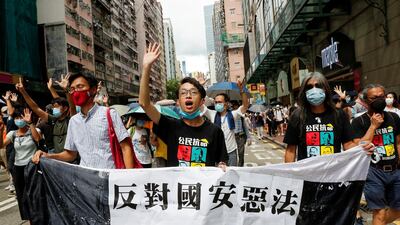
The US House of Representatives agreed unanimously to seek tough sanctions on Chinese officials and Hong Kong police after Beijing imposed a security law that clamps down on unrest in the city.
After a day in which Hong Kong authorities arrested hundreds of protesters, the House on Wednesday passed the act, which got the Senate approval last week.
But because of technical changes, the Senate will need to vote again and a senator said it could happen on Thursday.
"The Chinese regime just thinks that they can act with impunity and repressing the spirit of democracy," Speaker Nancy Pelosi said before the House passage.
"If we refuse to speak out on human rights in China because of commercial interests, we lose all moral authority to speak out for human rights anywhere in the world," said Washington's top elected Democrat, long a vocal proponent of human rights in China.
President Donald Trump has not said if he will sign the bill but one of his allies briefly held up the Senate version, seeking changes.
Mr Trump publicly hesitated last year before signing another rights bill on Hong Kong which also lays out sanctions against Chinese officials for infringing on the city's autonomy.
-
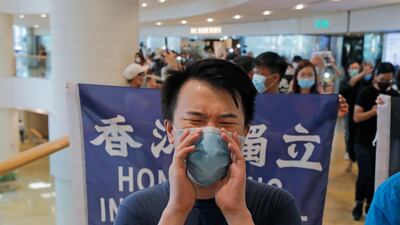
Protesters hold flags and shout slogans in a shopping mall during a protest in Hong Kong. Protesters in Hong Kong managed to make the government withdraw extradition legislation last year, but now they're getting a more dreaded national security law and the message from Beijing is that protest is futile. AP Photo -

Protesters hold flags as they march through a shopping mall during a protest in Hong Kong. Protesters in Hong Kong managed to make the government withdraw extradition legislation last year, but now they're getting a more dreaded national security law. And the message from Beijing is that protest is futile. AP Photo -
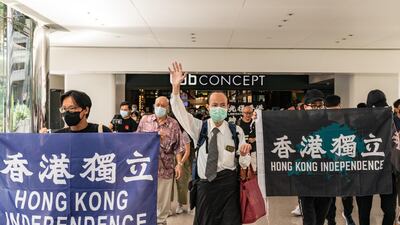
Pro-democracy supporters hold banners and shout slogans as they march in a shopping mall during a lunch protest in Hong Kong, China. Getty Images -
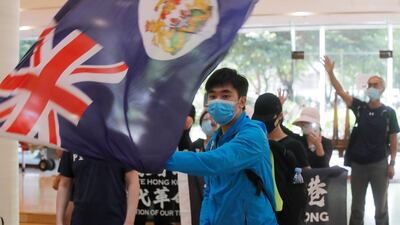
A protester waves a Hong Kong colonial flag in a shopping mall during a protest in Hong Kong. Protesters in Hong Kong got its government to withdraw extradition legislation last year, but now they're getting a more dreaded national security law. And the message from Beijing is that protest is futile. AP Photo -
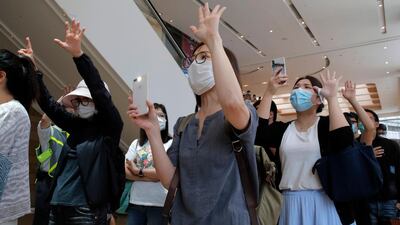
Protesters gesture with five fingers, signifying the "Five demands - not one less" in a shopping mall during a protest in Hong Kong. Protesters in Hong Kong got its government to withdraw extradition legislation last year, but now they're getting a more dreaded national security law. And the message from Beijing is that protest is futile. AP Photo -
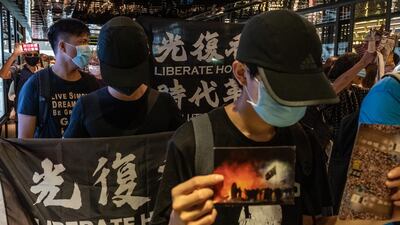
Pro-democracy supporters hold banners and shout slogans as they march in a shopping mall during a lunch protest in Hong Kong, China. Getty Images -
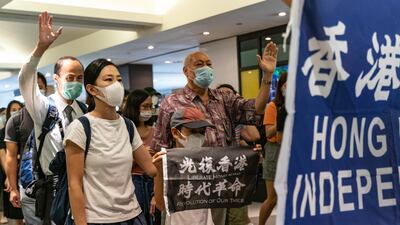
Pro-democracy supporters hold banners and shout slogans as they march in a shopping mall during a lunch protest in Hong Kong, China.Getty Images -
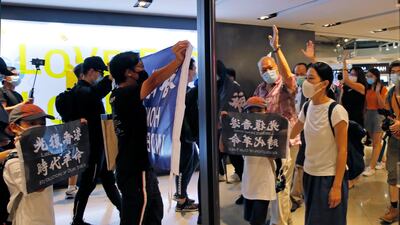
Protesters are reflected on a mirror as they march in a shopping mall during a protest in Hong Kong. Protesters in Hong Kong got its government to withdraw extradition legislation last year, but now they're getting a more dreaded national security law. And the message from Beijing is that protest is futile. AP Photo


Unlike the previous act, the new legislation would make sanctions mandatory, limiting Mr Trump's ability to waive them. In a crucial pressure point, it would also slap sanctions on banks that conduct transactions with violators.
Under a deal ahead of the 1997 handover from Britain, authoritarian China guaranteed Hong Kong civil liberties as well as judicial and legislative autonomy until 2047 in a formula known as "One Country, Two Systems".
China says the new law doesn't damage the territory's rights but will restore stability after months of pro-democracy unrest.
Beijing said Thursday it "deplores and firmly opposes" the US bill, adding that Hong Kong issues are part of China's internal affairs.
"We urge the US to grasp the reality of the situation, stop interfering in Hong Kong affairs and implementing the negative bill, otherwise we will take strong countermeasures," said foreign ministry spokesman Zhao Lijian.
China has also warned Britain it could retaliate with "corresponding measures" for London's decision to extend a broader path to citizenship for the residents of Hong Kong.
"If the British side makes unilateral changes to the relevant practice, it will breach its own position and pledges as well as international law and basic norms governing international relations," it said in a statement.
"We firmly oppose this and reserve the right to take corresponding measures," it said without elaborating.
The Chinese statement concluded by urging London to reassess its decision and "refrain from interfering in Hong Kong affairs in any way".
China imposed the long-threatened security law in Hong Kong that criminalizes "subversion" and other acts of dissent on Tuesday.
On Wednesday, Hong Kong police cracked down on protesters marking the anniversary of the 1997 handover, arresting about 370 people – including 10 under the new law.
US presidential candidate Joe Biden accused Mr Trump of allowing China to impose its will on Hong Kong through a hesitant response.
"It's no wonder Beijing is acting with impunity. Time and again, President Trump has surrendered our values and reassured China's autocrats they have a like-minded partner in the White House," the Democrat said in a statement.
"Where Trump has been weak, I will be strong, clear and consistent in standing up for our values."
The Trump administration has taken a series of actions in response to China's moves on Hong Kong, including restricting visas to an unspecified number of officials and blocking high-tech exports to the financial hub.
Critics say the actions were not enough and that Mr Trump has prioritised a trade deal with President Xi Jinping.
Secretary of State Mike Pompeo hinted that the Trump administration will do more to punish China – by reducing the special privileges of Hong Kong.
Mr Trump "wants to ensure, with a handful of exceptions, that Hong Kong is treated just like mainland China because that's the way that General Secretary Xi has chosen to treat that place as well," Mr Pompeo said.

