

The churches were full on Sunday morning as Christians in Sri Lanka gathered for one of the most important religious holidays of the year.
But what unfolded next would shake the nation and shock the world.
A little before 9am, suicide bombers detonated explosives at three churches across the country. Within minutes, scores were dead and hundreds wounded.
The 200-year-old Roman Catholic St Sebastian's Church in the small town of Negombo, north of the Sri Lankan capital of Colombo, was torn apart.
Wooden pews were tossed aside, rubble filled the central aisle and blood stained the walls. The blast killed at least 62 people.
-
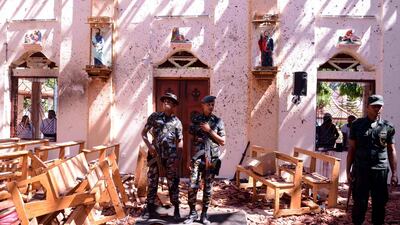
Sri Lankan soldiers look on inside the St Sebastian's Church at Katuwapitiya in Negombo. AFP -

Sri Lankan Crime Division police officers inspect the explosion site at a church in Batticaloa. Reuters -
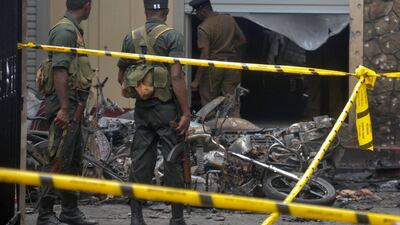
Sri Lankan military stand guard near the explosion site at a church in Batticaloa. Reuters -

A man rides his bicycle along a road during the curfew after multiple explosions in the country, in Colombo. Reuters -
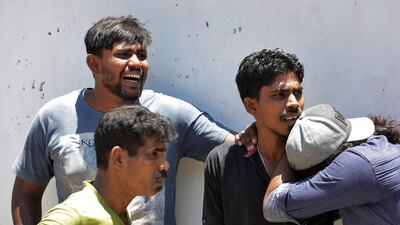
Relatives of a blast victim weep outside a police morgue in Colombo. AP -

A Sri Lankan nun looks on inside the St Sebastian's Church at Katuwapitiya in Negombo. AFP -

Sri Lankan officials inspect St Sebastian's Church in Negombo. Getty -
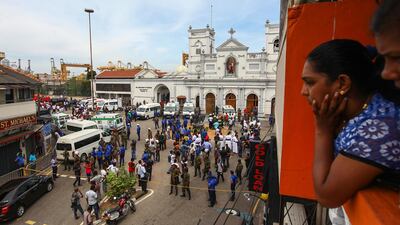
Sri Lankan security forces secure the area around St Anthony's Shrine. Getty -
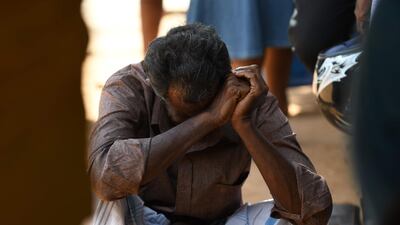
A relative of a Sri Lankan victim weeps outside a hospital in Batticaloa. AFP -
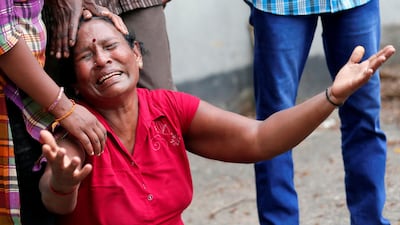
A relative of a victim of the explosion at St Anthony's Shrine, Kochchikade church, breaks down at the police mortuary. Reuters


The scene was repeated at the church of St Anthony's Shrine in Colombo and the Zion Church in the eastern town of Batticaloa.
NA Sumanapala was near the church of St Anthony’s when the blast happened.
"I ran inside to help," Mr Sumanapala said. "The priest came out and he was covered in blood. It was a river of blood."
When the initial reports came in, officials said 20 were dead and scores wounded. Within hours, that shot past 290 and more than 500 wounded.
As the carnage unfolded in the three churches, tourists and the well-heeled were gathering for an Easter brunch in some of Colombo’s most upmarket hotels.
In the five-star Cinnamon Grand on Galle Road, a man who had checked in the night before walked up to the breakfast bar.
Standing in line, he detonated the explosives in his rucksack and the death toll rose.
At the Kingsley Hotel and nearby Shangri-La, more bombers detonated their explosives.
Reports indicate that the security footage from the Shangri-La shows two men in the Table One restaurant.
One blew it apart while the other set off his explosives in the corridor, leaving a mass of shattered glass and wires and a hole in the side of the hotel.
Razeena Kukkady, 58, was among those killed. A resident of Dubai, the woman described by relatives as a keen traveller who was born in India but grew up in Sri Lanka.
"We are deeply saddened and shocked by the incident and our thoughts and prayers are with the families of the casualties and those who have been affected," the Shangri-La said.
At least 30 foreign nationals were caught up in the attacks.
US Secretary of State Mike Pompeo said several Americans were among the dead and the UK said its nationals were also caught up in the carnage.
Reports indicate that people from India, Pakistan, Portugal and Turkey were killed along with hotel workers, locals and those just passing through.
Sri Lanka has shot up global lists of tourist destinations as an idyllic Indian Ocean island of palm-lined beaches and jungle-covered mountains, but it is not unused to bloodshed.
Sectarian tension simmers in a country of 22 million. There have been accusations of hate crimes by extremist Buddhist monks against minority Muslims and last year, the government imposed a 12-day state of emergency to end anti-Muslim riots.
In January, Sri Lankan police seized explosives and detonators after the arrest of four men from a newly formed radical group.
Few have forgotten that for 26 years until 2009, a devastating conflict raged between the government and the Tamil Tigers, an insurgent force from one of the country’s ethnic minorities.
Until Sunday, the country had been spared such large-scale violence for nearly a decade.
Gabriel said his brother had been wounded in the explosion at St Anthony's church.
"We are all in shock. We don't want the country to go back to that dark past where we had to live in fear of suicide blasts all the time," Gabriel said.
The wounded from the six sites were rushed to hospital in taxis, cars, ambulances and on rickshaws,
Harsha de Silva, Sri Lanka’s Minister of Economic Reform, said on Twitter that he and Secretary of Defence Hemasiri Fernando had helped to take some of the wounded to hospital and that a full emergency response was under way.
"I am shocked and saddened by the situation that has occurred," said Maithripala Sirisena, President of Sri Lanka.
"Investigations have been launched to look into what conspiracy is behind these heinous acts. Please remain calm and do not be fooled by rumours."
But rumours swirled. Police and security forces tried to secure the capital but on Twitter, users were quoting a major Sri Lankan newspaper report of another attack at the Town Hall. There was no newspaper report.
Mr de Silva urged users to act responsibly and not share unverified information, but by the afternoon the government had blocked access to Facebook and WhatsApp, saying it was necessary to prevent panic from false reports.
A curfew was brought into effect. It was clear that a large network was behind the sophisticated, simultaneous attacks.
Mr Sirisena appointed a special task force to investigate the plot, and how the terrorists could carry out the attacks.
As security troops rushed to find those behind the bombings, another explosion ripped through a small hotel in Colombo’s Dehiwala neighbourhood.
At least two more were killed but the police made several arrests, although some of the suspects were severely injured.
Half an hour later, an eighth blast hit the suburb of Dematagoda, north of Colombo.
-
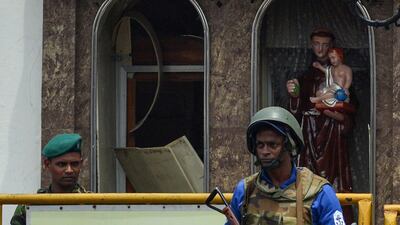
Sri Lankan security personnel keep watch outside St Anthony's Shrine in Kochchikade in Colombo. AFP -
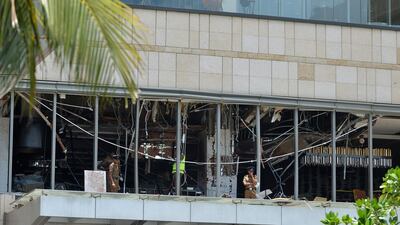
Sri Lankan police stand at the site of an explosion in a restaurant area of the Shangri-La Hotel. AFP -

A fire engine at the scene of the Shangri-la Hotel blast. AFP -
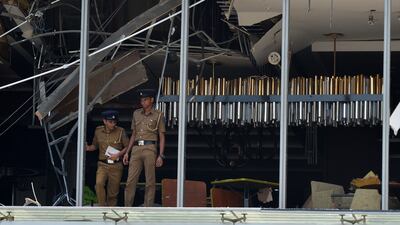
Sri Lankan police inspect the Shangri-la Hotel blast. AFP -
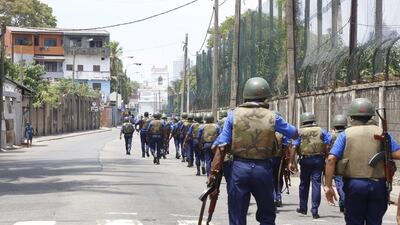
Armed policemen patrol the area near St Anthony's Shrine. EPA -
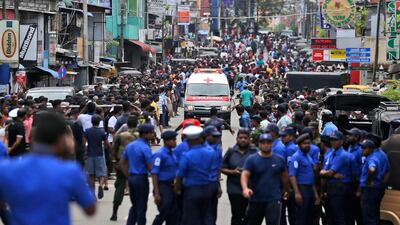
Sri Lankan police officers clear the road for an ambulance. AP -
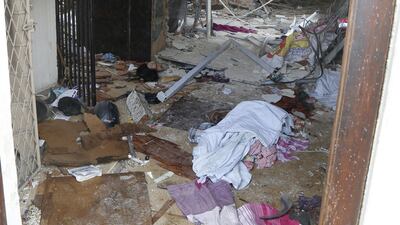
A general interior view showing damages after an explosion hit at St Anthony's Shrine. EPA -
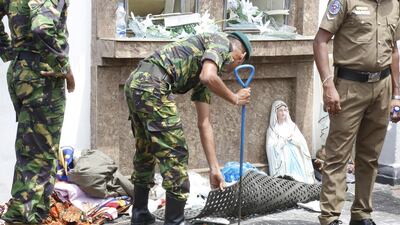
Security personal inspect the site after a explosion hit at St Anthony's Shrine in Kochchikade, Colombo. EPA -

Ambulances wait outside St Anthony's Shrine. Derana TV/via Reuters -
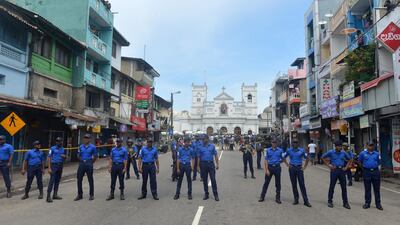
Sri Lankan security personnel keep watch. AFP -
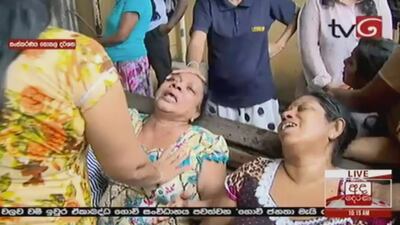
This image made from video, released by Derena TV shows women in despair after an explosion in Colombo, Sunday. Derena TV via AP -
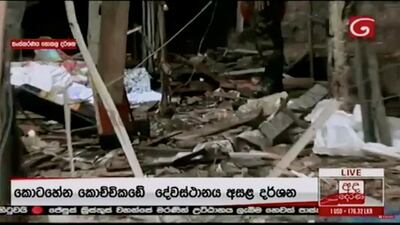
Debris is seen at St Anthony's Shrine. Derana TV/via Reuters -
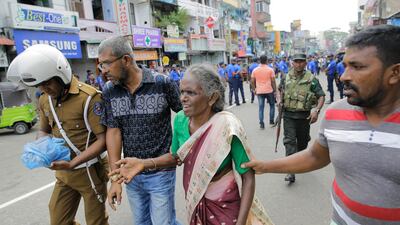
An elderly woman is helped away from the scene of a bombing. AP -
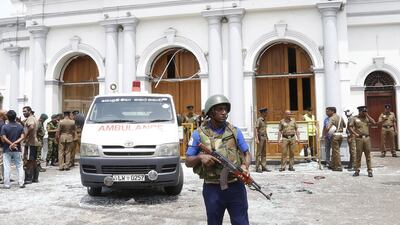
Security personal stand guard. EPA -
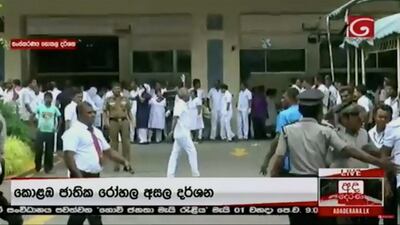
A crowd waits at a hospital. Derana TV/via Reuters -
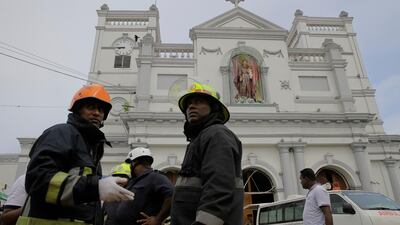
Sri Lankan firefighters stand in the area around St Anthony's Shrine. AP -

Ambulances are seen outside the church premises after a blast at the St Anthony's Shrine in Kochchikade, Colombo. AFP -
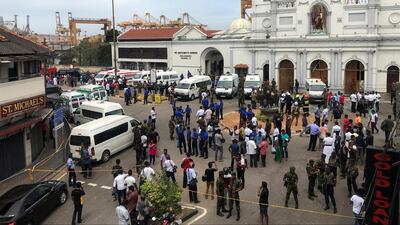
Ambulances are seen outside the church premises after a blast at the St Anthony's Shrine in Kochchikade, Colombo. Reuters -
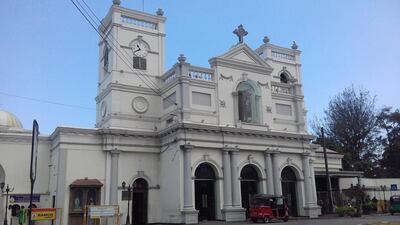
St. Anthony's Shrine, Kochchikade, Colombo, Sri Lanka -

Sri Lankan Army soldiers secure the area around a church after a blast in Colombo, Sri Lanka. AP -
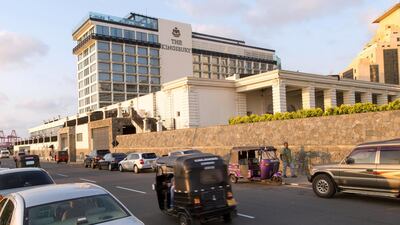
The Kingsbury Hotel building in central Colombo was targeted -
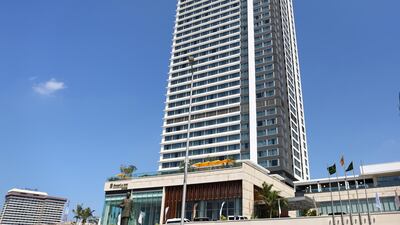
A general view of the Shangri- La hotel in Colombo. Alamy -
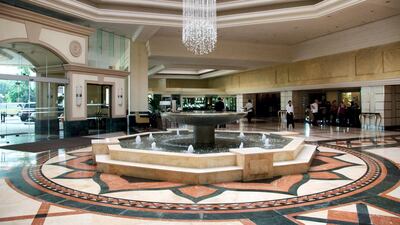
Foyer of Cinnamon Grand Hotel Colombo Sri Lanka. Alamy -

Sri Lankan military officials stand guard in front of the St. Anthony's Shrine, Kochchikade church after an explosion in Colombo, Sri Lanka. Reuters -
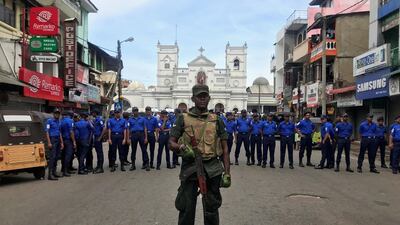
Sri Lankan military officials stand guard in front of the St Anthony's Church. Reuters


Defence Minister Ruwan Wijewardena said he believed police and military forces had identified the perpetrators of the blasts and that those "involved in this unfortunate terrorist incident will be taken into custody as soon as possible".
There was no immediate claim of responsibility but the government said eight people had been arrested and investigators would look into whether the attackers had "overseas links".
But after the violence, it was not just Christian communities feeling afraid.
“We haven't experienced anything like this in the past 10 years," said Rucki Fernando, a Christian Sri Lankan.
"There is a lot of fear, not just in the Christian community, but among everyone."
Gamini Francis, a longtime hotel worker, said: "After so many years we've started again. A lot of people are going to lose their jobs – 100 per cent sure.
"It's tragic. Crazy people killing innocent people."
Condolences poured in from around the world.
“Terrorists are those who betray worshippers in their places of worship, plant fear in their hearts and try to ignite religious conflicts in societies,” said Sheikh Mohammed bin Rashid, Vice President of the UAE and Ruler of Dubai.
He expressed his condolences to the people of Sri Lanka, “to the world and to everyone who works tirelessly towards tolerance and coexistence".
Pope Francis described the attack as "cruel violence" as he made his Easter Sunday message to tens of thousands of people in St Peter's Square in Rome.
"I wish to express my affectionate closeness to the Christian community, hit while it was gathered in prayer, and to all the victims of such cruel violence.”
UN Secretary General Antonio Guterres expressed outrage at the attacks.
His spokesman, Stephane Dujarric, said that Mr Guterres “commends the leadership demonstrated by the authorities and unity of the people of Sri Lanka in the wake of the attacks".

