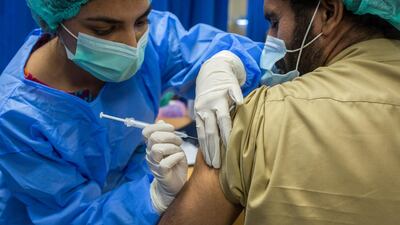
Pakistan has begun inoculating its huge population against the coronavirus just two days after it received its first consignment of vaccine as a gift from China.
The world's fifth most populous nation became the latest to start vaccinations as parts of the country are still battered by its second wave of infections.
While many rich countries have secured and ordered enough doses to protect their populations many times over, Pakistan began its own campaign having secured only a fraction of what it may eventually need.
Officials have warned of a far slower introduction than the campaigns in Europe, as the country will at first be largely reliant on donations and aid to secure Covid-19 shots, in what is likely to be mirrored around the developing world.
Half a million doses of the Chinese Sinopharm vaccine, which has not yet been fully approved by China's health authorities, began arriving by military planes on Monday.
Health workers began receiving shots across the country on Wednesday morning.
Dr Faisal Sultan, special health adviser to Pakistani Prime Minister Imran Khan, told The National before the campaign that the arrival of the vaccine brought "relief, happiness and satisfaction".
“We are happy that something that is important is here," Dr Sultan said. "We can start to protect our frontline workers and then, of course, from there on."
-
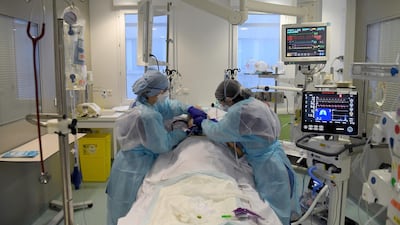
Nurses attend to a Covid-19 patient in the respiratory distress and severe infections unit of the Hopital Nord in Marseille, south-east France. AFP -

A woman plays the violin as a tribute to Captain Sir Tom Moore is displayed in Piccadilly Circus, London. The British Second World War veteran who entered the hearts of a nation in lockdown died after testing positive for Covid-19. He was 100. AP -
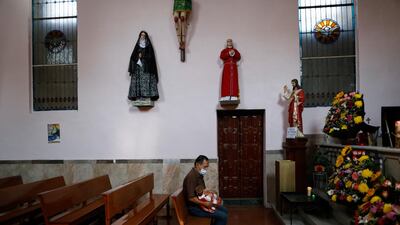
A man waits to have his Infant Jesus figure blessed with holy water at Purification of Our Lady of Candlemas Chapel in Mexico City. AP -

Peter Daszak and Thea Fischer, members of the World Health Organisation team investigating the origin of the coronavirus disease, arrive at Wuhan Institute of Virology in Wuhan, Hubei province, China. Reuters -
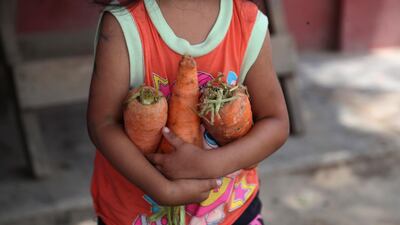
A child carries an armful of carrots to her mother who is helping prepare lunch at a soup kitchen in the Villa Maria slum of Lima, Peru, as the country battles a resurgence in Covid-19 cases. AP -
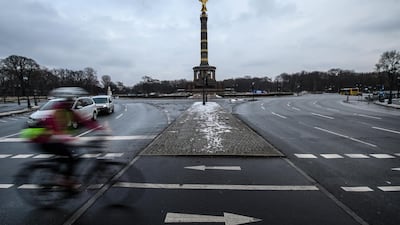
A cyclist crosses the nearly empty streets at the Victory Column in Berlin, Germany. EPA -
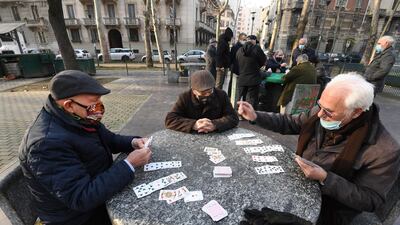
Elderly people wearing face masks play cards in a small park in Milan, northern Italy. EPA -
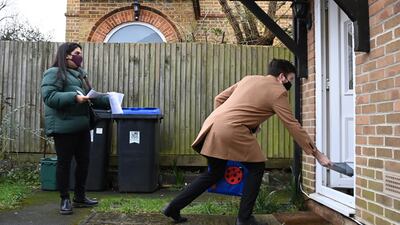
Volunteers go door-to-door delivering Covid-19 home test kits in Woking, Britain. EPA


Pakistan has recorded more than half a million cases and nearly 12,000 deaths in a population of more than 220 million. Limited testing suggests true figures are likely to be much higher.
The country has also been offered 17 million doses of the Oxford-AstraZeneca vaccine in its first shipment from the UN-backed Covax scheme to ensure poor countries have access.
Those two consignments should allow Pakistan to protect all of its health workers and its elderly, Dr Sultan said.
How much of the rest of the population is vaccinated and when will remain a “moving target”, he said.
Pakistan has a young population, with only about 100 million adults to vaccinate.
Only slightly more than 4 per cent are aged over 65, compared to nearly 19 per cent in the UK.
Dr Sultan estimated that vaccinating about 40 million Pakistanis by the end of the year would be a reasonable target, rising higher next year.
Health officials worry that any mass vaccination campaign may suffer from the long-standing suspicion of polio vaccine in some of the country.
Attempts to stamp out the crippling poliovirus have been undermined by conspiracy theories that vaccines are a plot to sterilise Muslims.
Dr Mohsin Ali, a doctor counselling patients in Pakistani clinical trials for another Chinese vaccine, said many of the volunteers confessed to similar misconceptions when they signed up for the experiment.
Dr Ali said that without a strong government message behind the campaign, it would fall prey to the same rumours.
“I can see it," he said. "If we don't do anything about it, I can see it as clear as day.”

