
Nato will continue to support Afghanistan’s security forces even after the planned withdrawal this year of the alliance’s 9,600 troops.
A civilian presence in the capital Kabul will be maintained to provide advice to security institutions, Nato Secretary General Jens Stoltenberg said on Tuesday.
Mr Stoltenberg spoke after an online meeting of Nato foreign ministers in which they discussed the alliance's future role in Afghanistan.
“We are ending our military mission in Afghanistan but we will continue to provide support to the Afghans,” he said.
Mr Stoltenberg said Nato members were committed to decisions they made when announcing the alliance’s military withdrawal from the country after almost 20 years.
“We will also help to support the Afghan security forces by now working on how we can provide out-of-country training, especially for the Afghan special operation forces," he said.
“We are working on how we can support critical infrastructure, including the continued running of the international airport.
"This is of course important for Nato and Nato civilian staff in Kabul, but also overall for the larger international community.”
Last month, Nato said it would withdraw its forces from Afghanistan this year, despite fears that the Taliban could regain power.
The talks on Tuesday also looked at how Nato could strengthen its collective defence and protect vital infrastructure.
“We also discussed concrete ways to sharpen our technological edge and prevent technological gaps among allies,” Mr Stoltenberg said.
-
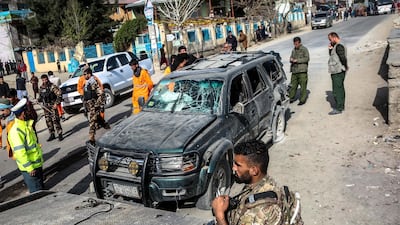
Security officials gather in the aftermath of a bomb explosion in Kabul, Afghanistan, on 18 March 2021. At least four people were killed and eleven others injured after a magnetic improvised explosive device (IED), targeting a minibus carrying employees of the Ministry of Communication and Information Technology, went off in Kabul. Hedayatullah Amid / EPA -
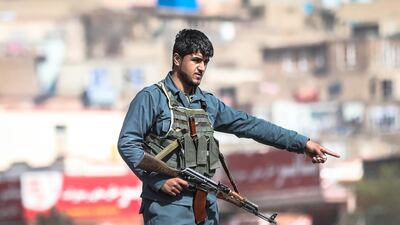
An Afghan security official inspects the scene in the aftermath of a bomb explosion in Kabul, Afghanistan, on 18 March 2021. Hedayatullah Amid / EPA -
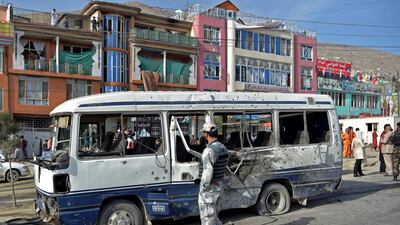
A security worker is seen near a damaged vehicle after a blast in Kabul on March 18, 2021. Wakil Kohsar / AFP -
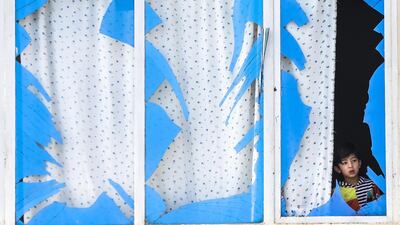
A boy looks out of a shattered window in the aftermath of a bomb explosion in Kabul, Afghanistan, on 18 March 2021. Hedayatullah Amid / EPA -
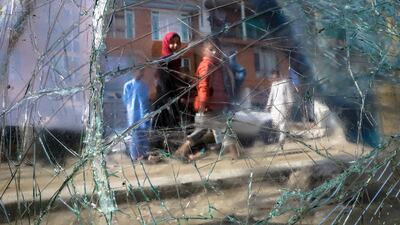
People are seen through a broken car window in the aftermath of a bomb explosion in Kabul, Afghanistan, on 18 March 2021. Hedayatullah Amid / EPA -
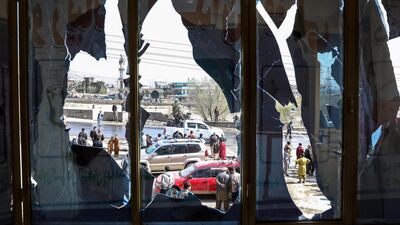
Shattered windows in the aftermath of a bomb explosion in Kabul, Afghanistan, on 18 March 2021. Hedayatullah Amid / EPA -
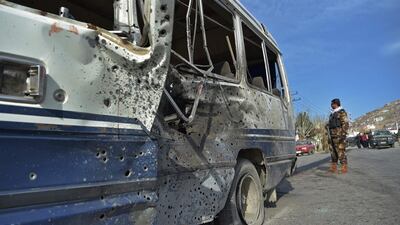
A security worker is seen near a damaged vehicle after a blast in Kabul on March 18, 2021. Wakil Kohsar / AFP -
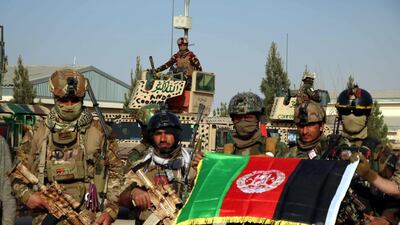
Afghan security officials pose in the Karokh district of Herat after suspected Taliban militants were killed in an attack on Pashtan Dam in Afghanistan on 16 March 2021. At least three Afghan soldiers and eight Taliban militants were killed in the incident. Jalil Rezayee / EPA -
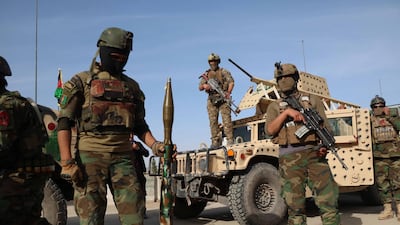
Afghan security officials pose in the Karokh district of Herat, Afghanistan, on 16 March 2021. EPA


He said that Nato members were "considering a defence innovation accelerator – a new centre to foster greater co-operation among allies on technology, underpinned with extra funding from nations that decide to participate”.
Mr Stoltenberg said there was a broad agreement that “additional resources” were needed to tackle the challenges in a more “unpredictable” and “contested world”.
Nato has a “historic opportunity” to strengthen the transatlantic relationship, he said.
US President Joe Biden has sought to rebuild ties with Nato and the EU after four tumultuous years under former president Donald Trump, who was often critical of the alliance and member states.
“Of course, spending together is a way to invest in the bond between Europe and North America,” Mr Stoltenberg said, as he urged member states to increase funding.
"Nato brings Europe and North America together every day."
The Pentagon's Central Command, responsible for operations in Afghanistan and the Middle East, said on Tuesday that it had already completed up to 44 per cent of the US withdrawal.
Mr Biden has set September 11 as the deadline for all US personnel to be out of Afghanistan, officially ending America's longest war, which began soon after the 9-11 attacks in 2001.
Mr Stoltenberg also commented on Nato’s serious concern about developments in Belarus, where a dissident journalist was detained last month after his Ryanair flight was forced to make an emergency landing in Minsk.
Belarus’s main opposition leader says the journalist, Roman Protasevich, has been tortured in jail.

“We have strongly condemned the serious violation of Belarus of the norms of international civil aviation and the fundamental right of the freedom to the speech, and I welcome sanctions by Nato allies and the European Union,” Mr Stoltenberg said.
On Wednesday, the Nato chief will head to London for talks with UK Prime Minister Boris Johnson and Foreign Secretary Dominic Raab.

