A team of 10 Nepalese climbers who became the first to scale the world's second-highest peak during the harsh winter season received a hero's welcome upon returning home in Nepal on Tuesday.
Mountaineers, supporters, friends and family lined the Kathmandu airport to greet the climbers with garlands and cheers as a police band played tunes. They were then driven around city in open trucks.
The team felt honoured, said Nirmal Purja, one of the members of the team who also holds the record for the fastest climb of the 14 highest peaks in the world.
-

Nirmal "Nims Purja, Dawa Tenji Sherpa (team MG), Mingma G, Dawa Temba Sherpa and Pem Chiri Sherpa, Mingma David Sherpa, Mingma Tenzi Sherpa, Nimsdai Purja and Gelje Sherpa are seen during the prayer ceremony before their winter attempt on K2 in Pakistan. Reuters -
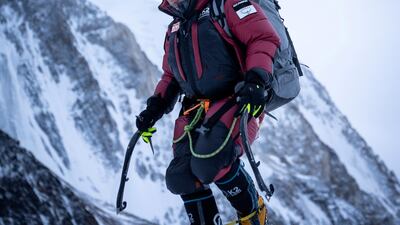
Nirmal Purja is seen before the winter attempt on K2, Pakistan. Reuters -
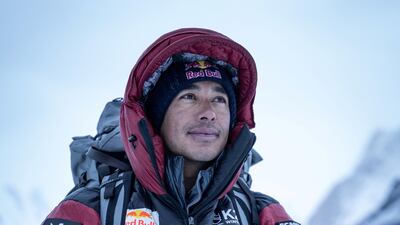
Nirmal Purja, a former Gurkha and who served in the British special forces, said his Nepali climbing team set out "to make the impossible possible". Reuters -

The Concordia camping site in front of K2 summit in the Karakoram range of Pakistan's mountain northern Gilgit region. AFP -
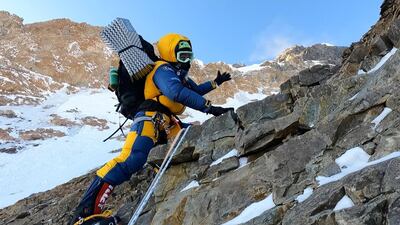
Polish climber Magdalena Gorzkowska attempts to climb the K2 mountain in winter, in Pakistan. Handout via REUTERS -
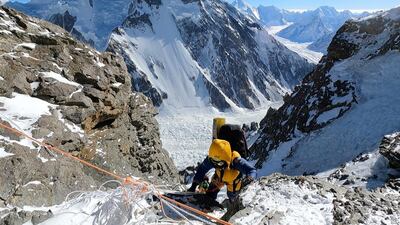
Polish climber Magdalena Gorzkowska attempts to climb the K2 mountain in winter, in Pakistan in this undated photo. Handout via REUTERS -

Dutch mountaineer Arnold Coster and Chhang Dawa Sherpa, Nepali expedition manager and team leader of the winter expedition to K2 peak as dozens of mountaineers converge on Pakistan's mighty K2 peak vying to conquer one of the world's last major climbing challenges -- reaching the summit in winter. AFP
The winter climb marks another achievement for Nepalese climbers who for decades worked as porters and guides for foreign mountaineers but now are setting their own records and running expeditions on the highest peaks.
K2 is the most prominent peak on the Pakistani side of the Himalayan range, and is second in height only to Mount Everest.
K2 had remained the last peak above 8,000 metres in the world that was yet to be climbed in the winter.
The Nepalese team made sure that all 10 members reached the summit at the same time.
"All 10 of us worked together in the same level. We all took a big risk to our lives. We felt like it has to be justice for every team member," Mr Purja said.

Whiile you're here
Damien McElroy: Anti-science attitudes in America are proving lethal
Editorial: What makes the UAE such a good place to test vaccines?
Editorial: The fight against Covid-19 should be guided by science
UK-EU trade at a glance
EU fishing vessels guaranteed access to UK waters for 12 years
Co-operation on security initiatives and procurement of defence products
Youth experience scheme to work, study or volunteer in UK and EU countries
Smoother border management with use of e-gates
Cutting red tape on import and export of food
Ten tax points to be aware of in 2026
1. Domestic VAT refund amendments: request your refund within five years
If a business does not apply for the refund on time, they lose their credit.
2. E-invoicing in the UAE
Businesses should continue preparing for the implementation of e-invoicing in the UAE, with 2026 a preparation and transition period ahead of phased mandatory adoption.
3. More tax audits
Tax authorities are increasingly using data already available across multiple filings to identify audit risks.
4. More beneficial VAT and excise tax penalty regime
Tax disputes are expected to become more frequent and more structured, with clearer administrative objection and appeal processes. The UAE has adopted a new penalty regime for VAT and excise disputes, which now mirrors the penalty regime for corporate tax.
5. Greater emphasis on statutory audit
There is a greater need for the accuracy of financial statements. The International Financial Reporting Standards standards need to be strictly adhered to and, as a result, the quality of the audits will need to increase.
6. Further transfer pricing enforcement
Transfer pricing enforcement, which refers to the practice of establishing prices for internal transactions between related entities, is expected to broaden in scope. The UAE will shortly open the possibility to negotiate advance pricing agreements, or essentially rulings for transfer pricing purposes.
7. Limited time periods for audits
Recent amendments also introduce a default five-year limitation period for tax audits and assessments, subject to specific statutory exceptions. While the standard audit and assessment period is five years, this may be extended to up to 15 years in cases involving fraud or tax evasion.
8. Pillar 2 implementation
Many multinational groups will begin to feel the practical effect of the Domestic Minimum Top-Up Tax (DMTT), the UAE's implementation of the OECD’s global minimum tax under Pillar 2. While the rules apply for financial years starting on or after January 1, 2025, it is 2026 that marks the transition to an operational phase.
9. Reduced compliance obligations for imported goods and services
Businesses that apply the reverse-charge mechanism for VAT purposes in the UAE may benefit from reduced compliance obligations.
10. Substance and CbC reporting focus
Tax authorities are expected to continue strengthening the enforcement of economic substance and Country-by-Country (CbC) reporting frameworks. In the UAE, these regimes are increasingly being used as risk-assessment tools, providing tax authorities with a comprehensive view of multinational groups’ global footprints and enabling them to assess whether profits are aligned with real economic activity.
Contributed by Thomas Vanhee and Hend Rashwan, Aurifer
House-hunting
Top 10 locations for inquiries from US house hunters, according to Rightmove
- Edinburgh, Scotland
- Westminster, London
- Camden, London
- Glasgow, Scotland
- Islington, London
- Kensington and Chelsea, London
- Highlands, Scotland
- Argyll and Bute, Scotland
- Fife, Scotland
- Tower Hamlets, London
What are NFTs?
Are non-fungible tokens a currency, asset, or a licensing instrument? Arnab Das, global market strategist EMEA at Invesco, says they are mix of all of three.
You can buy, hold and use NFTs just like US dollars and Bitcoins. “They can appreciate in value and even produce cash flows.”
However, while money is fungible, NFTs are not. “One Bitcoin, dollar, euro or dirham is largely indistinguishable from the next. Nothing ties a dollar bill to a particular owner, for example. Nor does it tie you to to any goods, services or assets you bought with that currency. In contrast, NFTs confer specific ownership,” Mr Das says.
This makes NFTs closer to a piece of intellectual property such as a work of art or licence, as you can claim royalties or profit by exchanging it at a higher value later, Mr Das says. “They could provide a sustainable income stream.”
This income will depend on future demand and use, which makes NFTs difficult to value. “However, there is a credible use case for many forms of intellectual property, notably art, songs, videos,” Mr Das says.
Mercer, the investment consulting arm of US services company Marsh & McLennan, expects its wealth division to at least double its assets under management (AUM) in the Middle East as wealth in the region continues to grow despite economic headwinds, a company official said.
Mercer Wealth, which globally has $160 billion in AUM, plans to boost its AUM in the region to $2-$3bn in the next 2-3 years from the present $1bn, said Yasir AbuShaban, a Dubai-based principal with Mercer Wealth.
“Within the next two to three years, we are looking at reaching $2 to $3 billion as a conservative estimate and we do see an opportunity to do so,” said Mr AbuShaban.
Mercer does not directly make investments, but allocates clients’ money they have discretion to, to professional asset managers. They also provide advice to clients.
“We have buying power. We can negotiate on their (client’s) behalf with asset managers to provide them lower fees than they otherwise would have to get on their own,” he added.
Mercer Wealth’s clients include sovereign wealth funds, family offices, and insurance companies among others.
From its office in Dubai, Mercer also looks after Africa, India and Turkey, where they also see opportunity for growth.
Wealth creation in Middle East and Africa (MEA) grew 8.5 per cent to $8.1 trillion last year from $7.5tn in 2015, higher than last year’s global average of 6 per cent and the second-highest growth in a region after Asia-Pacific which grew 9.9 per cent, according to consultancy Boston Consulting Group (BCG). In the region, where wealth grew just 1.9 per cent in 2015 compared with 2014, a pickup in oil prices has helped in wealth generation.
BCG is forecasting MEA wealth will rise to $12tn by 2021, growing at an annual average of 8 per cent.
Drivers of wealth generation in the region will be split evenly between new wealth creation and growth of performance of existing assets, according to BCG.
Another general trend in the region is clients’ looking for a comprehensive approach to investing, according to Mr AbuShaban.
“Institutional investors or some of the families are seeing a slowdown in the available capital they have to invest and in that sense they are looking at optimizing the way they manage their portfolios and making sure they are not investing haphazardly and different parts of their investment are working together,” said Mr AbuShaban.
Some clients also have a higher appetite for risk, given the low interest-rate environment that does not provide enough yield for some institutional investors. These clients are keen to invest in illiquid assets, such as private equity and infrastructure.
“What we have seen is a desire for higher returns in what has been a low-return environment specifically in various fixed income or bonds,” he said.
“In this environment, we have seen a de facto increase in the risk that clients are taking in things like illiquid investments, private equity investments, infrastructure and private debt, those kind of investments were higher illiquidity results in incrementally higher returns.”
The Abu Dhabi Investment Authority, one of the largest sovereign wealth funds, said in its 2016 report that has gradually increased its exposure in direct private equity and private credit transactions, mainly in Asian markets and especially in China and India. The authority’s private equity department focused on structured equities owing to “their defensive characteristics.”
Key facilities
- Olympic-size swimming pool with a split bulkhead for multi-use configurations, including water polo and 50m/25m training lanes
- Premier League-standard football pitch
- 400m Olympic running track
- NBA-spec basketball court with auditorium
- 600-seat auditorium
- Spaces for historical and cultural exploration
- An elevated football field that doubles as a helipad
- Specialist robotics and science laboratories
- AR and VR-enabled learning centres
- Disruption Lab and Research Centre for developing entrepreneurial skills
Tomorrow 2021
The%20stats%20and%20facts
GOLF’S RAHMBO
- 5 wins in 22 months as pro
- Three wins in past 10 starts
- 45 pro starts worldwide: 5 wins, 17 top 5s
- Ranked 551th in world on debut, now No 4 (was No 2 earlier this year)
- 5th player in last 30 years to win 3 European Tour and 2 PGA Tour titles before age 24 (Woods, Garcia, McIlroy, Spieth)
Ultra processed foods
- Carbonated drinks, sweet or savoury packaged snacks, confectionery, mass-produced packaged breads and buns
- margarines and spreads; cookies, biscuits, pastries, cakes, and cake mixes, breakfast cereals, cereal and energy bars;
- energy drinks, milk drinks, fruit yoghurts and fruit drinks, cocoa drinks, meat and chicken extracts and instant sauces
- infant formulas and follow-on milks, health and slimming products such as powdered or fortified meal and dish substitutes,
- many ready-to-heat products including pre-prepared pies and pasta and pizza dishes, poultry and fish nuggets and sticks, sausages, burgers, hot dogs, and other reconstituted meat products, powdered and packaged instant soups, noodles and desserts.
The National Archives, Abu Dhabi
Founded over 50 years ago, the National Archives collects valuable historical material relating to the UAE, and is the oldest and richest archive relating to the Arabian Gulf.
Much of the material can be viewed on line at the Arabian Gulf Digital Archive - https://www.agda.ae/en

