South Korean health authorities have found more evidence that people who tested positive for Covid-19 again after being given the all-clear have not been reinfected.
Last month, dozens of patients who had recovered from the illness later tested positive again.
Doctors worried that some people who survived Covid-19 could become sick with it a second time, complicating efforts to lift quarantine restrictions and produce a vaccine.
But after weeks of research, they now say that such test results appear to be "false positives" caused by lingering, but probably not infectious, bits of the virus.
South Korea reported more than 350 such cases as of Wednesday, the Korea Centres for Disease Control and Prevention said.
What is happening?
-
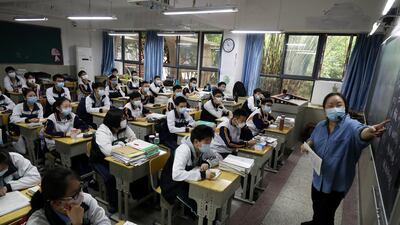
A teacher and senior high school pupils wearing face masks are seen inside a classroom on their first day of returning to school in Wuhan, Hubei province, China. Reuters -

Senior pupils enter a high school in Wuhan in China's central Hubei province. AFP -
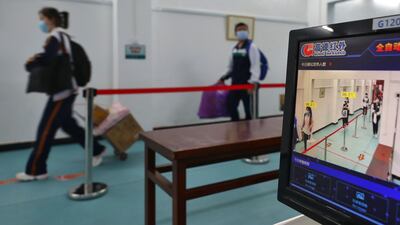
Pupils walk past a temperature-monitoring camera as they enter a high school in Wuhan in China's central Hubei province. AFP -
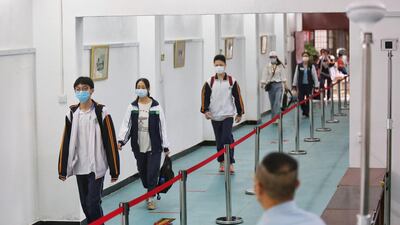
Pupils arrive at a high school in Wuhan in China's central Hubei province. AFP -
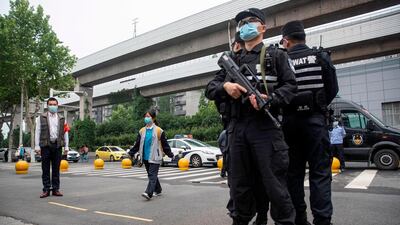
Police officers stand guard at an entrance of a high school as senior pupils enter school in Wuhan in China's central Hubei province. AFP -

President Donald Trump holds up a chart on global coronavirus disease testing as he sits in front of coronavirus testing machines and their boxes that he brought with him from Washington for his visit to a Honeywell manufacturing plant in Phoenix, Arizona. Reuters -

US President Donald Trump tours a Honeywell International Inc. factory producing N95 masks in Phoenix, Arizona. AFP -
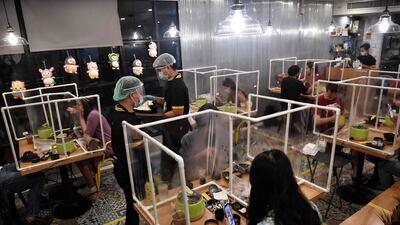
People eat in between plastic partitions, set up in an effort to contain COVID-19 at the Penguin Eat Shabu hotpot restaurant in Bangkok. AFP -

A milkman pours milk into a pot before delivering to their customers in Rawalpindi. AFP -

A Fiumicino airport employee wearing a "Smart-Helmet" portable thermoscanner to screen passengers and staff for COVID-19, scans a fellow airport staff at boarding gates at Rome's Fiumicino airport. AFP -
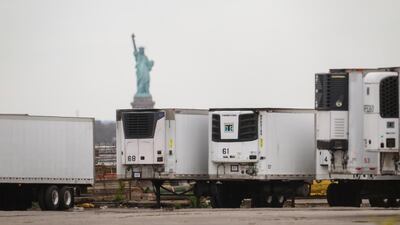
Refrigerated tractor trailers used to store bodies of deceased people are seen at a temporary morgue in the Brooklyn borough of New York City. Reuters -
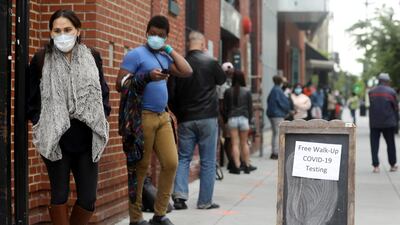
People keep a social distance in Washington. Reuters -
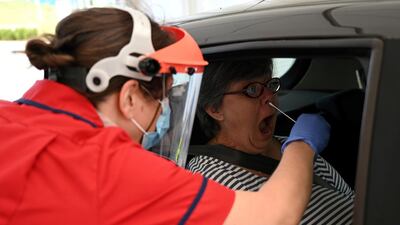
Clinical staff wear Personal Protective Equipment (PPE) in Cambridge, Britain. Reuters -
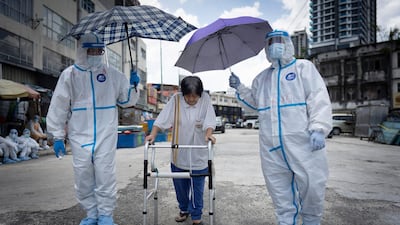
Health officials escort an elderly women back home after she had a coronavirus test at a wet market in Kuala Lumpur, Malaysia. AP Photo -
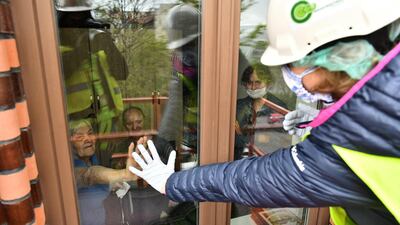
Family members and relatives greet their loved ones through a window in a social care centre in Wroclaw, southwestern Poland. EPA


As more and more South Koreans were released from treatment for Covid-19, authorities discovered a disturbing trend. Some ostensibly cured patients were later testing positive.
While officials examined several possible explanations, including reinfection of patients or reactivation of the virus, an expert panel convened by the government concluded last week that the most likely explanation was that the tests were returning false positives.
South Korea uses reverse transcription-polymerase chain reaction tests, which detect the coronavirus's genetic material.
The process can quickly return results and is considered the most accurate way to find out if a patient is infected.
But in some cases, the tests may detect old particles of the virus, which may no longer pose a significant threat to the patient or others, said Seol Dai-wu, an expert in vaccine development at Seoul's Chung-Ang University.
"The machine cannot distinguish an infectious viral particle versus a non-infectious virus particle, as the test simply detects any viral component," Mr Seol said.
This false-positive result is probably behind the cases of recovered patients testing positive again, the Korean centre says.
Authorities are still gathering evidence to support their theory that the particles are from "dead" virus cells, centre director Jeong Eun-kyeong said on Wednesday.
The patients were retested after they exhibited new respiratory symptoms or were selected by authorities.
Less than half of those retested by mid-April were showing symptoms, the centre said.
But authorities now say it is unlikely that those symptoms were caused by the coronavirus.
Are the patients still infectious?
Patients who tested positive for the new coronavirus after recovering from Covid-19 do not appear to be infectious.
The centre has not found one case where such patients passed the coronavirus to another person, Ms Jeong said.
When investigating people who appear to suffer a relapse of symptoms after recovering, the centre takes cultures of the virus, which takes more than two weeks before reliable results become evident.
All 29 completed culture tests as of Wednesday had come back negative. At least 79 are being processed.
"The virus in the relapse cases have little to no infectiousness," Ms Jeong said.
Oh Myoung-don, a doctor at Seoul National University Hospital who is leading the panel of experts investigating the cases, said unlike hepatitis B or HIV, coronavirus does not infiltrate the host cell's nucleus.
That means it does not cause chronic infection and chances of it reactivating are very low, Dr Oh said at a briefing last week.
Authorities are also conducting tests to detect the presence of antibodies that may have developed to fight the virus.
They are testing and monitoring people who came into contact with the patients.

