Khalil, 20, stands in the school building he constructed three years ago in Afghanistan's Kandahar province. Stefanie Glinski for The National

Between conflict and Covid-19, education takes a back seat in Afghanistan


  • English
  • Arabic

The high school in Passab village, in Afghanistan’s Kandahar province, first had to close its doors after being caught in crossfire shortly after the US-led invasion in 2001.

Its buildings were destroyed, its classrooms looted.

It reopened weeks after but for more than a decade pupils gathered amid the rubble, studying in flimsy tents or under the scorching sun.

Then three years ago a pupil, 17, decided to rebuild the entire school.

Khalil, now 20, was fed up with the old tents that barely provided shelter from either sun or rain, and that many children had to stay at home because their parents did not want to send them to such a temporary set-up.

“I knew that something needed to change, so I approached my classmates and told them I wanted to build a proper school," Khalil says. "They were immediately on board.”

With no funds available, he had to be creative. He borrowed a tractor from his father, a vegetable farmer, and told teachers and students that everyone’s help was necessary.

“And that’s how it started,” Khalil smiles. “We had no engineers and none of us had ever built anything, but with parents and teachers helping it quickly became a community project.

"In the mornings we’d study and in the afternoons we built our school.”

Even with new functioning buildings, however, the school could not avoid Covid-19 restrictions. It is one of many that are closed to pupils while the pandemic rages.

Afghanistan officially had about 40,000 confirmed coronavirus cases but with limited testing available, numbers are thought to be much higher.

A survey conducted by the Ministry of Public Health analysing antibodies found that up to 10 million Afghans probably had the virus.

Acting Health Minister Ahmad Osmani said the survey showed 31.5 per cent of the population had been infected and recovered.

Education activists have taken to social media, decrying a public school system that has been gutted by conflict and coronavirus, and asking for schools to open again immediately.

Private, tuition-based schools have long reopened since being closed in March to prevent the spread of the disease, and even senior high school pupils at public institutions returned to class.

But millions of children remain affected by large-scale school closures and it is feared that many will not return to class at all.

The Afghan government announced this week that schools throughout the country should open in October but obstacles remain.

Afghanistan’s schools were in crisis before the pandemic, with the number of studying children falling in many provinces as conflict escalated and donor funding ended, a Human Rights Watch report found.

“Now things are even worse,” said Heather Barr, the group's co-director for women’s rights.

“With only 30 per cent of women and 55 per cent of men literate, many parents cannot help their children to study.”

Even before the pandemic, an estimated 3.7 million children across Afghanistan’s 34 provinces were out of school, Unicef said, with girls from lower-income families at risk of being married off.

The Ministry of Education reported that at least 7,000 schools still did not have a building.

And with most of Afghanistan’s funding being spend on defence, little is left for repairing classrooms that are destroyed by extreme weather, a lack of maintenance and the war.

But Passab’s high school is an example of the kind of Afghan spirit that can be witnessed throughout the country.

With the government offering few services, people are willing to invest and make sacrifices to build their country.

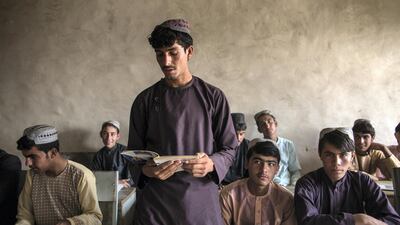
Male students at the school building Khalil constructed three years ago in Afghanistan's Kandahar province. Stefanie Glinski for The National

After the destruction, a mere 180 pupils, most of them boys, gathered amid the rubble, determined to study anyway.

Today the school has expanded to 850 children studying in 11 brick classrooms.

The school, about 30 minutes’ drive from Kandahar’s provincial capital in southern Afghanistan, is painted white with the colours of the Afghan flag lining each classroom’s door frame.

Each room is equipped with desks and benches, and the pupils even dug a borehole for access to clean water.

With the new classrooms opening three years ago, pupil numbers peaked and teachers decided to offer two sessions – one in the morning and one in the afternoon.

The school is due to reopen after its enforced Covid-19 closure but challenges remain.

“Students have barely attended classes this year and in a few months the weather will be too cold once again for children to sit in a classroom," said education activist Freshta Karim, who has been pushing for the reopening of schools

"The government most probably doesn’t have enough budget to heat schools. Besides that, who will the government compensate for the lost months?”

Ms Karim said she remained optimistic nonetheless.

“It’s an achievement to have public schools reopened,” she said.

While the pandemic continues to affect people throughout Afghanistan, life has returned to normal, with neither restrictions nor lockdowns enforced.

That is one of the reasons why private schools, not reliant on government funding, opened their doors a long time ago.

"This has created divisions between students from well-off families and students depending on the public education sector," Ms Karim told The National.

While short televised lessons were regularly broadcast throughout the country over the past months, many children remain without TVs at home.

As the Taliban and the Afghan government meet in Doha for a first round of direct negotiations, pupils hope that any future power-sharing deal would consider the importance of education.

“We’ve long needed peace in Afghanistan but education is at the heart of it," Khalid says.

"It’s the key. If every child in this country would be able to attend and finish school, we will see a bright future.”


Arabian Gulf League fixtures:

Friday:

  • Emirates v Hatta, 5.15pm
  • Al Wahda v Al Dhafra, 5.25pm
  • Al Ain v Shabab Al Ahli Dubai, 8.15pm

Saturday:

  • Dibba v Ajman, 5.15pm
  • Sharjah v Al Wasl, 5.20pm
  • Al Jazira v Al Nasr, 8.15pm
Analysis

Members of Syria's Alawite minority community face threat in their heartland after one of the deadliest days in country’s recent history. Read more

Turkish Ladies

Various artists, Sony Music Turkey 

Labour dispute

The insured employee may still file an ILOE claim even if a labour dispute is ongoing post termination, but the insurer may suspend or reject payment, until the courts resolve the dispute, especially if the reason for termination is contested. The outcome of the labour court proceedings can directly affect eligibility.


- Abdullah Ishnaneh, Partner, BSA Law 

Gulf Under 19s final

Dubai College A 50-12 Dubai College B

RESULTS

5pm: Sheikh Mansour bin Zayed Al Nahyan Racing Festival Purebred Arabian Cup Conditions (PA) Dh 200,000 (Turf) 1,600m
Winner: Hameem, Adrie de Vries (jockey), Abdallah Al Hammadi (trainer)
5.30pm: Sheikha Fatima bint Mubarak Cup Conditions (PA) Dh 200,000 (T) 1,600m
Winner: Winked, Connor Beasley, Abdallah Al Hammadi
6pm: Sheikh Sultan bin Zayed Al Nahyan National Day Cup Listed (TB) Dh 380,000 (T) 1,600m
Winner: Boerhan, Ryan Curatolo, Nicholas Bachalard
6.30pm: Sheikh Sultan bin Zayed Al Nahyan National Day Group 3 (PA) Dh 500,000 (T) 1,600m
Winner: AF Alwajel, Tadhg O’Shea, Ernst Oertel
7pm: Sheikh Sultan bin Zayed Al Nahyan National Day Jewel Crown Group 1 (PA) Dh 5,000,000 (T) 2,200m
Winner: Messi, Pat Dobbs, Timo Keersmaekers
7.30pm: Sheikh Mansour bin Zayed Al Nahyan Racing Festival Handicap (PA) Dh 150,000 (T) 1,400m
Winner: Harrab, Ryan Curatolo, Jean de Roualle
8pm: Wathba Stallions Cup Handicap (PA) Dh 100,000 (T) 1,400m
Winner: AF Alareeq, Connor Beasley, Ahmed Al Mehairbi

Heather, the Totality
Matthew Weiner,
Canongate 

So what is Spicy Chickenjoy?

Just as McDonald’s has the Big Mac, Jollibee has Spicy Chickenjoy – a piece of fried chicken that’s crispy and spicy on the outside and comes with a side of spaghetti, all covered in tomato sauce and topped with sausage slices and ground beef. It sounds like a recipe that a child would come up with, but perhaps that’s the point – a flavourbomb combination of cheap comfort foods. Chickenjoy is Jollibee’s best-selling product in every country in which it has a presence.
 

Know before you go
  • Jebel Akhdar is a two-hour drive from Muscat airport or a six-hour drive from Dubai. It’s impossible to visit by car unless you have a 4x4. Phone ahead to the hotel to arrange a transfer.
  • If you’re driving, make sure your insurance covers Oman.
  • By air: Budget airlines Air Arabia, Flydubai and SalamAir offer direct routes to Muscat from the UAE.
  • Tourists from the Emirates (UAE nationals not included) must apply for an Omani visa online before arrival at evisa.rop.gov.om. The process typically takes several days.
  • Flash floods are probable due to the terrain and a lack of drainage. Always check the weather before venturing into any canyons or other remote areas and identify a plan of escape that includes high ground, shelter and parking where your car won’t be overtaken by sudden downpours.


The specs

Engine: 4.0-litre V8 twin-turbocharged and three electric motors

Power: Combined output 920hp

Torque: 730Nm at 4,000-7,000rpm

Transmission: 8-speed dual-clutch automatic

Fuel consumption: 11.2L/100km

On sale: Now, deliveries expected later in 2025

Price: expected to start at Dh1,432,000

Specs

Engine: Dual-motor all-wheel-drive electric

Range: Up to 610km

Power: 905hp

Torque: 985Nm

Price: From Dh439,000

Available: Now

Gully Boy

Director: Zoya Akhtar
Producer: Excel Entertainment & Tiger Baby
Cast: Ranveer Singh, Alia Bhatt, Kalki Koechlin, Siddhant Chaturvedi​​​​​​​
Rating: 4/5 stars

Company%20Profile
%3Cp%3E%3Cstrong%3EName%3A%3C%2Fstrong%3E%20Ovasave%3Cbr%3E%3Cstrong%3EStarted%3A%3C%2Fstrong%3E%20November%202022%3Cbr%3E%3Cstrong%3EFounders%3A%3C%2Fstrong%3E%20Majd%20Abu%20Zant%20and%20Torkia%20Mahloul%3Cbr%3E%3Cstrong%3EBased%3A%3C%2Fstrong%3E%20Abu%20Dhabi%3Cbr%3E%3Cstrong%3ESector%3A%3C%2Fstrong%3E%20Healthtech%3Cbr%3E%3Cstrong%3ENumber%20of%20staff%3A%3C%2Fstrong%3E%20Three%20employees%3Cbr%3E%3Cstrong%3EInvestment%20stage%3A%3C%2Fstrong%3E%20Pre-seed%3Cbr%3E%3Cstrong%3EInvestment%3A%3C%2Fstrong%3E%20%24400%2C000%3C%2Fp%3E%0A
RESULTS

5pm: Maiden (PA) Dh80,000 1,400m
Winner: JAP Almahfuz, Fernando Jara (jockey), Irfan Ellahi (trainer).

5.30pm: Handicap (PA) Dh90,000 1,400m​​​​​​​
Winner: AF Momtaz, Antonio Fresu, Musabah Al Muhairi.

6pm: Handicap (TB) Dh100,000 1,400m​​​​​​​
Winner: Yaalail, Fernando Jara, Ali Rashid Al Raihe.

6.30pm: Abu Dhabi Championship Listed (PA) Dh180,000 1,600m​​​​​​​
Winner: Ihtesham, Szczepan Mazur, Ibrahim Al Hadhrami.

7pm: Wathba Stallions Cup Handicap (PA) Dh70,000 1,600m​​​​​​​
Winner: Dahess D’Arabie, Fernando Jara, Helal Al Alawi.

7.30pm: Maiden (PA) Dh80,000 2.200m
​​​​​​​Winner: Ezz Al Rawasi, Connor Beasley, Helal Al Alawi.

Armies of Sand

By Kenneth Pollack (Oxford University Press)
 

Jetour T1 specs

Engine: 2-litre turbocharged

Power: 254hp

Torque: 390Nm

Price: From Dh126,000

Available: Now

Getting there
Flydubai flies direct from Dubai to Tbilisi from Dh1,025 return including taxes

The biog

Born: near Sialkot, Pakistan, 1981

Profession: Driver

Family: wife, son (11), daughter (8)

Favourite drink: chai karak

Favourite place in Dubai: The neighbourhood of Khawaneej. “When I see the old houses over there, near the date palms, I can be reminded of my old times. If I don’t go down I cannot recall my old times.”

The Vile

Starring: Bdoor Mohammad, Jasem Alkharraz, Iman Tarik, Sarah Taibah

Director: Majid Al Ansari

Rating: 4/5

Ten tax points to be aware of in 2026

1. Domestic VAT refund amendments: request your refund within five years

If a business does not apply for the refund on time, they lose their credit.

2. E-invoicing in the UAE

Businesses should continue preparing for the implementation of e-invoicing in the UAE, with 2026 a preparation and transition period ahead of phased mandatory adoption. 

3. More tax audits

Tax authorities are increasingly using data already available across multiple filings to identify audit risks. 

4. More beneficial VAT and excise tax penalty regime

Tax disputes are expected to become more frequent and more structured, with clearer administrative objection and appeal processes. The UAE has adopted a new penalty regime for VAT and excise disputes, which now mirrors the penalty regime for corporate tax.

5. Greater emphasis on statutory audit

There is a greater need for the accuracy of financial statements. The International Financial Reporting Standards standards need to be strictly adhered to and, as a result, the quality of the audits will need to increase.

6. Further transfer pricing enforcement

Transfer pricing enforcement, which refers to the practice of establishing prices for internal transactions between related entities, is expected to broaden in scope. The UAE will shortly open the possibility to negotiate advance pricing agreements, or essentially rulings for transfer pricing purposes. 

7. Limited time periods for audits

Recent amendments also introduce a default five-year limitation period for tax audits and assessments, subject to specific statutory exceptions. While the standard audit and assessment period is five years, this may be extended to up to 15 years in cases involving fraud or tax evasion. 

8. Pillar 2 implementation 

Many multinational groups will begin to feel the practical effect of the Domestic Minimum Top-Up Tax (DMTT), the UAE's implementation of the OECD’s global minimum tax under Pillar 2. While the rules apply for financial years starting on or after January 1, 2025, it is 2026 that marks the transition to an operational phase.

9. Reduced compliance obligations for imported goods and services

Businesses that apply the reverse-charge mechanism for VAT purposes in the UAE may benefit from reduced compliance obligations. 

10. Substance and CbC reporting focus

Tax authorities are expected to continue strengthening the enforcement of economic substance and Country-by-Country (CbC) reporting frameworks. In the UAE, these regimes are increasingly being used as risk-assessment tools, providing tax authorities with a comprehensive view of multinational groups’ global footprints and enabling them to assess whether profits are aligned with real economic activity. 

Contributed by Thomas Vanhee and Hend Rashwan, Aurifer

UNpaid bills:

Countries with largest unpaid bill for UN budget in 2019

USA – $1.055 billion

Brazil – $143 million

Argentina – $52 million

Mexico – $36 million

Iran – $27 million

Israel – $18 million

Venezuela – $17 million

Korea – $10 million

Countries with largest unpaid bill for UN peacekeeping operations in 2019

USA – $2.38 billion

Brazil – $287 million

Spain – $110 million

France – $103 million

Ukraine – $100 million


Yuki Means Happiness
Alison Jean Lester
John Murray