Pakistan army chief Gen Asim Munir attends a ceremony in Islamabad on November 1, 2022. AP Photo

Protests in Pakistan after inconclusive election result


  • English
  • Arabic

The head of Pakistan's armed forces called for “political maturity and unity” on Saturday after independent candidates backed by jailed former prime minister Imran Khan won the most seats after his party was barred from taking part.

Independents won 100 of the 245 seats contested in the lower house of Parliament, according to provisional results declared by the election commission on Friday.

The Pakistan Muslim League-Nawaz (PML-N) led by former prime minister Nawaz Sharif, considered to be the army's favoured candidate, emerged as the biggest party with 71 seats.

Aleema Khan, Mr Khan's sister, said that seats that should have rightfully been won by Mr Khan's Pakistan Tehreek-e-Insaaf (PTI) had been "stolen," and called the results a "revolution" against the government.

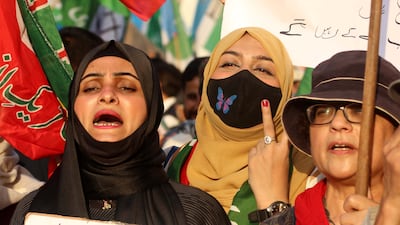
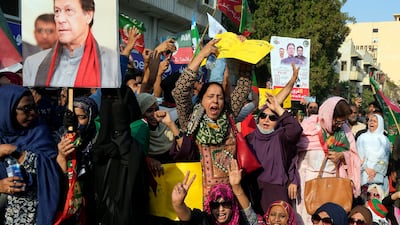
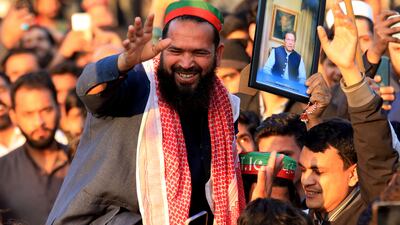
Hundreds of Mr Khan's supporters rallied in the northwestern city of Peshawar led by two of his aides who said they had been declared losers despite having won the polls.

Mr Sharif has said that the PML-N would hold talks with other parties including the Pakistan People's Party (PPP), which won 54 seats, on forming a coalition government.

Nawaz Sharif, leader of the Pakistan Muslim League-Nawaz, addresses supporters in Lahore as votes in the general election were counted on Friday night. EPA

“Pakistan’s diverse polity and pluralism will be well-represented by a unified government of all democratic forces imbibed with national purpose,” army chief Gen Asim Munir said in a message of congratulations to all concerned.

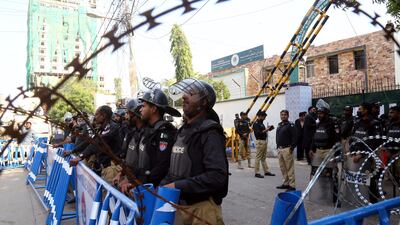
The vote for parliament and four provincial assemblies on Thursday followed an election campaign marred by violence and was held amid an economic crisis and deep political polarisation after Khan was convicted in three cases a week earlier and his PTI party barred from having members contest under its symbol, the cricket bat.

Pakistan now needs “stable hands and a healing touch to move on from the politics of anarchy and polarisation which does not suit a progressive country of 250 million”, Gen Munir said.

Mr Sharif and Khan both declared victory as the provisional results emerged on Friday.

Gen Munir called on political parties and their supporters to “rise above self-interests and synergise efforts in governing and serving the people”.

“As the people of Pakistan have reposed their combined trust in the Constitution of Pakistan, it is now incumbent upon all political parties to reciprocate the same with political maturity and unity.”

The US, Britain and the European Union on Friday expressed concerns about the conduct of the election.

Mobile phone services were suspended before polling began in what authorities said was a security measure, while the election commission cited an “internet issue” for a delay in results being announced.

In response on Saturday, Pakistan's Foreign Ministry said it was surprised by the “negative tone” of statements on the general election issued by “certain countries and organisations”.

These statements “neither take into account the complexity of the electoral process, nor acknowledge the free and enthusiastic exercise of the right to vote by tens of millions of Pakistanis”, it said.


Three trading apps to try

Sharad Nair recommends three investment apps for UAE residents:

  • For beginners or people who want to start investing with limited capital, Mr Nair suggests eToro. “The low fees and low minimum balance requirements make the platform more accessible,” he says. “The user interface is straightforward to understand and operate, while its social element may help ease beginners into the idea of investing money by looking to a virtual community.”
  • If you’re an experienced investor, and have $10,000 or more to invest, consider Saxo Bank. “Saxo Bank offers a more comprehensive trading platform with advanced features and insight for more experienced users. It offers a more personalised approach to opening and operating an account on their platform,” he says.
  • Finally, StashAway could work for those who want a hands-off approach to their investing. “It removes one of the biggest challenges for novice traders: picking the securities in their portfolio,” Mr Nair says. “A goal-based approach or view towards investing can help motivate residents who may usually shy away from investment platforms.”

Mercer, the investment consulting arm of US services company Marsh & McLennan, expects its wealth division to at least double its assets under management (AUM) in the Middle East as wealth in the region continues to grow despite economic headwinds, a company official said.

Mercer Wealth, which globally has $160 billion in AUM, plans to boost its AUM in the region to $2-$3bn in the next 2-3 years from the present $1bn, said Yasir AbuShaban, a Dubai-based principal with Mercer Wealth.

Within the next two to three years, we are looking at reaching $2 to $3 billion as a conservative estimate and we do see an opportunity to do so,” said Mr AbuShaban.

Mercer does not directly make investments, but allocates clients’ money they have discretion to, to professional asset managers. They also provide advice to clients.

“We have buying power. We can negotiate on their (client’s) behalf with asset managers to provide them lower fees than they otherwise would have to get on their own,” he added.

Mercer Wealth’s clients include sovereign wealth funds, family offices, and insurance companies among others.

From its office in Dubai, Mercer also looks after Africa, India and Turkey, where they also see opportunity for growth.

Wealth creation in Middle East and Africa (MEA) grew 8.5 per cent to $8.1 trillion last year from $7.5tn in 2015, higher than last year’s global average of 6 per cent and the second-highest growth in a region after Asia-Pacific which grew 9.9 per cent, according to consultancy Boston Consulting Group (BCG). In the region, where wealth grew just 1.9 per cent in 2015 compared with 2014, a pickup in oil prices has helped in wealth generation.

BCG is forecasting MEA wealth will rise to $12tn by 2021, growing at an annual average of 8 per cent.

Drivers of wealth generation in the region will be split evenly between new wealth creation and growth of performance of existing assets, according to BCG.

Another general trend in the region is clients’ looking for a comprehensive approach to investing, according to Mr AbuShaban.

“Institutional investors or some of the families are seeing a slowdown in the available capital they have to invest and in that sense they are looking at optimizing the way they manage their portfolios and making sure they are not investing haphazardly and different parts of their investment are working together,” said Mr AbuShaban.

Some clients also have a higher appetite for risk, given the low interest-rate environment that does not provide enough yield for some institutional investors. These clients are keen to invest in illiquid assets, such as private equity and infrastructure.

“What we have seen is a desire for higher returns in what has been a low-return environment specifically in various fixed income or bonds,” he said.

“In this environment, we have seen a de facto increase in the risk that clients are taking in things like illiquid investments, private equity investments, infrastructure and private debt, those kind of investments were higher illiquidity results in incrementally higher returns.”

The Abu Dhabi Investment Authority, one of the largest sovereign wealth funds, said in its 2016 report that has gradually increased its exposure in direct private equity and private credit transactions, mainly in Asian markets and especially in China and India. The authority’s private equity department focused on structured equities owing to “their defensive characteristics.”

Updated: February 11, 2024, 11:58 AM