

Chinese authorities announced that they are easing nationwide Covid-19 rules, the first set of widespread reforms to its zero-Covid policy since rare protests erupted late last month.
Proof of a negative Covid test will no longer be required for entry to public places, with the exception of schools, nurseries and care facilities for the elderly, the National Health Commission announced on Wednesday.
Asymptomatic cases and people with mild symptoms will be allowed to quarantine at home.
The scope and frequency of testing for the coronavirus will also be reduced, and people travelling between provinces will no longer need to show evidence of a negative test or test on arrival.
Local authorities across the country have eased several restrictions after protests against the zero-Covid policy, which has dramatically slowed international trade with the country as the rest of the world opens up, while damaging the local economy. China said the policy was necessary due to low vaccination rates among the elderly. The government is launching a new vaccination drive to protect vulnerable citizens.
Residents in Beijing no longer have to show a negative test to enter shops and offices, authorities said on Tuesday. Similar measures were introduced at the capital's international airports.
Lockdowns can now be limited to specific apartment floors and residential buildings, the commission said on Wednesday — a drastic reversal of the snap shutdowns that have left entire neighbourhoods and districts under lockdown, often at short notice.
The government announced last week it would speed up vaccinations for the elderly.
Vice Premier Sun Chunlan later said the country was in a new stage of the fight against Covid-19, as the Omicron variant weakens.
Fifty-three cities, home to nearly a third of China's population, still had some restrictions in place as of Monday, AFP reported, citing Japanese company Nomura.
Markets slumped as rare demonstrations surfaced at the end of November, including in Beijing and the financial hub of Shanghai.
Riot police clashed with protesters, who demanded an end to President Xi Jinping's stringent restrictions, which curtailed daily life and dealt a sharp blow to its economy.
Security forces, sent in large numbers to protest sites, clamped down on dissenters. Demonstrators told various media outlets they had been summoned to police stations and questioned over their whereabouts by authorities.
-
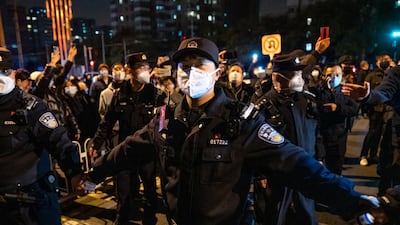
Police stand guard during a protest against Covid-19 restrictions, in China's capital Beijing. Bloomberg -
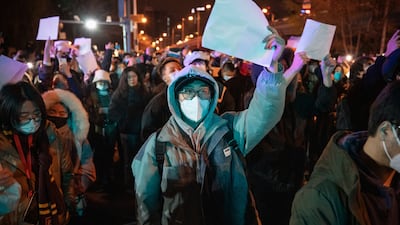
Demonstrators hold blank signs during a protest in Beijing, China. Bloomberg -
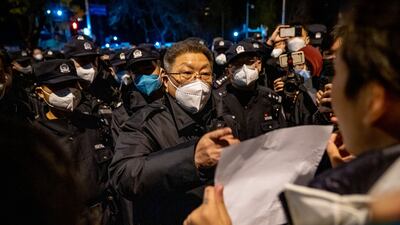
An official speaks with a demonstrator holding a blank sign, during a protest in Beijing. Bloomberg -
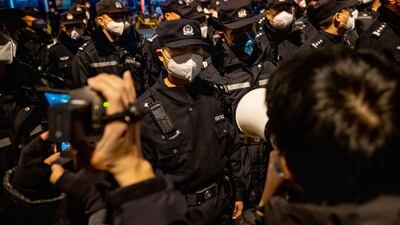
The death of at least 10 people in a fire in Urumqi, north-west China, which is under strict Covid restrictions, has led to protests nationwide. Bloomberg -
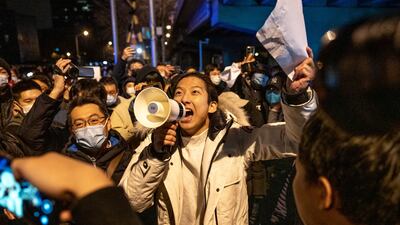
Demonstrators in Beijing. Protesters blame the deaths in Urumqi on strict Covid restrictions on leaving buildings. The authorities deny this. Bloomberg -
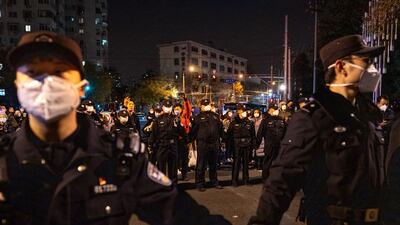
Police form a chain at Beijing protests. Demonstrations have also been reported in cities including, Shanghai, Nanjing, Chengdu, Lanzhou, Guangzhou and Wuhan – where Covid-19 was first reported. Bloomberg -
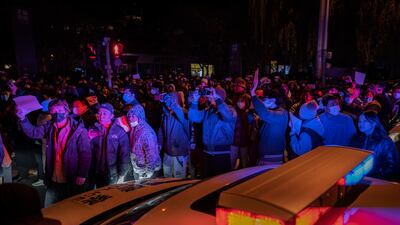
Protesters march past a police vehicle during a demonstration against China's strict zero-Covid measures, in Beijing. Getty -
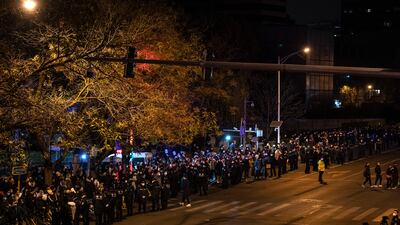
Protesters and police in Beijing. Chinese stocks fell over concerns about the impact of the demonstrations. Getty -

Demonstrators rally in Beijing. China reported more than 40,000 new cases of Covid-19 on Monday. AFP


Public anger boiled over after the death of 10 people in an apartment fire in the Xianjing city of Urumqi. Protesters said Covid restrictions had prevented building residents from escaping the blaze, a claim authorities denied.
Wednesday's announcement came hours after the government released further data showing the crippling economic effects of zero-Covid.
Imports and exports plunged in November to levels not seen since early 2020.
Imports in November fell 10.6 per cent year on year, the biggest drop since May 2020, according to the General Administration of Customs. Exports fell 8.7 per cent over the same period.
- With reporting from AFP

