• A family friend holds a photo frame of Cyrus Mistry, the former chairman of Tata Sons, after his cremation in Mumbai. AFP
    A family friend holds a photo frame of Cyrus Mistry, the former chairman of Tata Sons, after his cremation in Mumbai. AFP
  • Cyrus Mistry at a Tata Consultancy Services shareholders meeting in Mumbai. Mistry died in an accident after his car crashed into a road divider in western India. AP Photo
    Cyrus Mistry at a Tata Consultancy Services shareholders meeting in Mumbai. Mistry died in an accident after his car crashed into a road divider in western India. AP Photo
  • Simone Tata, centre, stepmother of Indian industrialist Ratan Tata, leaves after attending the funeral of Cyrus Mistry, in Mumbai. EPA
    Simone Tata, centre, stepmother of Indian industrialist Ratan Tata, leaves after attending the funeral of Cyrus Mistry, in Mumbai. EPA
  • Indian businessman Anil Ambani leaves after attending the Mistry's funeral. He died in a car crash while travelling to Mumbai from Ahmedabad. EPA
    Indian businessman Anil Ambani leaves after attending the Mistry's funeral. He died in a car crash while travelling to Mumbai from Ahmedabad. EPA
  • Subramaniam Ramadorai, former vice chairman of Tata Consultancy Services, attends the funeral. EPA
    Subramaniam Ramadorai, former vice chairman of Tata Consultancy Services, attends the funeral. EPA
  • A group of Parsis at Mistry's funeral. AP Photo
    A group of Parsis at Mistry's funeral. AP Photo
  • Mourners at the funeral in Mumbai. AP Photo
    Mourners at the funeral in Mumbai. AP Photo
  • Family and friends wait for their vehicles as they leave after attending the funeral of Cyrus Mistry, the former chairman of Tata Group, at a crematorium in Mumbai on September 6, 2022. (Photo by Punit PARANJPE / AFP)
    Family and friends wait for their vehicles as they leave after attending the funeral of Cyrus Mistry, the former chairman of Tata Group, at a crematorium in Mumbai on September 6, 2022. (Photo by Punit PARANJPE / AFP)
  • Mistry's death has put the spotlight on India's dismal road safety record and triggered an appeal for passengers to wear seat belts. AFP
    Mistry's death has put the spotlight on India's dismal road safety record and triggered an appeal for passengers to wear seat belts. AFP
  • The smashed car in which Mistry was travelling in Palghar district near Mumbai. The car crashed into a barrier on a bridge. AP Photo
    The smashed car in which Mistry was travelling in Palghar district near Mumbai. The car crashed into a barrier on a bridge. AP Photo
  • Mistry after attending a meeting at the company's head office in Mumbai, in 2016. EPA
    Mistry after attending a meeting at the company's head office in Mumbai, in 2016. EPA

Cyrus Mistry's death puts spotlight on India's dismal road safety record


Ramola Talwar Badam
  • English
  • Arabic

The death of former Tata Sons boss Cyrus Mistry has put the spotlight on India's dismal road safety record and triggered an appeal for passengers to wear seat belts.

The accident on Sunday afternoon killed Mr Mistry, 54, and friend Jehangir Pandole, who were in the back seat of a Mercedes sedan.

The driver, leading gynaecologist Dr Anahita Pandole, and her husband Darius Pandole, in the front seats, were critically injured when the car slammed into a concrete barrier of a bridge about 100 kilometres outside Mumbai.

A police report said speeding caused the accident and that both passengers in the rear were not buckled up.

India has 38 deaths per 100 crashes - more than anywhere else in the world
Piyush Tewari,
founder of SaveLIFE Foundation

The death of the billionaire businessman, whose family founded the construction group Shapoorji Pallonji, has stirred industry figures to pledge to rear seat belts.

India has a law that mandates all passengers to use seat belts — but many don't adhere to it.

Police can issue a fine of 1,000 rupees (Dh46/$12) to passengers not buckled up in the front but they do not tend to check passengers in the back.

India has just 1 per cent of the world's road vehicles but accounts for 11 per cent of global deaths from road accidents.

Dangers of failing to buckle up

Piyush Tewari, the founder of the SaveLIFE Foundation investigating the crash, said enforcement of traffic law and safety awareness is key.

“It’s unfortunate that it took such a tragic incident for the country to start focusing on the issue of road safety which otherwise kills 155,000 people each year or about 426 people every day,” Mr Tewari told The National.

“What caused the crash was a combination of over speeding that led to loss of control and interaction with an exposed concrete structure leading to a very serious crash taking place at a high speed.

“What led to deaths and injuries was the fact that the seat belts were not used by rear passengers.”

The non-government organisation conducts forensic investigations into road accidents for police across the country.

On Sunday, its team examined the accident involving Mr Mistry.

The speed limit on the bridge was 40 kph but few on highways and roads adhere to speed limits.

Mr Tewari spelt out the dangers of not buckling up at the back.

“If you are not belted at the back, the curtain airbag along the window is not going to save the passenger. The first thing that will happen is that their head will hit the roof — and the roof has no air bags,” he said.

“After that, their head will hit the front passenger who is also moving forward.

“Then they will move and front load the seat, as we call it, which will cause spinal injuries and fractures to the front seat passengers.”

Among the world's deadliest roads

Investigations carried out by SaveLIFE on Indian highways show that 30 per cent of fatalities were due to passengers not wearing seat belts in the back seats.

A 2019 survey conducted by the group covering more than 6,000 people in 11 Indian cities found only 7 per cent said they used the rear seat belt and only 27 per cent were aware of the law on seat-belt wearing in the back seats of cars.

As many as 91 per cent of people said they had never been stopped by police for not using rear seat belts.

The use of rear seat belts can prevent death by 25 per cent and injury by 75 per cent, according to the World Health Organisation.

Road traffic injuries claim more than 1.35 million lives each year globally, with the number of deaths high among low and middle-income countries.

Grim statistics from India reinforce the global fatality rate.

Family and friends attend the funeral of Cyrus Mistry on Tuesday. AFP

The World Bank last year said that although India had one per cent of the world’s vehicles, it accounted for 11 per cent of all road crash deaths, 53 road crashes every hour, and the death of one person every four minutes.

The country has the highest crash severity rate in the world, or the highest number of deaths per 100 crashes.

“India has 38 deaths per 100 crashes which is much more than what you might have in the US, Europe and among the other developing countries, so we definitely have deadlier roads than anywhere else in the world,” Mr Tewari said.

“More people are killed per 100 crashes than anywhere else in the world so that unfortunately pegs us at the very top when it comes to severity of road crashes.”

He said efforts were continuing to work with authorities to identify high fatality areas and reduce deaths using road engineering design, police enforcement, improved trauma care and user engagement.

Safety messaging that the lives of passengers in the back seats are as important as those in the front and rear seat belt reminders for all cars, not just luxury cars, will be important going forward.

His team of six forensic scientists and engineers have examined tread marks, pools of oil and blood at the site and will correlate injuries of the victims with a study of the car interior.

Road safety pledges

On Tuesday, hundreds attended the cremation of Mr Mistry in Mumbai.

Industry heads and friends of Mr Mistry have trained the spotlight on road safety.

Billionaire businessman Anand Mahindra said Mr Mistry was “destined for greatness” if his life had not snatched away.

“I resolve to always wear my seat belt even when in the rear seat of the car. And I urge all of you to take that pledge too. We all owe it to our families,” he said on Twitter.

Experts worry these are knee-jerk reactions.

Ashish Verma, a professor and convener of the Indian Institute of Sciences Sustainable Transportation Lab, said safety on all roads and not just national highways was essential.

We are always reactive, not proactive, that is the problem,” he said.

“A major overhaul is required. We concentrate on engineering aspects of highways but we are not doing enough on the human aspect.

“There must be education and systematic improvement in the driver licensing.

“Drivers should not just be taught to manoeuvre vehicles, we must create licensed drivers who are safe. That remains a big element.”

Road accidents in India — in pictures

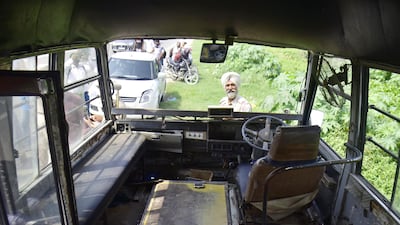
  • The wreckage of a school bus which collided with a car in Amritsar, India. The deadly crash happened in August 2021. Getty Images
    The wreckage of a school bus which collided with a car in Amritsar, India. The deadly crash happened in August 2021. Getty Images
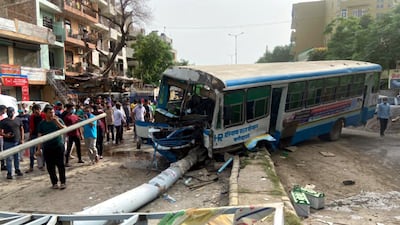
  • A bus crashed into a pole after its brakes failed in the Indian city of Gurugram. Getty Images
    A bus crashed into a pole after its brakes failed in the Indian city of Gurugram. Getty Images
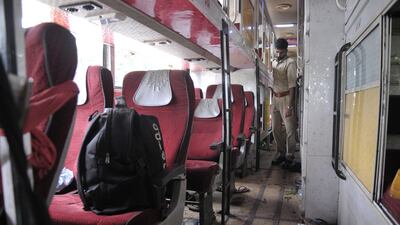
  • Indian police at the scene of an accident in which 18 were killed and 25 injured when a speeding truck rammed into an overcrowded double-decker bus in Barabanki. Getty Images
    Indian police at the scene of an accident in which 18 were killed and 25 injured when a speeding truck rammed into an overcrowded double-decker bus in Barabanki. Getty Images
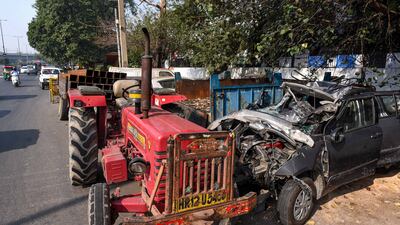
  • This car collided with a tractor in New Delhi. Getty Images
    This car collided with a tractor in New Delhi. Getty Images
  • The wreckage of a bus rammed by a speeding container lorry in Coimbatore district, Tamil Nadu. EPA
    The wreckage of a bus rammed by a speeding container lorry in Coimbatore district, Tamil Nadu. EPA
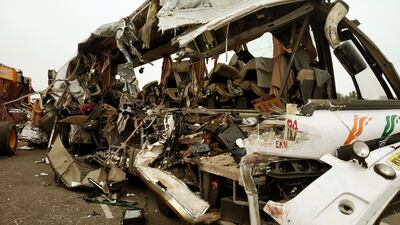
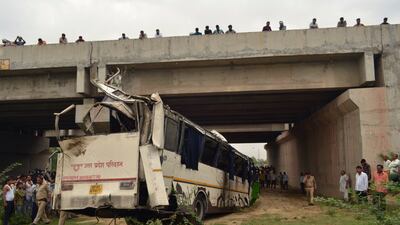
  • The crumpled remains of a bus that crashed on the Delhi-Agra motorway. AFP
    The crumpled remains of a bus that crashed on the Delhi-Agra motorway. AFP
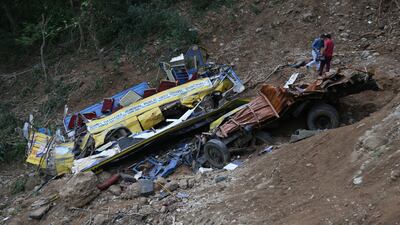
  • A school bus lies at the bottom of a gorge in Kangra district, Himachal Pradesh. EPA
    A school bus lies at the bottom of a gorge in Kangra district, Himachal Pradesh. EPA
How to come clean about financial infidelity
  • Be honest and transparent: It is always better to own up than be found out. Tell your partner everything they want to know. Show remorse. Inform them of the extent of the situation so they know what they are dealing with.
  • Work on yourself: Be honest with yourself and your partner and figure out why you did it. Don’t be ashamed to ask for professional help. 
  • Give it time: Like any breach of trust, it requires time to rebuild. So be consistent, communicate often and be patient with your partner and yourself.
  • Discuss your financial situation regularly: Ensure your spouse is involved in financial matters and decisions. Your ability to consistently follow through with what you say you are going to do when it comes to money can make all the difference in your partner’s willingness to trust you again.
  • Work on a plan to resolve the problem together: If there is a lot of debt, for example, create a budget and financial plan together and ensure your partner is fully informed, involved and supported. 

Carol Glynn, founder of Conscious Finance Coaching

How much do leading UAE’s UK curriculum schools charge for Year 6?
  1. Nord Anglia International School (Dubai) – Dh85,032
  2. Kings School Al Barsha (Dubai) – Dh71,905
  3. Brighton College Abu Dhabi - Dh68,560
  4. Jumeirah English Speaking School (Dubai) – Dh59,728
  5. Gems Wellington International School – Dubai Branch – Dh58,488
  6. The British School Al Khubairat (Abu Dhabi) - Dh54,170
  7. Dubai English Speaking School – Dh51,269

*Annual tuition fees covering the 2024/2025 academic year

Ten tax points to be aware of in 2026

1. Domestic VAT refund amendments: request your refund within five years

If a business does not apply for the refund on time, they lose their credit.

2. E-invoicing in the UAE

Businesses should continue preparing for the implementation of e-invoicing in the UAE, with 2026 a preparation and transition period ahead of phased mandatory adoption. 

3. More tax audits

Tax authorities are increasingly using data already available across multiple filings to identify audit risks. 

4. More beneficial VAT and excise tax penalty regime

Tax disputes are expected to become more frequent and more structured, with clearer administrative objection and appeal processes. The UAE has adopted a new penalty regime for VAT and excise disputes, which now mirrors the penalty regime for corporate tax.

5. Greater emphasis on statutory audit

There is a greater need for the accuracy of financial statements. The International Financial Reporting Standards standards need to be strictly adhered to and, as a result, the quality of the audits will need to increase.

6. Further transfer pricing enforcement

Transfer pricing enforcement, which refers to the practice of establishing prices for internal transactions between related entities, is expected to broaden in scope. The UAE will shortly open the possibility to negotiate advance pricing agreements, or essentially rulings for transfer pricing purposes. 

7. Limited time periods for audits

Recent amendments also introduce a default five-year limitation period for tax audits and assessments, subject to specific statutory exceptions. While the standard audit and assessment period is five years, this may be extended to up to 15 years in cases involving fraud or tax evasion. 

8. Pillar 2 implementation 

Many multinational groups will begin to feel the practical effect of the Domestic Minimum Top-Up Tax (DMTT), the UAE's implementation of the OECD’s global minimum tax under Pillar 2. While the rules apply for financial years starting on or after January 1, 2025, it is 2026 that marks the transition to an operational phase.

9. Reduced compliance obligations for imported goods and services

Businesses that apply the reverse-charge mechanism for VAT purposes in the UAE may benefit from reduced compliance obligations. 

10. Substance and CbC reporting focus

Tax authorities are expected to continue strengthening the enforcement of economic substance and Country-by-Country (CbC) reporting frameworks. In the UAE, these regimes are increasingly being used as risk-assessment tools, providing tax authorities with a comprehensive view of multinational groups’ global footprints and enabling them to assess whether profits are aligned with real economic activity. 

Contributed by Thomas Vanhee and Hend Rashwan, Aurifer

COMPANY%20PROFILE
%3Cp%3E%3Cstrong%3EName%3A%20%3C%2Fstrong%3ESmartCrowd%0D%3Cbr%3E%3Cstrong%3EStarted%3A%20%3C%2Fstrong%3E2018%0D%3Cbr%3E%3Cstrong%3EFounder%3A%20%3C%2Fstrong%3ESiddiq%20Farid%20and%20Musfique%20Ahmed%0D%3Cbr%3E%3Cstrong%3EBased%3A%20%3C%2Fstrong%3EDubai%0D%3Cbr%3E%3Cstrong%3ESector%3A%20%3C%2Fstrong%3EFinTech%20%2F%20PropTech%0D%3Cbr%3E%3Cstrong%3EInitial%20investment%3A%20%3C%2Fstrong%3E%24650%2C000%0D%3Cbr%3E%3Cstrong%3ECurrent%20number%20of%20staff%3A%3C%2Fstrong%3E%2035%0D%3Cbr%3E%3Cstrong%3EInvestment%20stage%3A%20%3C%2Fstrong%3ESeries%20A%0D%3Cbr%3E%3Cstrong%3EInvestors%3A%20%3C%2Fstrong%3EVarious%20institutional%20investors%20and%20notable%20angel%20investors%20(500%20MENA%2C%20Shurooq%2C%20Mada%2C%20Seedstar%2C%20Tricap)%3C%2Fp%3E%0A
Updated: September 06, 2022, 1:47 PM