


India has increased its commitments to reduce emissions and increase the use of green energy beyond the levels promised under the Paris Agreement in 2015.
The country is one of the fastest growing global economies and the third largest contributor of greenhouse gases after China and the United States.
The revisions to India's Nationally Determined Contributions (NDCs) to the UN Framework Convention on Climate Change were announced by the Environment Ministry on Wednesday.
Instead of aiming far a 33-35 per cent reduction in emissions intensity — defined as the amount of greenhouse gas emitted for every unit of GDP — by 2030, India will now try to bring this down by 45 per cent, the ministry said.
At the same time, New Delhi will act to to source about 50 per cent of it installed power capacity from non-fossil fuel-based energy resources.
-

-
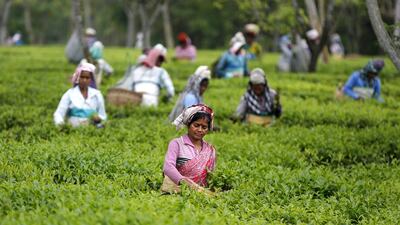
Workers pluck tea leaves inside Aideobarie tea estate. -

Freshly picked tea leaves are seen in the hand of a tea garden worker. -

A tea worker fills a bag with leaves inside the tea estate in Jorhat, Assam. -

A tea garden worker fills a basket with freshly picked tea leaves. -

Workers wearing jappi hats made out of bamboo and palm leaves wait for the rain to stop to resume their work. -
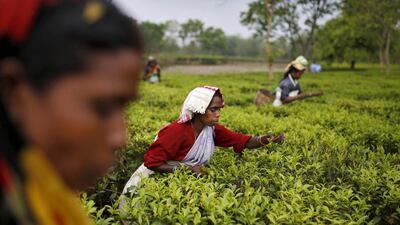
Female workers pick tea leaves inside Aideobarie tea estate in Jorhat, Assam. -
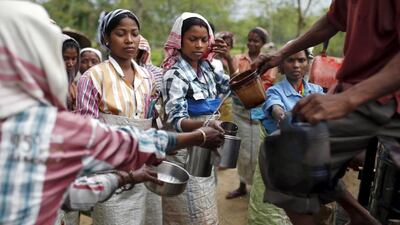
Workers collect drinking water during a break. -

A tea garden worker wearing a jappi hat is seen on the Aideobarie tea estate in Jorhat, Assam. -

Tea garden workers huddle under an umbrella as they wait for the rain to stop. -
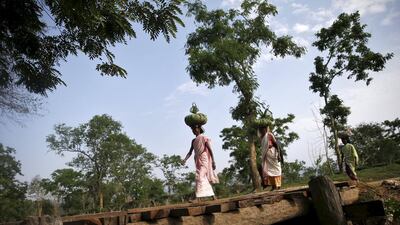
Workers carry tea leaves balanced on their heads after picking. -

Garden workers pick tea leaves inside Aideobarie tea estate in Jorhat, Assam -

Workers line-up to weigh tea leaves picked during the day at the estate. -

A tea garden worker smells a bunch of freshly picked tea leaves. -



The ministry said the new targets were an extension of Prime Minister Narendra Modi’s vision of “sustainable lifestyles and climate justice to protect the poor and vulnerable from adverse impacts of climate change”.
“The decision on enhanced NDCs demonstrates India’s commitment at the highest level for decoupling of economic growth from greenhouse gas emissions,” it said.
“India’s updated NDC also reaffirms our commitment to work towards a low carbon emission pathway, while simultaneously endeavouring to achieve sustainable development goals.”
The Paris Agreement of 2015 is a legally binding international treaty on climate change, seeking to limit global warming to below 2 degrees Celsius, compared to pre-industrial levels.
India, the world’s second most populous country, is under pressure to balance emissions reduction and investment in clean energy while striving to upgrade and expand infrastructure to meet the needs of 1.3 billion people.
Since 2015, India has installed 66 gigawatts of solar and wind capacity and can currently generate 110GW of electricity from these sources.
Similarly, India has cut 40 million tonnes of carbon dioxide emissions by promoting the use of energy-efficient LED bulbs.
At the COP26 climate talks held in Glasgow, Scotland, last November, Mr Modi announced that India would make a one billion-tonne reduction in projected emissions until 2030, and strive for net-zero emissions by 2070.
Indian Railways, one of the biggest rail networks in the world, will achieve a net-zero target by 2030, reducing 60 million tonnes of emissions annually, the Environment Ministry said.
India is investing in non-fossil resources to generate 50 per cent of its total energy requirements — 500 gigawatts — by the end of this decade.
The ministry said tax concessions and incentives for the adoption of renewable energy in industries would lead to an overall increase in green jobs.
It also plans to increase forest cover to create an additional carbon sink of 2.5 to 3 billion tonnes of carbon dioxide equivalent.
Avantika Goswami, climate change programme manager at the Centre for Science and Environment, a Delhi-based think tank, said the new commitments showed India's intention to work towards climate change goals.
“From a global standpoint, this is a step up in ambition for India, considering that it has a very small contribution to historical greenhouse gas emissions. It shows that India is committed to co-operating and decarbonising its economy, despite having to balance major developmental goals like poverty reduction,” Ms Goswami told The National.

