

The Myanmar military carried out mass killings of civilians which left at least 40 men dead in July, a BBC investigation has found.
Soldiers as young as 17 rounded up villagers before separating the men and killing them, witnesses and survivors told the BBC.
The killings took place in July in four separate incidents in Kani Township, an opposition stronghold in Sagaing District in central Myanmar.
The BBC said video and pictures it obtained appear to show many of the victims were tortured and buried in shallow graves. A military government representative did not deny the allegations.
The military has faced resistance from civilians since it seized control of the country in a February coup, deposing a democratically elected government led by Aung San Suu Kyi.
The BBC spoke to 11 witnesses in Kani and compared their accounts with mobile phone footage and photographs collected by Myanmar Witness, a UK-based NGO that investigates human rights abuses in the country.
The highest number of killings took place in Yin village, where at least 14 men were tortured or beaten to death and their bodies thrown in a forested gully. Witnesses in Yin, who were not named by the BBC, said the men were tied up with ropes and beaten before they were killed.
'Do your last rites'
"We couldn't stand to watch it so we kept our heads down, crying," said one woman, whose brother, nephew and brother-in-law were killed. "We begged them not to do it. They didn't care. They asked the women, 'Are your husbands among them? If they are, do your last rites'."
A man who managed to escape the killings said that soldiers inflicted horrifying abuse on the men for hours before they died.
"They were tied up, beaten with stones and rifle butts and tortured all day," the survivor said. "Some soldiers looked young, maybe 17 or 18, but some were really old. There was also a woman with them."
In nearby Zee Bin Dwin village, in late July, 12 mutilated bodies were found buried in shallow mass graves, including a small body, possibly a child, and the body of a disabled person. Some were mutilated.
The body of a man aged in his sixties was found tied to a plum tree nearby. Footage of his corpse, which the BBC said it had reviewed, showed clear signs of torture. His family said that his son and grandchild had fled when the military entered the village, but he had stayed, believing his age would protect him from harm.
The killings appeared to be a collective punishment for attacks on the military by civilian militia groups in the area, who are demanding that democracy be restored.
Myanmar streets deserted in 'silent strike' against coup - in pictures
-
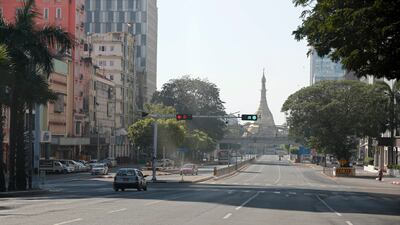
An almost-deserted street in Yangon, Myanmar's largest city. Activists had called on the public to take part in a silent strike on Friday. EPA -
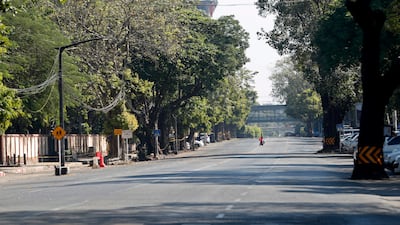
A woman crosses an empty street in downtown Yangon. For the silent strike, members of the public stayed at home and businesses closed from 10am to 4pm. EPA -

A church at the top of a deserted Yangon street. The silent strike is a protest against military rule, following a coup in February. EPA -
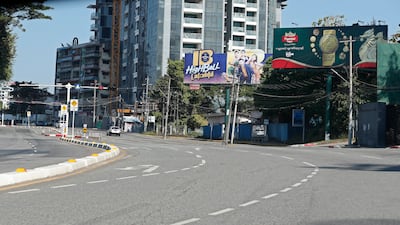
A taxi travels along an empty street in downtown Yangon. The military overthrew leader Aung San Suu Kyi and her government on February 1, triggering protests. EPA -

Military vehicles parked in downtown Yangon. On Monday, Ms Suu Kyi was sentenced to four years in prison – subsequently reduced to two years – after being convicted of the first of many charges she faces. EPA -
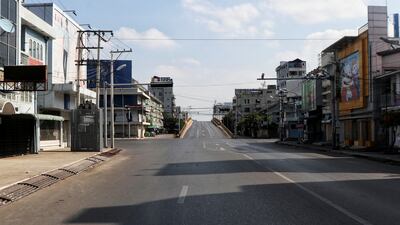
An almost empty road in Mandalay, central Myanmar. Social media posts indicated that the silent strike took place in a number of towns and cities. Reuters -
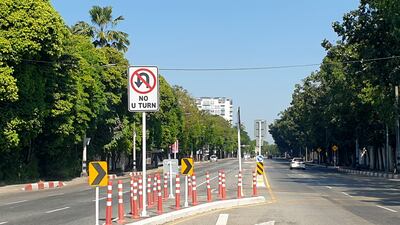
A car drives along an empty road in Yangon. On Sunday, five people were killed when security forces drove a car into an anti-coup protest in the city. EPA -
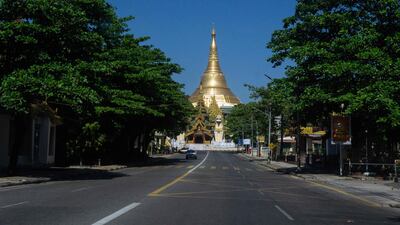
An empty street leading to the Shwedagon Pagoda in Yangon, during the silent strike. AFP -
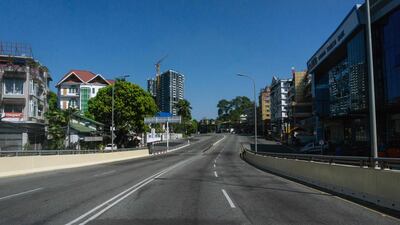
A deserted street in Yangon. Protests against the country's military are continuing despite the deaths of more than 1,300 people since the coup. AFP -
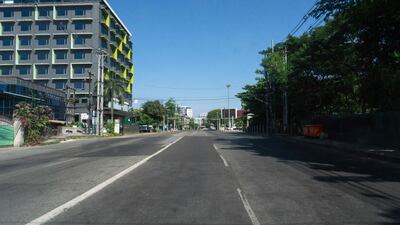
An empty street in Yangon. Myanmar's military has said it staged the coup because a November election won by Ms Suu Kyi's party was rigged. The country's election commission dismissed the claim. AFP -
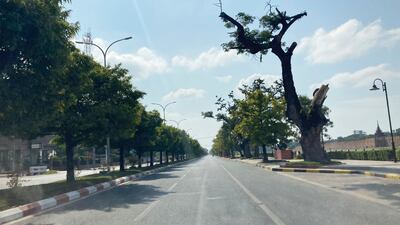
An empty street in Mandalay. The silent strike coincided with International Human Rights Day. AP -
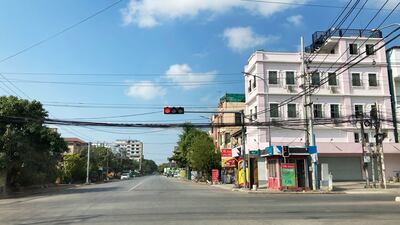
An deserted street in Mandalay. AP -
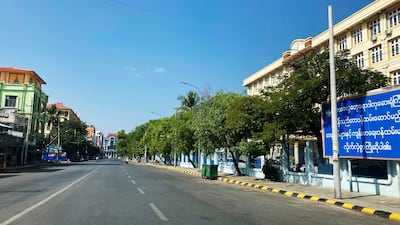
An empty street in Mandalay. A student activist from the General Strikes Collaboration Body protest group said participation in the silent strike had been widespread. AP


Fighting between the military and the local branches of the People's Defence Force, a collective name for civilian militia groups, had intensified in the area in the months before the mass killings, including clashes near Zee Bin Dwin.
The BBC said visual evidence and testimony it had gathered showed that men were specifically aimed at, fitting with a pattern observed across Myanmar in recent months of male villagers facing collective punishment for clashes between the People's Defence Forces and the military.
The families of those killed said that the men were not involved in attacks on the military. A woman who lost her brother in the Yin village massacre said she pleaded with the soldiers, telling them her brother "could not even handle a catapult".
She said a soldier replied, "Don't say anything. We are tired. We will kill you."
Foreign journalists have been barred from reporting in Myanmar since the coup, while most non-state media outlets have been shut down.
When asked about the BBC allegations, Myanmar's Deputy Minister for Information and military spokesperson General Zaw Min Tun did not deny soldiers had carried out the mass killings.
"It can happen," he said. "When they treat us as enemies, we have the right to defend ourselves."
The UN is investigating alleged human rights abuses carried out by the Myanmar military.

