



At Kabul’s Zarghona High School, where hundreds of students sit on wooden benches, squeezing into their small classrooms, 6,000 of the 8,000 students are missing.
While the Taliban on Friday said classes would resume for boys who are grade seven and above, the situation for girls in Afghanistan under the hardline group is unclear.
There was no mention of girls schooling in the statement, effectively leaving half of all Afghan children unable to attend secondary education and missing out on weeks of classes.
The only girls in class at Zarghona High School were those below grade six whom the Taliban have said can return.
“We miss the older students. Our wish is for them to come back,” deputy principal Rabia Rashid told The National from her office.
-
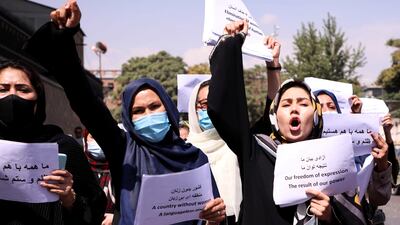
Activists protest to demand equal rights for women under Taliban rule, in front of the presidential palace, in Kabul, Afghanistan. Reuters -
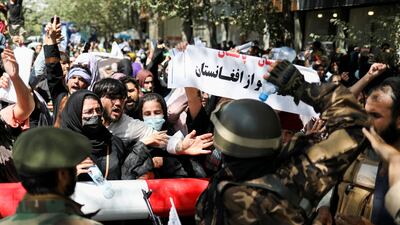
Taliban soldiers stand in front of demonstrators during a protest in Kabul. Reuters -
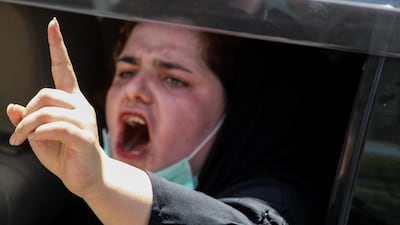
A woman shouts slogans during a protest. EPA -
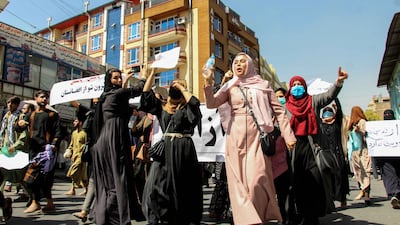
Unrest has broken out in cities across Afghanistan over the past few weeks, as people demand inclusive policies from the Taliban. EPA -
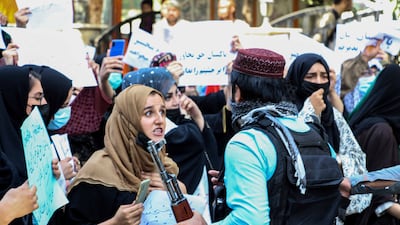
Women have led many of the protests held in recent days. EPA


While the Taliban’s education minister Abdul Baqi Haqqani has said women and girls between 13 and 18 would be allowed to go to school, he has yet to set out how and when this will happen.
In the meantime, the Education Ministry is only allowing boys to resume their studies.
Teachers say they are increasingly worried the Taliban has reversed their promises to Afghanistan’s women that they could keep studying.
While the school’s grounds are vibrant and busy in the early morning hours when younger students attend classes, the afternoons - reserved for high school students - are quiet, the classrooms empty, desolate.
Aisha, a 16-year-old grade 10 student, told The National she was “only crying” now and the Taliban’s announcement had left her devastated.
“I knew we couldn’t trust them, they have not changed,” she said from her home, where she tries to keep up with her studies remotely by reading books, memorising poems and meeting with her classmates to study together.
Aisha wants to pursue a career in journalism, believing Afghanistan needed more women in the media.
“I’m afraid they are taking away the dreams of our generation.”
Mila Amini, a 45-year-old first-grade teacher said she remembered the previous Taliban regime well, saying she spent it mostly confined to her home and was unable to start working as a teacher, even though she had just graduated with a literature degree.
Since starting teaching 20 years ago, she says there has been a progressive change in her students – a growing drive within Afghanistan’s women.
“They have gained knowledge and confidence, and they dare to dream bigger,” she said from her classroom, a cramped space with bright green walls and a large blackboard at its front.
She said she hoped her students could one day become Afghanistan’s future leaders.
“When I graduated more than two decades ago, there were few girls – in my class, we were only seven. But things have changed. Girls and women are being educated, and they are changing our country. All of them – the younger ones and the older ones – have ambitions to study hard and to serve Afghanistan,” Ms Amini told The National.
But, she admitted, concerns were growing among teachers about the absence of older students.
During their 1996-2001 regime, women weren’t allowed to go to school and could barely leave their homes, with some of them attending secret underground schools to at least receive basic education.
With an average country-wide literacy rate of 48 per cent, women still rank much lower, at around 30 per cent, according to United Nations figures.
As well as delaying setting the rules for secondary school girls, the Taliban announced women would not be allowed to hold high-ranking government jobs. The new Cabinet is all male and the former Women’s Affairs Ministry has been turned into the Ministry for the Propagation of Virtue and Prevention of Vice.
The education ministry’s Mr Haqqani has said “co-education is in conflict with the principles of Islam and is against the customs and traditions of Afghans.”
He said that universities and schools would be segregated and hijabs would be compulsory on school grounds.
The Taliban has also vowed to adjust school curriculums, removing subjects not in accordance with their interpretation of Islam and Sharia.
Arezu Atahi has been working as a teacher for the past 35 years, spending the years of the Taliban’s previous reign in neighbouring Pakistan.
Now 62, teaching younger girls at Zarghona High School, she says her hopes are fading after the Taliban’s return.
“Afghanistan’s future can only be bright when girls and boys alike receive an education,” she said.

