
Zimbabwe's President Robert Mugabe emerged for the first time Friday from military-imposed house arrest, presiding at a university graduation ceremony in a fragile show of normalcy even as former loyalists across the country demanded that he resign after nearly four decades in power.
In an extraordinary evening newscast, state broadcaster ZBC — for decades, a mouthpiece for the Mugabe government — reported on the surging campaign for his ouster and showed video of ruling party members saying he should resign.
Clad in a blue academic gown, the 93-year-old leader earlier joined academics on a red carpet and sat in a high-backed chair in front of several thousand students and guests, a routine he has conducted for many years as the official chancellor of Zimbabwe's universities.
_______________
Read more:
Mugabe makes first public appearance since military takeover
Zimbabwe crisis: Crunch talks between Mugabe and army chief
Mugabe's fall from grace unlikely to end Zimbabwe's political infighting and economic decay
_______________
This time, however, the spectacle was jarring because the authority of the world's oldest head of state, once seen as impregnable, is evaporating daily.
That Mr Mugabe was permitted to go to the Zimbabwe Open University event possibly reflected a degree of respect by the military for the president, a former rebel leader who took power after independence from white minority rule in 1980. The armed forces are in a delicate position, sending tanks and troops into Harare's streets this week to effectively end the Mugabe era, while refraining from more heavy-handed measures that would heighten accusations that they staged a coup and violated the constitution.
-

Protesters gather calling for Zimbabwean president Robert Mugabe to step down, in Harare. Philimon Bulawayo / Reuters -
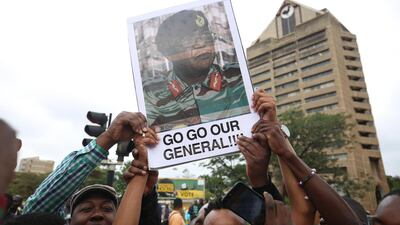
People take part in a march along the city's streets, heading for a solidarity rally, on the removal of Zimbabwean president Robert Mugabe, at the Zimbabwe Grounds in Highfield, Harare. Aaron Ufumeli / EPA -

People take part in a march along the city's streets, heading for a solidarity rally, on the removal of Zimbabwean president Robert Mugabe, at the Zimbabwe Grounds in Highfield, Harare. Aaron Ufumeli / EPA -

Protesters take part in a march along the city's streets, heading for a solidarity rally, on the removal of Zimbabwean president Robert Mugabe, at the Zimbabwe Grounds in Highfield, Harare. Aaron Ufumeli / EPA -
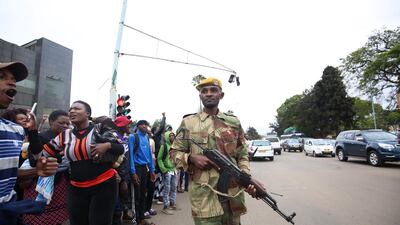
Soldiers on the streets as people, head for a solidarity rally, on the removal of Zimbabwean president Robert Mugabe, at the Zimbabwe Grounds in Highfield, Harare, Aaron Ufumeli / EPA -
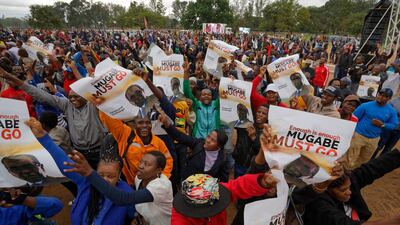
Protesters hold posters asking president Mugabe to step down, on which one has handwritten "37 years for nothing", at a demonstration at Zimbabwe Grounds in Harare. Ben Curtis / AP Photo -
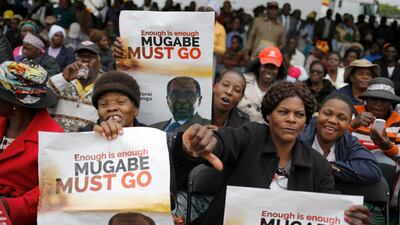
People taking to the streets as part of the mass action protests against president Robert Mugabe, in Harare. Kim Ludbrook / EPA -

People taking to the streets as part of the mass action protests against President Robert Mugabe, in Harare. Kim Ludbrook / EPA


Meanwhile, the ruling ZANU-PF party signalled impatience with Mr Mugabe amid negotiations on his exit. Party branches passed no-confidence votes in all 10 Zimbabwean provinces, and the state-run Zimbabwe Herald newspaper said all called for the resignation of Mr Mugabe and his wife. They seek a special meeting within two days of the party's Central Committee.
Demonstrations were called for Saturday in Harare to support the military's move against Mr Mugabe, who drew applause from the graduating students on the outskirts of the capital only when he made brief, perfunctory remarks, usually to bestow degrees on delighted graduates. The military said it supports plans for a march, as long as the demonstration is orderly and peaceful.
"It was a long struggle," graduate Arthur Chipra said of the years of effort that went into his master's degree in conflict resolution. He declined to say anything when asked what he thought about Mr Mugabe's presence at the ceremony, highlighting the lingering caution of many in a country where people have been prosecuted for criticising the president.
Discontent with Mr Mugabe has been growing because of the dire state of the economy, concerns about corruption and mismanagement, a sense that he is no longer physically capable of leading the country due to advanced age and the ambitions of his wife, Grace Mugabe, to succeed him.
The military stepped into the factional battles of the ruling party on Wednesday after the firing of Vice President Emmerson Mnangagwa, who is close to the armed forces and was heavily criticized by both Mugabes.
-
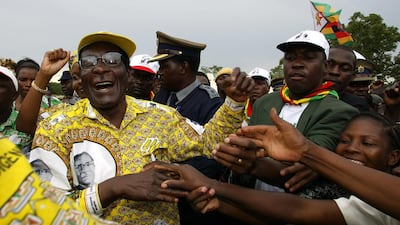
Zimbabwe president Robert Mugabe and leader of the ruling party ZANU PF greets a crowd of about 15,000 people at a golf course in Chinhoyi town 120Km northwest of Harare during a pre-election rally in 2002. Alexander Joe / AFP -
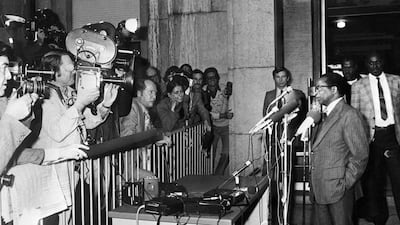
Patriotic Front leader Robert Mugabe, right, gives a press conference, on October 29, 1976 in Geneva. AFP -
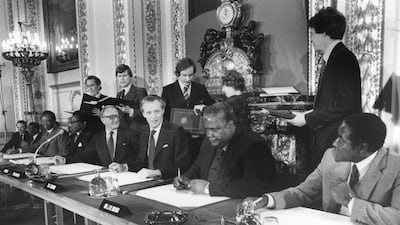
The leaders of the Patriotic Front, Robert Mugabe and Joshua Nkomo, Lord Carrington the British foreign secretary, Sir Ian Gilmore and Bishop Abel Muzorewa the prime minister of Zimbabwe-Rhodesia, at Lancaster House. The occasion is the signing of the agreement on the independence of Zimbabwe on December 21, 1979. Central Press / Getty Images -
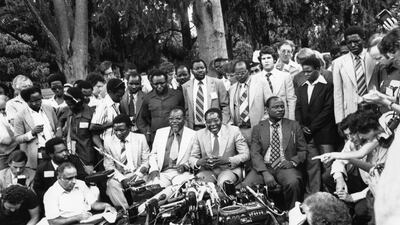
Robert Mugabe, newly elected president of Zimbabwe, holds a press conference in his garden in Mount Pleasant, Salisbury on March 6, 1980. Keystone / Getty Images -
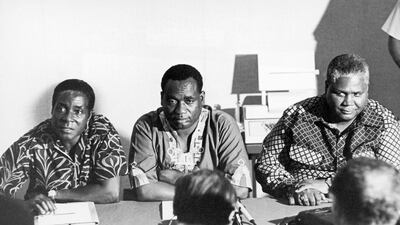
From left: Robert Mugabe, secretary for information and deputy of the African National Congress (Anc) George Silundika, and leader of the Zapu Party (Zimbabwe African People Union) Joshua Nkomo at a meeting in Dar Es Salaam, Tanzania in the 1960s. Keystone-France / Gamma-Keystone via Getty Images -
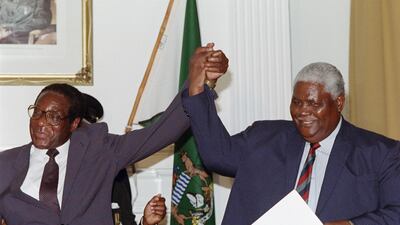
Zimbabwe's president Robert Mugabe, left, and former president of Zimbabwe African People's Union (ZAPU) Joshua Nkomo raise their fists on December 22, 1987 in Nairobi. Mugabe, Zimbabwean first Premier in 1980 and president in 1987, was born in Kutama in 1924, formerly Southern Rhodesia. Largely self-educated, he became a teacher. After short periods in the National Democratic Party and ZAPU, he co-founded the Zimbabwe African National Union (ZANU). After a 10-year detention in Rhodesia (1964-74), he spent five years in Mozambique gathering support in preparation for independence in 1980. Alexander Joe / AFP -
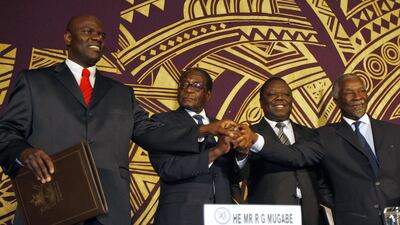
From left: Zimbabwean MDC (Movement for Democratic Change) breakaway faction leader Arthur Mutambara, Zimbabwe's president Robert Mugabe, opposition's leader Morgan Tsvangirai and South African Thabo Mbeki pose after signing the power-sharing accord on September 15, 2008 in Harare. Mbeki said the region and Africa had to extend a helping hand to Zimbabwe and that getting seeds, fertilizer and fuel to the country was a matter of urgency with rains approaching. Desmond Kwande / AFP -
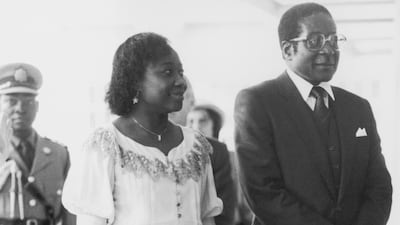
Robert Mugabe, the prime minister of Zimbabwe, visits Queen Elizabeth at Buckingham Palace in London with his wife Sally on May 20, 1982. Rob Taggart / Central Press / Hulton Archive / Getty Images -
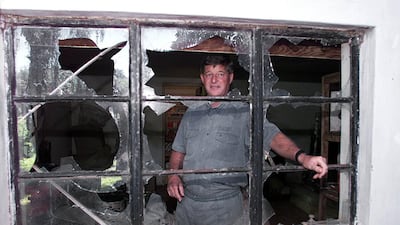
Zimbabwean farmer Paul Retzlaff stands on April 12, 2000 in front of a broken window at his home in Arcturus, Gormonzi district, 30 km east of Harare, a day after clashes broke out at his farm when drunken would-be squatters invaded the property before being repelled by black farm workers. Retzlaff said shots had been fired by the invaders, including a leading veteran of the war against white rule in the 1970s. The couple was saved after black farm workers from neighbouring farms responded to a call for help over ham radio. His wife Liz said the invaders were shouting that they had president Robert Mugabe's permission to invade the property. Alexander Joe / AFP


Mr Mnangagwa, who fled Zimbabwe after his dismissal, will return only after the process to remove Mr Mugabe is complete, high-level supporters told The Associated Press. They spoke on condition of anonymity because they were not authorised to talk to reporters about the matter.
In Washington, US Secretary of State Rex Tillerson called for a return to civilian rule in Zimbabwe, urged any new leader to respect democracy and human rights, and said the country has a chance to put itself on a "new path."
China said it hopes Zimbabwe's political situation can be resolved "under the legal framework" and that stability can be restored.
Questions have been raised about China's possible role in Zimbabwe's affairs because Zimbabwe's army commander was in Beijing last week. China said the visit by Gen Constantino Chiwenga was a "normal military exchange."
As Mr Mugabe tries to hang on in negotiations over his departure from office, he has asked for "a few more days, a few more months," the chairman of the influential war veterans' association in Zimbabwe told reporters.
Chris Mutsvangwa, a Mnangagwa ally, said there is little tolerance for Mr Mugabe to extend his presidency.
Several ruling party figures linked to Grace Mugabe — Jonathan Moyo, the higher education minister; Saviour Kasukuwere, the local government minister; and Ignatious Chombo, the finance minister — were detained during military operations, according to Mr Mutsvangwa. Mr Moyo was not at the graduation ceremony, even though he had been scheduled to attend.
The military said "significant progress has been made in their operation to weed out criminals around President Mugabe," saying they had committed "crimes that were causing social and economic suffering in Zimbabwe."
Photographs of talks at Mr Mugabe's official residence show the president, Defence Minister Sydney Sekeramayi, Intelligence Minister Kembo Mohadi, South African Cabinet ministers who are acting as mediators and a local Catholic priest, the Rev Fidelis Mukonori, whom Mr Mugabe has used as a mediator before. Grace Mugabe was not pictured. Negotiations on Mr Mugabe's exit come ahead of a key ruling party congress next month, and elections next year.
There was no obvious military presence at the university graduation that Mr Mugabe attended. His security was handled by presidential guards. Burly men in suits surrounded him as he walked slowly out of the graduation tent after declaring — to applause — an end to the ceremony.

