

Pope Francis is looking forward to visiting South Sudan in July, the pontiff, Archbishop of Canterbury and a Scottish church official said in a joint message.
The Pope is expected to visit South Sudan from July 5 to July 7, amid continuing unrest in the country.
The message released by the Vatican on Monday was addressed to South Sudanese political leaders and signed by the Pope, Archbishop of Canterbury Justin Welby and Jim Wallace, Moderator of the Church of Scotland.
The three church officials will visit South Sudan together.
The Holy See announced two months ago that the pontiff would make the latest African pilgrimage of his nine-year-old papacy, beginning with a pastoral visit to the Democratic Republic of Congo on July 2.
The Pope’s mobility has been limited of late by a nagging knee problem. On Thursday, Francis, 85, was seen for the first time in public using a wheelchair.
The majority of South Sudan’s population is Christian.
Churches helped rally international support when the South Sudanese fought for independence from Sudan, which is overwhelmingly Muslim.
Ceasefire breaches
The Pope’s visit comes as unrest has intensified in South Sudan, with rival political powers trading accusations of breaching a ceasefire and peace agreement.
A 2018 peace agreement ended five years of bloody civil war between President Salva Kiir and Vice President Riek Machar, a conflict that left 400,000 dead and forced four million people to flee their homes.
-
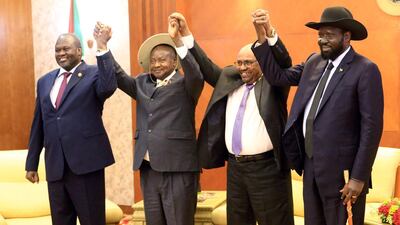
South Sudanese rivals President Salva Kiir, right, and rebel leader Riek Machar, left, with Uganda's President Yoweri Museveni, second left, during peace talks hosted by Sudan's former president Omar Al Bashir, second right, on June 25, 2018. Reuters -
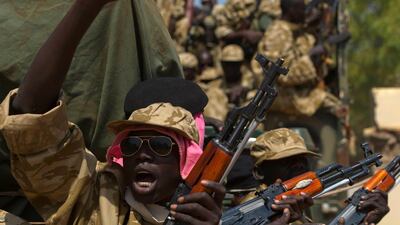
A soldier of the Sudan People's Liberation Army, predecessor to the South Sudan People's Defence Forces, gestures as he sits in a vehicle in the capital Juba, on December 21, 2013. Reuters -
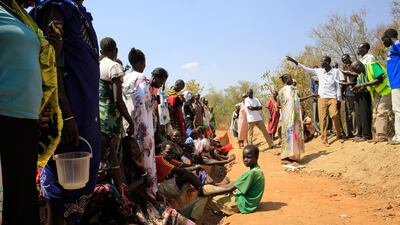
Families displaced by the civil war in South Sudan gather to be registered to receive food rations at a makeshift camp inside the UN Mission in Sudan's centre in Jabel, on the outskirts of Juba, on December 23, 2013. Reuters -
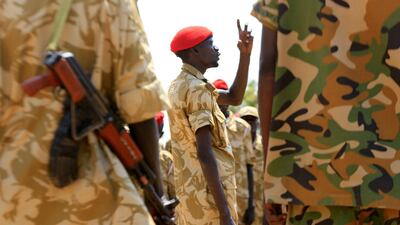
South Sudanese soldiers gather for a briefing at the army general headquarters in Juba, on January 8, 2014. Reuters -
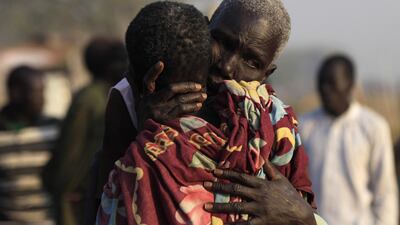
Women displaced by the fighting in Bor county hug each other in the port in Minkaman, in Awerial county, Lakes state, South Sudan, on January 15, 2014. Reuters -
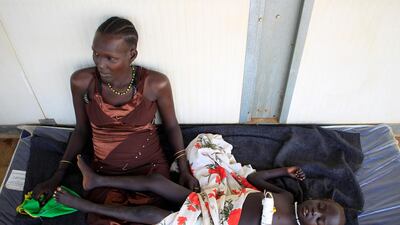
A displaced mother tends to her sick child at a UN hospital at Tomping camp, where some 15,000 displaced people who fled their homes are shelterednear South Sudan's capital Juba on January 7, 2014. Reuters -
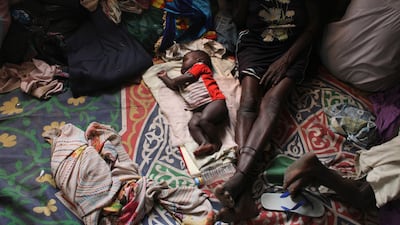
A baby sleeps next to a woman at a Catholic church in Malakal, South Sudan, on January 21, 2014. Reuters -
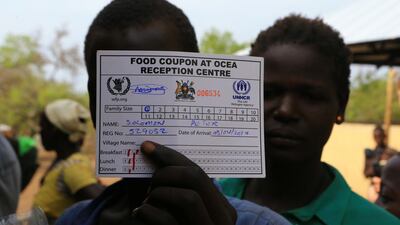
A South Sudanese refugee uses his meal card to cover his face as he waits to be served porridge at Imvepi settlement in Arua district, northern Uganda, on April 4, 2017. Reuters


On Saturday, a panel of UN experts recommended maintaining an arms embargo imposed on South Sudan.
The embargo had been due to expire at the end of the month and the UN Security Council is expected to discuss the matter on May 26.
The Panel of Experts on South Sudan recommended, in a 77-page report to the UN Security Council, that the embargo be maintained.
It has in any case been breached in the 12 months since it was extended in May 2021, said the experts, as the government had bought armoured troop carriers.
The peace accord provided for a power-sharing arrangement in a government of national unity, set up in 2020 with Mr Kiir as president and Mr Machar as vice-president.
But their rivalry has persisted, leaving many articles of the accord still to be respected, while armed clashes between the two sides have resumed.
While acknowledging there had been some progress, the report highlighted the continuing violence, as well as floods that had created "unprecedented levels of food insecurity".
"Millions remain displaced, with around 70 per cent of the population in need of humanitarian assistance," it said.
It also described state corruption and a "chaotic system of public finances".

