


Scientists have used the James Webb Space Telescope to study an ancient galaxy even larger than the Milky Way that formed 11.5 billion years ago.
The study, published in the Nature science journal on February 15, has tested scientists’ understanding of how galaxies form and the nature of dark matter.
Dark matter - invisible particles that do not emit, absorb or reflect light - makes up most of the universe and provides the necessary gravitational pull to attract and hold gas and dust together. This process eventually formed stars and galaxies in the early universe.
But the new research has shown that the galaxy, called ZF-UDS-7329, appears to be too large for the amount of dark matter that was present at that time.
Claudia Lagos of the International Centre for Radio Astronomy Research played a key role in creating the theoretical models for the study that explain how dark matter concentrations have changed over time.
“Galaxy formation is in large part dictated by how dark matter concentrates,” she said.
“Having these extremely massive galaxies so early in the universe is posing significant challenges to our standard model of cosmology.
"This is because we don’t think such massive dark matter structures as to host these massive galaxies have had time yet to form."
She said more observations were needed to understand how common these galaxies may be and to help them understand how truly vast they are.
Scientists had been trying to capture data on this galaxy for seven years and used two large ground-based telescopes to learn how old it was.
But the galaxy was too red and faint to be measured properly, so experts had to use JWST to confirm its nature.
JWST, a $10 billion telescope, is the most advanced space observatory yet built and uses its 6.5-metre mirror to collect light from faint, distant objects.
It captures them in the infrared spectrum, a type of light that is invisible to the human eye but can be captured as heat by science instruments to observe distant and cold objects in deep space.
Professor Karl Glazebrook, who led the study, said he hopes the latest findings could herald a new chapter in scientists' understanding of the physics of dark matter.
“JWST has been finding increasing evidence for massive galaxies forming early in time," he said.
"This result sets a new record for this phenomenon. Although it is very striking, it is only one object.
"But we hope to find more, and if we do this will really upset our ideas of galaxy formation.”
James Webb space images: in pictures
-
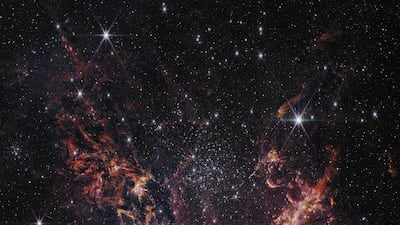
A cluster of stars in the Small Magellanic Cloud in an image taken by the James Webb Space Telescope. PA -
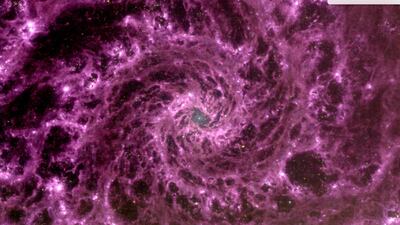
A colour composite image of the Messier 74 galaxy. Photo: Gabriel Brammer (Cosmic Dawn Center, Niels Bohr Institute, University of Copenhagen) / James Webb Space Telescope -
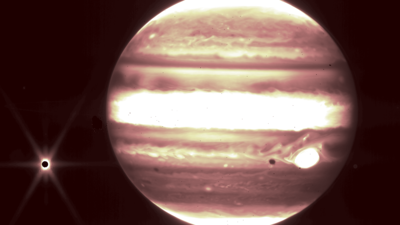
Jupiter and its moon Europa, left, are seen through the James Webb Space Telescope. Photo: Nasa -
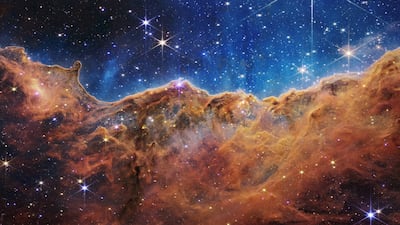
Captured in infrared light by Nasa's new James Webb Space Telescope, this image reveals areas of star birth in Carina Nebula. All photos: James Webb Space Telescope -
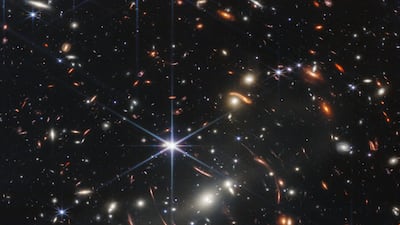
Known as Webb's First Deep Field, the picture showcases a galaxy cluster called SMACS 0723 as it appeared 4.6 billion years ago. The image was revealed by US President Joe Biden on July 11 during an event at the White House. -
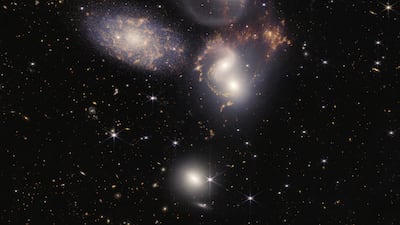
An image of Stephan's Quintet, an area in space with a group of five galaxies. -
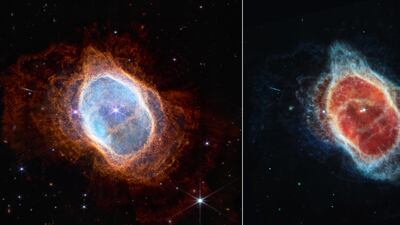
Side-by-side comparison shows observations of the Southern Ring Nebula in near-infrared light (left) and mid-infrared light. -
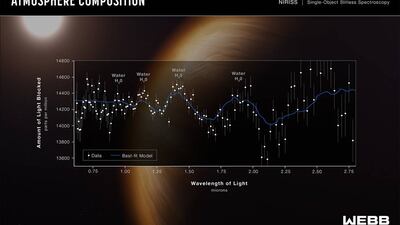
The telescope has captured the distinct signature of water, along with evidence for clouds and haze, in the atmosphere surrounding a hot, puffy gas giant planet orbiting a distant Sun-like star, called WASP-96 b. Photo: James Webb Space Telescope



