


The world would "go backwards" on refugee rights if the UN Refugee Convention was opened to reform, a UN leader has said.
There is a “global environment of populist rhetoric” that is damaging to refugees, Gillian Triggs, UN Assistant Secretary General, told the One Young World Summit in Belfast, Northern Ireland.
Protection is outlined in the 1951 UN Refugee Convention, including basic minimum standards, and asserts they should not be returned to a country where they face serious threats to their lives or freedom.
In a trip to Washington DC last week, UK Home Secretary Suella Braverman said it should be questioned whether the application of the UN’s Refugee Convention is “fit for our modern age”.
When asked by former broadcast journalist Jacky Rowland, who chaired the panel at the global summit in Belfast, whether the international refugee system was fit for purpose, Ms Triggs said it was a “very dangerous question to ask”.
“Because if we say that the system is not fit for purpose and that we are not meeting the needs of tens of millions, and maybe many more coming with climate change … the problem is that it gives politicians in many countries the opportunity to say: ‘This is not working, the system is broken, we will stop the the boats, we will deny access to asylum and we will detain people indefinitely, including children,’” she said.
“So by emphasising what is not working, we’re actually feeding into the populist message that the system is not working.
“And can I say, from a UN refugee point of view, from the agency point of view, this system is working across the world a lot of the time.
“But the Refugee Convention, although it is [from] 1951, is actually saving lives all the time and that’s why we’re so grateful to have its point of view.
“If we were to open up the convention to reform it, we would probably go backwards. We would not have what was capable of being achieved in 1951.”
100,000 migrants cross the Channel in five years - in pictures
-
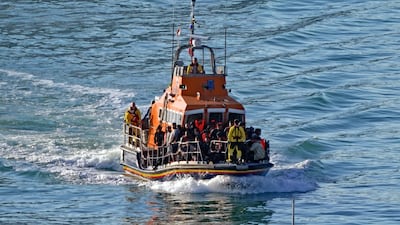
It is thought the number of migrants who have arrived in the UK since 2018 by crossing the English Channel on small boats now exceeds 100,000. PA -
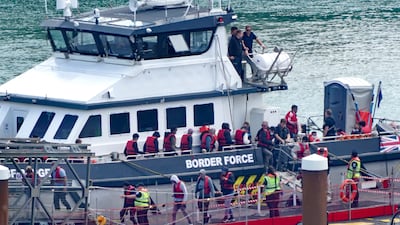
The milestone adds pressure on Prime Minister Rishi Sunak to fulfil his pledge to “stop the boats”. PA -

An aerial view shows rolled-up inflatable dinghies and outboard engines, stored in a Port Authority yard in Dover. AFP -
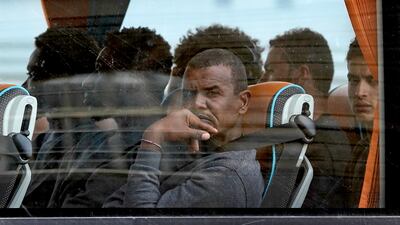
A group of people thought to be migrants are driven away from Dover. PA -
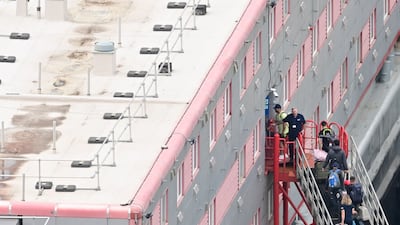
Migrants are being hosted on the Bibby Stockholm, which is being used as an accommodation barge in Dorset. AFP -

Migrants seeking asylum in the UK have also been housed at Napier Barracks in Folkestone, Kent. PA -
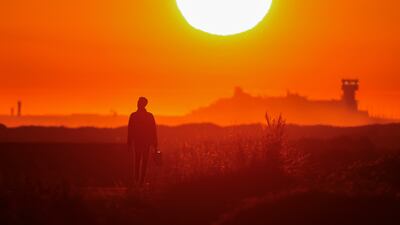
A migrant walks back to his makeshift camp at sunrise after a failed attempt to cross the Channel in Sangatte, near Calais. Reuters


Ms Triggs said there was a “good case to be made” for a new protocol or treaty dealing with climate refugees.
“But again, the risk is that it will actually lead to a lesser level of protection than we have at the moment,” she said.
“So I’m not suggesting we shouldn’t be trying, and we should be, but let’s be a little careful because we’re in a global environment of populist rhetoric.
"That is denigrating people who are seeking protection across national boundaries.”
According to UNHCR, the UN’s refugee agency, between 2008 and 2016 an average of 21.5 million people were forcibly displaced each year by weather-related events such as floods, storms, wildfires and extreme temperatures.
International think tank the IEP predicts that 1.2 billion people could be displaced globally by 2050 because of climate change.
Ms Triggs, a former president of the Australian Human Rights Commission, said that the UN refugee agency was “scaling up” its capacity to protect climate refugees.
“Very recently, last year or so, we found Lake Chad has been drying up and all its tributaries are dying,” she said.
“We have herders who need grasses for their cattle, we have farmers who are agriculturalists and we have fishermen, all using Lake Chad.
“And as it dries up, the tensions rise, there is conflict and over one week 13,000 people fled across the border into Chad.
“Now that would be a clear example of somebody who is a climate refugee.
"And at the UN Refugee Agency, we are trying to scale up our work so that we’re able to protect people in that situation and that they have the benefit of the whole legal regime, right to work to get the children to school, access to health care and so on.”
About 500 migrants rescued off Italian coast - video
Ms Triggs said that defining a climate refugee might be more difficult than when the definition of a refugee was first outlined in 1951.
“But there will be some, and this is where we get into a sort of grey area, where people have been moved partly as a consequence of climate,” she said.
“We might call it slow onset. There may be years when the grasses are drying up, the rivers are drying up, and bit by bit they move.
“Now, they would be described, I think, by many as economic migrants.
"Now it’s clear that international human rights law applies to everybody everywhere, so of course they have a right to get their children to school, but they may not be refugees.”
The One Young World summit has attracted thousands of young leaders from more than 190 countries to Belfast to discuss global issues.
Tens of thousands of people in the UK asylum system could be at risk of homelessness
Tens of thousands of people in the asylum system could be at risk of homelessness as the government works to clear the so-called legacy backlog before the end of the year, a major charity has warned.
The British Red Cross said it had seen the number of people it supports, who have been granted refugee status but who have become destitute, more than double since early summer.
The charity criticised changes the government has made to the time people are given to move out of asylum accommodation when they are given refugee status – the 28-day “move-on” period.
It said it had seen some refugees get only seven days’ notice, and that while reducing the asylum backlog and speeding up claims was something to be welcomed, it was putting “an increasing amount of pressure on local authorities to support people to find housing quickly”.
One of the charity’s refugee service managers claimed that in parts of Greater Manchester, “homelessness for single men has almost become a guaranteed part of getting refugee status”.
British Prime Minister Rishi Sunak has pledged to clear by the end of 2023 the backlog of older cases that had been in the asylum system as of the end of June last year.
By the end of June this year, there were 67,870 legacy asylum cases awaiting a decision.
The Home Office has previously insisted the government is “on track” to clear the legacy backlog by the end of 2023.
The British Red Cross has estimated that, based on the percentage of people and dependants in the backlog who were in asylum accommodation in June last year, a worst-case scenario could see more than 53,000 people affected by having to leave their accommodation soon.
It suggested about 26,000 people are at risk even if the backlog is not cleared by Mr Sunak’s deadline.
The charity said its figures are based on all decisions for people who live in asylum accommodation – those who are granted refugee status and those who are not – who will also need to leave in the days that follow.
Afghan migrant documents dangerous journey across Channel - video
A Home Office representative said they “do not recognise these forecasts” and insisted the government provides support for refugees to gain jobs, benefits and housing.
The charity’s comments follow a similar complaint from the Refugee Council last month.
It said that while the notice period for people granted refugee status had previously started from when a person received their Biometric Residence Permit, it now begins when someone receives a letter telling them their protection claim has been accepted.
Both charities said they had seen people left with too little time to move out of their asylum accommodation, with the British Red Cross warning this “could lead to devastating levels of destitution”.
The charity said it had seen the number of people it supported with refugee status, who then became destitute, rise from 132 in June and July to 317 people in August and September.
The charity has repeated its call for the government to extend the move-on period to 56 days – to match the period local authorities are given to work with households at risk of homelessness.
“People who have been forced to flee their homes have already experienced unimaginable trauma," said Alex Fraser, the British Red Cross director for refugee support.
"They need stability, support and to feel safe. Making people destitute only causes more distress and hardship.
“Once they get refugee status, they need more time, not less, to find housing, work or benefits.
"It takes at least 35 days to start getting universal credit and local authorities need at least 56 days to help them find accommodation.
“Extending the move-on period would give refugees the support they need as they start to rebuild their lives.”
The Home Office representative said: “All asylum applications are considered on individual merits.
“The pressure on the asylum system has continued to grow, with hotel accommodation costing millions of pounds a day.
“We encourage individuals to make their onward plans as soon as possible after receiving their decision, whether that is leaving the UK following a refusal, or taking steps to integrate in the UK following a grant.”

