

Armenia has asked the European Union for assistance to help it deal with refugees arriving from Nagorno-Karabakh since Azerbaijan took back control of the region last week, the office of Italy's prime minister said on Saturday.
More than 100,000 refugees have arrived in Armenia since Azerbaijan launched a military operation to retake control of Nagorno-Karabakh, which previously had a population of around 120,000, according to UNHCR and Armenian authorities.
Armenia has asked the EU for temporary shelters and medical supplies, the office said in a statement, adding that Rome was working to promote stabilisation in the region.
Nagorno-Karabakh is internationally recognised as part of Azerbaijan but is populated mainly by Armenian Christians who set up the self-styled Republic of Artsakh three decades ago after a bloody ethnic conflict as the Soviet Union collapsed.
A total of 21,043 vehicles have crossed the Hakari Bridge, which links Armenia to Nagorno-Karabakh, since last week, Nazeli Baghdasaryan, the press secretary to Armenian Prime Minister Nikol Pashinyan, said on Saturday.
Some people lined up for days after the winding mountain road that is the only route to Armenia became jammed.
The departure of more than 80 per cent of Nagorno-Karabakh's population raises questions about Azerbaijan's plans for the enclave that has been internationally recognised as part of its territory.
The region's separatist ethnic Armenian government said on Thursday it would dissolve itself by the end of the year after a three-decade bid for independence.
Mr Pashinyan has alleged the ethnic Armenian exodus amounted to “a direct act of an ethnic cleansing and depriving people of their motherland”.
Azerbaijan’s Foreign Ministry strongly rejected the characterisation, saying the mass migration by the region's residents was “their personal and individual decision and has nothing to do with forced relocation”.
During three decades of conflict in the region, Azerbaijan and the separatists backed by Armenia have accused each other of targeted attacks, massacres and other atrocities, leaving people on both sides deeply suspicious and fearful.
While Azerbaijan has pledged to respect the rights of ethnic Armenians in Nagorno-Karabakh, most are fleeing because they do not trust Azerbaijani authorities to treat them humanely or to guarantee them their language, religion and culture.
After six years of separatist fighting ended in 1994 following the collapse of the Soviet Union, Nagorno-Karabakh came under the control of ethnic Armenian forces, backed by Armenia.
Then, during a six-week war in 2020, Azerbaijan took back parts of the region in the south Caucasus Mountains along with surrounding territory that Armenian forces had claimed earlier.
In December 2022, Azerbaijan blocked the Lachin Corridor, the only road connecting Nagorno-Karabakh with Armenia, accusing the Armenian government or using it for illicit weapons shipments to the region's separatist forces.
Weakened by the blockade and with Armenia’s leadership distancing itself from the conflict, ethnic Armenian forces in the region agreed to lay down arms less than 24 hours after Azerbaijan began its offensive.
Talks have begun between officials in the Azerbaijani capital of Baku and Nagorno-Karabakh’s separatist authorities on “reintegrating” the region into Azerbaijan.
-
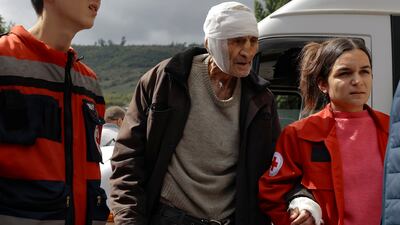
A wounded Armenian man from Stepanakert, Nagorno-Karabakh, is helped by volunteers as he arrives in Goris, Armenia. AP -
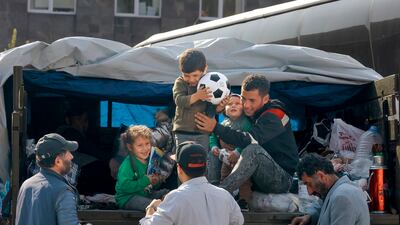
A family from Nagorno-Karabakh are helped as they leave a truck with their belongings after arriving at Goris. AP -
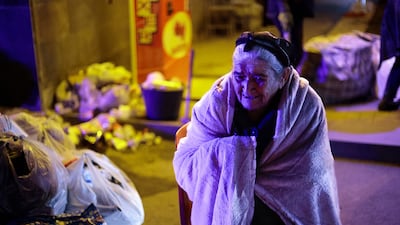
An Armenian woman from Nagorno-Karabakh warms herself near a tent camp after arriving in Goris. AP -
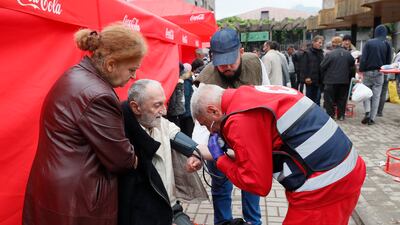
A medic helps an Armenian man from Nagorno-Karabakh near the registration and distribution centre in Goris. EPA -
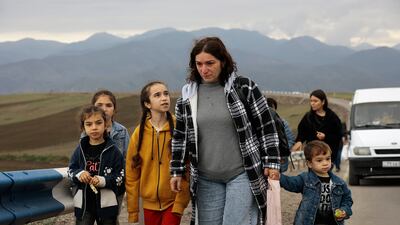
Ethnic Armenians fleeing Nagorno-Karabakh walk on a road to Kornidzor, in Armenia's Syunik region. AP -
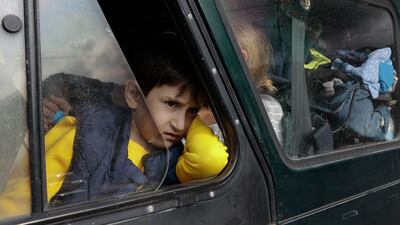
An ethnic Armenian boy from Nagorno-Karabakh, looks out from a car window upon his arrival in Goris, Armenia's Syunik region. AP -
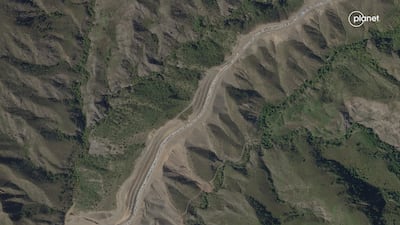
A satellite view of a long traffic jam of vehicles along the highway approaching to the Armenian border with Azerbaijan, at the Lachin corridor in the Nagorno-Karabakh region. AP -
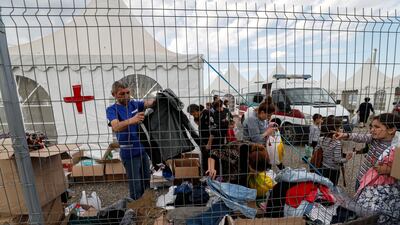
Armenian volunteers distribute clothes to ethnic Armenians fleeing Nagorno-Karabakh, after they crossed the Azerbaijan-Armenia border near the village of Kornidzor, Armenia. EPA -
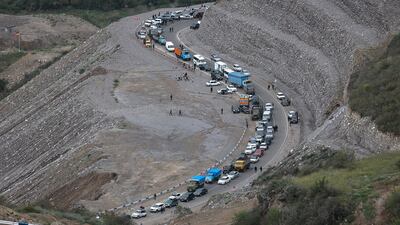
Ethnic Armenians flee Nagorno-Karabakh to Kornidzor, in Armenia's Syunik region. AP -
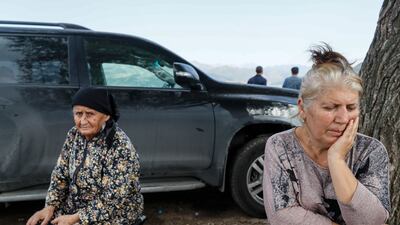
Ethnic Armenians fleeing Nagorno-Karabakh region rest on a roadside after crossing the border with Azerbaijan, near the village of Kornidzor. EPA -
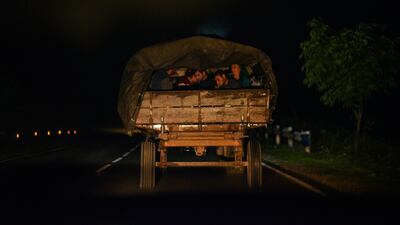
Ethnic Armenians from Nagorno-Karabakh sit in the back of a vehicle after crossing the border on their way to an Armenian Ministry of Foreign Affairs registration centre in Kornidzor, Armenia. EPA -
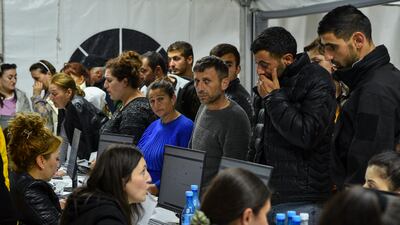
Ethnic Armenians at the registration centre. EPA -
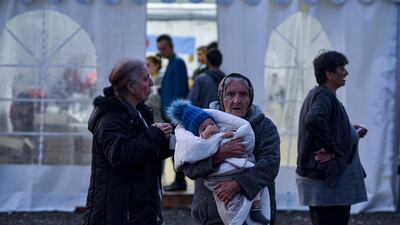
An elderly woman holds an infant. EPA -
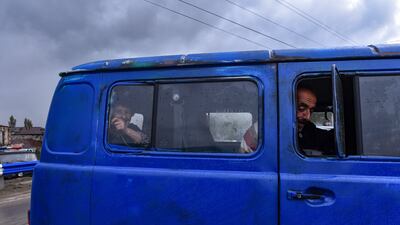
Ethnic Armenians from Nagorno-Karabakh look on from inside a van. EPA -

Ethnic Armenians arrive at the registration centre. EPA -
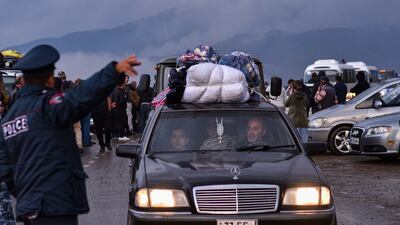
Ethnic Armenians arrive at the registration centre. EPA -

Ethnic Armenians from Nagorno-Karabakh wait near Kornidzor, the town in Syunik region, Armenia. AP -
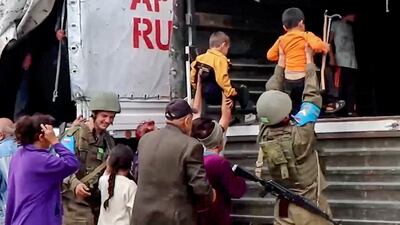
Russian peacekeepers evacuate Nagorno-Karabakh civilians at an undisclosed location. AFP -
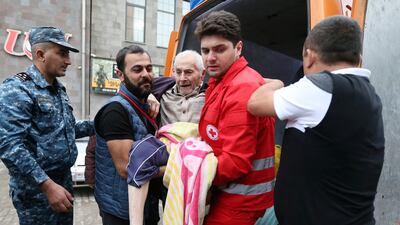
A refugee from Nagorno-Karabakh region is carried out of a vehicle upon arrival at a temporary accommodation centre in the town of Goris, Armenia. Reuters -
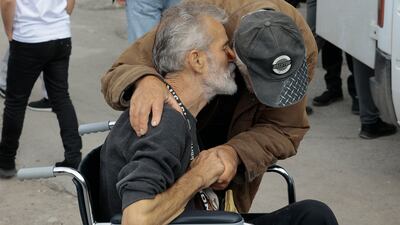
An ethnic Armenian embraces a man upon arrival in Armenia's Goris. AP -
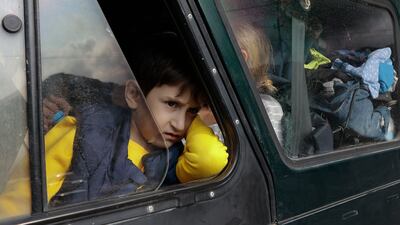
An ethnic Armenian boy from Nagorno-Karabakh, looks on from a car upon arrival in Goris. AP



