


Follow the latest news from UNGA
UN Secretary General Antonio Guterres on Tuesday warned of a new nuclear race that poses the threat of “annihilation” as nuclear-armed nations modernise their arsenals with faster, more accurate and stealthier bombs.
Speaking on the International Day for the Total Elimination of Nuclear Weapons, which the UN General Assembly has marked since 2013, Mr Guterres said the world must reverse course as countries look to develop or expand nuclear capabilities.
“Any use of a nuclear weapon – any time, anywhere and in any context – would unleash a humanitarian catastrophe of epic proportions,” he said.
“Nuclear sabres are again being rattled. This is madness.”
The UN chief said the number of nuclear weapons on the planet could rise for the first time in decades, warning the shadow of “annihilation” is hanging over the world.
In June, the Stockholm International Peace Research Institute (Sipri) reported that the world's nuclear powers, China in particular, increased investment in their arsenals for a third consecutive year in 2022.
While the total number of nuclear warheads held by Britain, China, France, India, Israel, North Korea, Pakistan, Russia and the US had fallen about 1.6 per cent to 12,512 over the previous year, Sipri said the declining trend was on the cusp of a reversal.
US and Russia nuclear missiles – in pictures
-
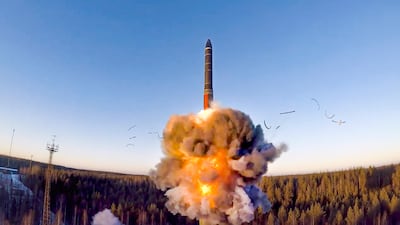
A rocket launches from a missile system as part of a ground-based intercontinental ballistic missile test in December launched from the Plesetsk facility in northwestern Russia. AP -

Russia published a revamped national security concept in January that states Moscow has lowered the threshold for using nuclear weapons to counter what it sees as a growing military threat. Reuters -
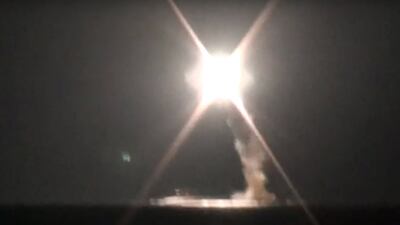
Russia said on October 1 it had launched a new hypersonic cruise missile from a submarine, the latest test of emerging weapons President Vladimir Putin has dubbed 'invincible'. AFP -

A Russian Topol-M intercontinental ballistic missile drives through Red Square in Moscow in May 2009. AFP -
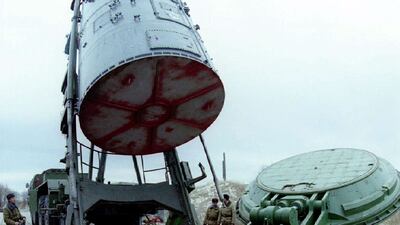
A nuclear missile silo is opened for inspection by Russian rocket forces at a site 70 kilometres from Saratov on November 12, 1994. -
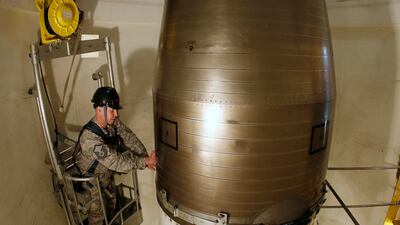
Master Sgt Tad Wagner looks over an inert Minuteman 3 missile in a US training launch tube at Minot Air Force Base, North Dakota. AP -
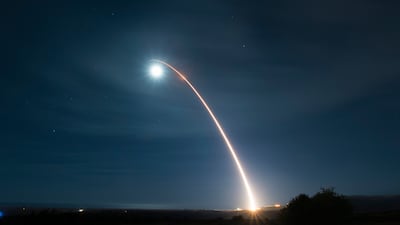
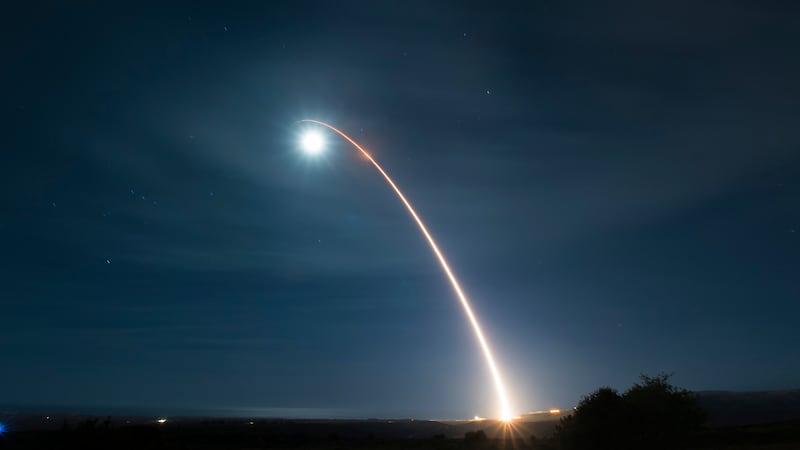
An unarmed Minuteman III intercontinental ballistic missile launches during a developmental test on February 5, 2020, at Vandenberg Air Force Base, California. AFP -
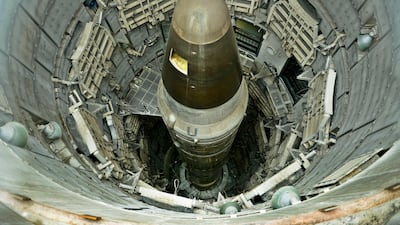
A deactivated Titan II nuclear ICMB is seen in a silo at the Titan Missile Museum in Green Valley, Arizona, on May 12, 2015. AFP -

A Russian strategic nuclear forces officer inspects a launching tube in Drovjanaja, Siberia, in 1992. AFP




The UN chief's comments came on the final day of this year's UNGA in New York, where world leaders have been gathered for the past week.
Mr Guterres also called for introduction of the Comprehensive Nuclear Test Ban Treaty, adopted by the General Assembly in 1996 but still not in force because several key countries have not joined in.
The treaty has 196 member states. Of these, 186 have signed it and 178 have ratified it. The pact has not taken effect because it still needs ratification by eight nations – the US, China, Egypt, Iran, Israel, North Korea, India and Pakistan – that had nuclear power or research reactors.
The UN says frustration is growing from member states over the perceived slow pace of nuclear disarmament. Concerns are being raised about the catastrophic humanitarian fallout of deploying even a single nuclear weapon, let alone a regional or global nuclear conflict.
Russia has made threats it could use tactical nuclear bombs in the war in Ukraine and President Vladimir Putin has sent such weapons to Belarus, escalating geopolitical tensions.
Iran is widely believed to be developing the potential to build its own weapons. Tehran has long denied this and says its nuclear programme is peaceful.
Mr Guterres said the framework for stopping nuclear proliferation and advancing disarmament has eroded.
To get back on the track towards a reduction of nuclear weapons, he called for countries to commit to never using atom bombs “under any circumstances”.
“The world has spent too long under the shadow of nuclear weapons. Let's step back from the edge of disaster,” he said.

