


The James Webb Space Telescope has observed the farthest star yet detected in the universe, revealing new details of its temperature and surroundings.
Even though it was first discovered by its predecessor – the Hubble Space Telescope – the latest findings show that the star is more than twice as hot as the Sun, and about a million times brighter.
It has been given the name Earendel by astronomers and is located in the Sunrise Arc galaxy, which is about 12.9 billion light-years away.
“Nasa’s James Webb Space Telescope has followed up on observations by the Hubble Space Telescope of the farthest star ever detected in the very distant universe, within the first billion years after the big bang,” the US space agency said on Tuesday.
The telescope was able to spot the star because of gravitational lensing, which is when a massive nearby galaxy curves space-time and bends the path of light around it, allowing neighbouring objects to become visible.
Earendel became visible because it was located behind a wrinkle in space-time created by the galaxy cluster WHL0137-08.
“The galaxy cluster, located between us and Earendel, is so massive that it warps the fabric of space itself, which produces a magnifying effect, allowing astronomers to look through the cluster like a magnifying glass,” Nasa said.
The new data has also shown that Earendel could have other stars near by.
Astronomers studied the colours of Earendel to see whether it had neighbours.
“Stars as massive as Earendel often have companions. Astronomers did not expect Webb to reveal any companions of Earendel since they would be so close together and indistinguishable in the sky,” Nasa said.
“However, based solely on the colours of Earendel, astronomers think they see hints of a cooler, redder companion star.
“This light has been stretched by the expansion of the universe to wavelengths longer than Hubble’s instruments can detect, and so was only detectable with Webb.”
Webb was launched into space on Christmas Day, 2021, to study the evolution of the universe and give astronomers deeper insights into the solar system.
Since beginning operations, the telescope has given scientists a peak at stars and galaxies formed in the early universe.
The $10 billion telescope was developed by Nasa and the European and Canadian space agencies.
Telescope's remarkable discoveries - in pictures
-
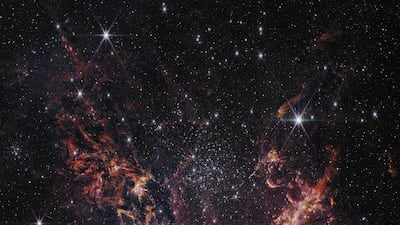
A cluster of stars in the Small Magellanic Cloud in an image taken by the James Webb Space Telescope. PA -
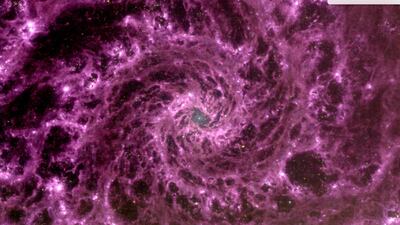
A colour composite image of the Messier 74 galaxy. Photo: Gabriel Brammer (Cosmic Dawn Center, Niels Bohr Institute, University of Copenhagen) / James Webb Space Telescope -
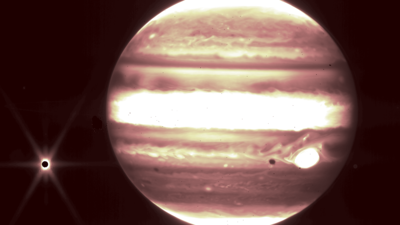
Jupiter and its moon Europa, left, are seen through the James Webb Space Telescope. Photo: Nasa -
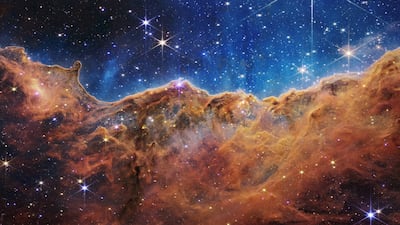
Captured in infrared light by Nasa's new James Webb Space Telescope, this image reveals areas of star birth in Carina Nebula. All photos: James Webb Space Telescope -
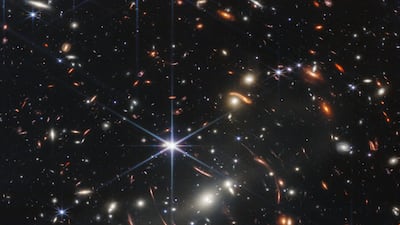
Known as Webb's First Deep Field, the picture showcases a galaxy cluster called SMACS 0723 as it appeared 4.6 billion years ago. The image was revealed by US President Joe Biden on July 11 during an event at the White House. -
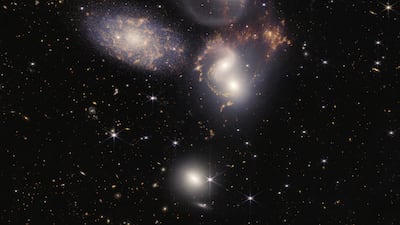
An image of Stephan's Quintet, an area in space with a group of five galaxies. -
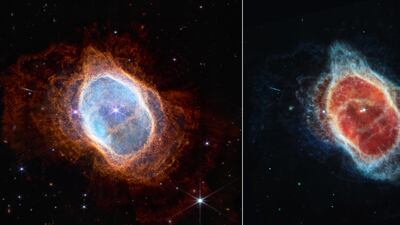
Side-by-side comparison shows observations of the Southern Ring Nebula in near-infrared light (left) and mid-infrared light. -
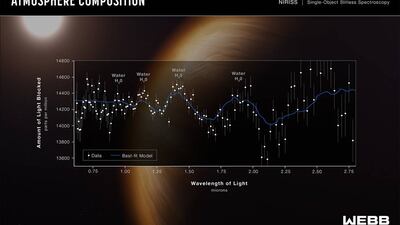
The telescope has captured the distinct signature of water, along with evidence for clouds and haze, in the atmosphere surrounding a hot, puffy gas giant planet orbiting a distant Sun-like star, called WASP-96 b. Photo: James Webb Space Telescope



