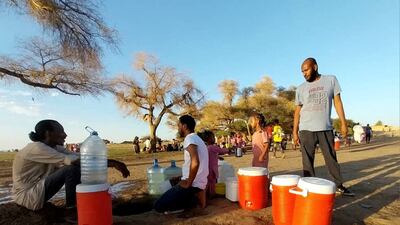
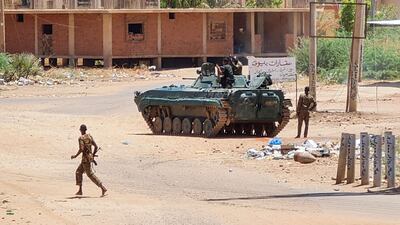
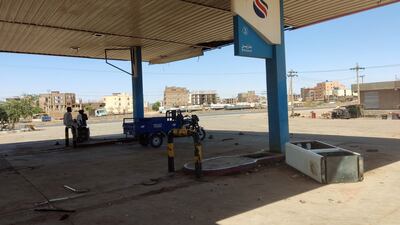
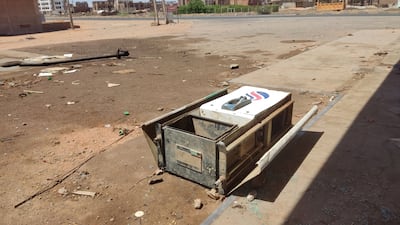
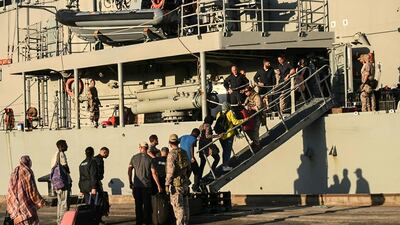
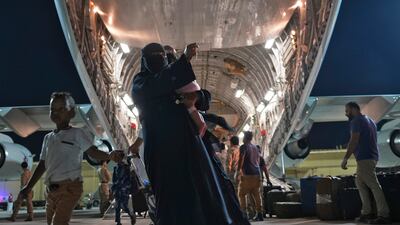
Sudan's warring parties agreed on Friday to protect civilians and allow the movement of humanitarian aid, but remained far apart on a ceasefire.
After a week of talks in the Saudi port of Jeddah, Sudan's army and its rival paramilitary Rapid Support Forces signed a declaration that they would work towards a short-term ceasefire in further discussions, US officials said.
“The two sides are quite far apart,” a senior US State Department official involved in the talks told Reuters.
A text of the declaration released after the talks said the two factions “commit to prioritising discussions to achieve a short-term ceasefire to facilitate the delivery of emergency humanitarian assistance and restoration of essential services.”
The agreement commits both sides in general terms to let in humanitarian assistance, to allow the restoration of electricity, water and other basic services, to withdraw security forces from hospitals and to arrange for the “respectful burial” of the dead.
A proposal is still on the table to halt fighting for 10 days, the US official said.
“This is not a ceasefire. This is an affirmation of their obligations under international humanitarian law, particularly with regard to the treatment of civilians and the need to create space for humanitarians to operate,” the official said.
“We are hopeful, cautiously, that their willingness to sign this document will create some momentum that will force them to create the space” to bring in relief supplies.
Saudi Foreign Minister Prince Faisal bin Farhan said on Twitter that the talks and the commitment to protecting civilians were a first step, and “other steps will follow”.
“The most important thing is to adhere to what was agreed upon, and the kingdom will work until security and stability return to Sudan and its brotherly people,” the Saudi minister said.
Secretary General of the UN, Antonio Guterres, welcomed the agreement, and "hopes this Declaration will ensure that the relief operation can scale up swiftly and safely to meet the needs of millions of people in Sudan," spokesman Stephane Dujarric said.
The UN's World Food Programme said millions of dollars worth of food had been looted in Khartoum.
Envoys from the warring generals — army chief Gen Abdel Fattah Al Burhan and paramilitary commander Gen Mohamed Dagalo — have been meeting since Saturday in Jeddah for “pre-negotiation talks” with the participation of the US and the UN.
The top UN aid official, Martin Griffiths, had outlined proposals in Jeddah in which the two sides would guarantee safe passage for humanitarian relief.
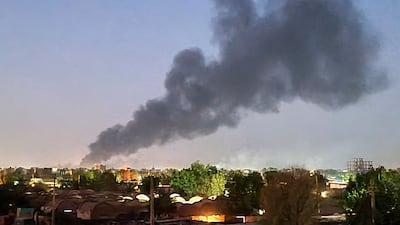
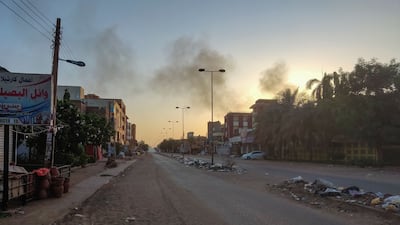
Meanwhile, clashes took place in Halfaya, an entry point to the capital Khartoum, on Thursday as residents heard warplanes circling over Khartoum and its adjoining cities of Bahri and Omdurman, Reuters reported.
Still, the fighting appeared calmer than on Wednesday.
In public neither side has shown it is ready to offer concessions to end the conflict that erupted last month, threatening to pitch Sudan into a civil war, killing hundreds of people and causing a humanitarian crisis.
Previous ceasefire agreements have been repeatedly violated, leaving civilians to navigate a terrifying landscape of chaos and bombardment with failing power and water, little food and a collapsing health system.
The World Health Organisation has said more than 600 people have been killed and more than 5,000 injured in the fighting.
The Health Ministry said at least 450 were killed in the western Darfur region.
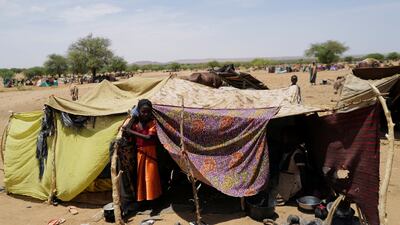
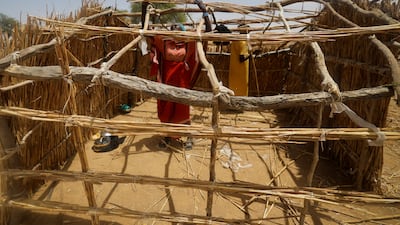
Many have fled Khartoum and Darfur, uprooting 700,000 people inside the country and sending 150,000 as refugees into neighbouring states, according to UN figures.
Western countries condemned abuses by both sides at a human rights meeting in Geneva, but Sudan's envoy there said the conflict was “an internal affair”.

Mercer, the investment consulting arm of US services company Marsh & McLennan, expects its wealth division to at least double its assets under management (AUM) in the Middle East as wealth in the region continues to grow despite economic headwinds, a company official said.
Mercer Wealth, which globally has $160 billion in AUM, plans to boost its AUM in the region to $2-$3bn in the next 2-3 years from the present $1bn, said Yasir AbuShaban, a Dubai-based principal with Mercer Wealth.
“Within the next two to three years, we are looking at reaching $2 to $3 billion as a conservative estimate and we do see an opportunity to do so,” said Mr AbuShaban.
Mercer does not directly make investments, but allocates clients’ money they have discretion to, to professional asset managers. They also provide advice to clients.
“We have buying power. We can negotiate on their (client’s) behalf with asset managers to provide them lower fees than they otherwise would have to get on their own,” he added.
Mercer Wealth’s clients include sovereign wealth funds, family offices, and insurance companies among others.
From its office in Dubai, Mercer also looks after Africa, India and Turkey, where they also see opportunity for growth.
Wealth creation in Middle East and Africa (MEA) grew 8.5 per cent to $8.1 trillion last year from $7.5tn in 2015, higher than last year’s global average of 6 per cent and the second-highest growth in a region after Asia-Pacific which grew 9.9 per cent, according to consultancy Boston Consulting Group (BCG). In the region, where wealth grew just 1.9 per cent in 2015 compared with 2014, a pickup in oil prices has helped in wealth generation.
BCG is forecasting MEA wealth will rise to $12tn by 2021, growing at an annual average of 8 per cent.
Drivers of wealth generation in the region will be split evenly between new wealth creation and growth of performance of existing assets, according to BCG.
Another general trend in the region is clients’ looking for a comprehensive approach to investing, according to Mr AbuShaban.
“Institutional investors or some of the families are seeing a slowdown in the available capital they have to invest and in that sense they are looking at optimizing the way they manage their portfolios and making sure they are not investing haphazardly and different parts of their investment are working together,” said Mr AbuShaban.
Some clients also have a higher appetite for risk, given the low interest-rate environment that does not provide enough yield for some institutional investors. These clients are keen to invest in illiquid assets, such as private equity and infrastructure.
“What we have seen is a desire for higher returns in what has been a low-return environment specifically in various fixed income or bonds,” he said.
“In this environment, we have seen a de facto increase in the risk that clients are taking in things like illiquid investments, private equity investments, infrastructure and private debt, those kind of investments were higher illiquidity results in incrementally higher returns.”
The Abu Dhabi Investment Authority, one of the largest sovereign wealth funds, said in its 2016 report that has gradually increased its exposure in direct private equity and private credit transactions, mainly in Asian markets and especially in China and India. The authority’s private equity department focused on structured equities owing to “their defensive characteristics.”
Avatar: Fire and Ash
Director: James Cameron
Starring: Sam Worthington, Sigourney Weaver, Zoe Saldana
Rating: 4.5/5
Company profile
Name: Thndr
Started: October 2020
Founders: Ahmad Hammouda and Seif Amr
Based: Cairo, Egypt
Sector: FinTech
Initial investment: pre-seed of $800,000
Funding stage: series A; $20 million
Investors: Tiger Global, Beco Capital, Prosus Ventures, Y Combinator, Global Ventures, Abdul Latif Jameel, Endure Capital, 4DX Ventures, Plus VC, Rabacap and MSA Capital
Company Profile
Company name: Fine Diner
Started: March, 2020
Co-founders: Sami Elayan, Saed Elayan and Zaid Azzouka
Based: Dubai
Industry: Technology and food delivery
Initial investment: Dh75,000
Investor: Dtec Startupbootcamp
Future plan: Looking to raise $400,000
Total sales: Over 1,000 deliveries in three months
PROFILE OF INVYGO
Started: 2018
Founders: Eslam Hussein and Pulkit Ganjoo
Based: Dubai
Sector: Transport
Size: 9 employees
Investment: $1,275,000
Investors: Class 5 Global, Equitrust, Gulf Islamic Investments, Kairos K50 and William Zeqiri
If you go
The flights
There are direct flights from Dubai to Sofia with FlyDubai (www.flydubai.com) and Wizz Air (www.wizzair.com), from Dh1,164 and Dh822 return including taxes, respectively.
The trip
Plovdiv is 150km from Sofia, with an hourly bus service taking around 2 hours and costing $16 (Dh58). The Rhodopes can be reached from Sofia in between 2-4hours.
The trip was organised by Bulguides (www.bulguides.com), which organises guided trips throughout Bulgaria. Guiding, accommodation, food and transfers from Plovdiv to the mountains and back costs around 170 USD for a four-day, three-night trip.
Fifa%20World%20Cup%20Qatar%202022%20
%3Cp%3E%3Cstrong%3EFirst%20match%3A%20%3C%2Fstrong%3ENovember%2020%0D%3Cbr%3E%3Cstrong%3EFinal%2016%20round%3A%20%3C%2Fstrong%3EDecember%203%20to%206%0D%3Cbr%3E%3Cstrong%3EQuarter-finals%3A%20%3C%2Fstrong%3EDecember%209%20and%2010%0D%3Cbr%3E%3Cstrong%3ESemi-finals%3A%20%3C%2Fstrong%3EDecember%2013%20and%2014%0D%3Cbr%3E%3Cstrong%3EFinal%3A%20%3C%2Fstrong%3EDecember%2018%3C%2Fp%3E%0A
COMPANY%20PROFILE%20
%3Cp%3E%3Cstrong%3EName%3A%3C%2Fstrong%3E%20Dooda%20Solutions%0D%3Cbr%3E%3Cstrong%3EBased%3A%3C%2Fstrong%3E%20Lebanon%0D%3Cbr%3E%3Cstrong%3EFounder%3A%20%3C%2Fstrong%3ENada%20Ghanem%0D%3Cbr%3E%3Cstrong%3ESector%3A%3C%2Fstrong%3E%20AgriTech%0D%3Cbr%3E%3Cstrong%3ETotal%20funding%3A%20%3C%2Fstrong%3E%24300%2C000%20in%20equity-free%20funding%0D%3Cbr%3E%3Cstrong%3ENumber%20of%20employees%3A%3C%2Fstrong%3E%2011%3C%2Fp%3E%0A
Silent Hill f
Publisher: Konami
Platforms: PlayStation 5, Xbox Series X/S, PC
Rating: 4.5/5
TO A LAND UNKNOWN
Director: Mahdi Fleifel
Starring: Mahmoud Bakri, Aram Sabbah, Mohammad Alsurafa
Rating: 4.5/5
Killing of Qassem Suleimani
Who's who in Yemen conflict
Houthis: Iran-backed rebels who occupy Sanaa and run unrecognised government
Yemeni government: Exiled government in Aden led by eight-member Presidential Leadership Council
Southern Transitional Council: Faction in Yemeni government that seeks autonomy for the south
Habrish 'rebels': Tribal-backed forces feuding with STC over control of oil in government territory
Company Fact Box
Company name/date started: Abwaab Technologies / September 2019
Founders: Hamdi Tabbaa, co-founder and CEO. Hussein Alsarabi, co-founder and CTO
Based: Amman, Jordan
Sector: Education Technology
Size (employees/revenue): Total team size: 65. Full-time employees: 25. Revenue undisclosed
Stage: early-stage startup
Investors: Adam Tech Ventures, Endure Capital, Equitrust, the World Bank-backed Innovative Startups SMEs Fund, a London investment fund, a number of former and current executives from Uber and Netflix, among others.