


Scientists have long been fascinated by the cognitive effects of language and how speaking different languages can fundamentally alter the way our brains work.
As the world becomes increasingly interconnected and multilingual, research in this field could have important implications for everything from education policy to the workplace.
The roots of linguistic relativity — the idea that the structure of a language influences a person's thinking and perception of the world — can be traced back to ancient Greece and the ideas behind it were developed in the 1800s. The term itself was coined in the 19th century by Benjamin Lee Whorf, an American linguist whose name gave rise to an alternative term: Whorfianism.
A recent study, based on brain scans of 94 people, found that German and Levantine Arabic speakers differed in the extent to which parts of the brain were connected.
In German speakers, there tended to be stronger connections within the brain’s left hemisphere, possibly, the authors suggest, because ordering words is particularly complex in this language.
Meanwhile, the fact that many words in Arabic have a three-consonant root may increase demands on, and lead to the strengthening of, parts of the brain involved in understanding words and sounds.
Arabic speakers also showed stronger connections between the right and left hemispheres, something the researchers speculate may be because the language is written from right to left.
Another interesting issue is the emotional resonance that languages or words have or do not have, depending on whether they are a native tongue or a second language.
Space, time and colour
Linguistic relativity also appears to influence how people perceive space, time and a great deal else, as well as colour.
In a study published a few years ago, researchers compared how Chinese speakers and Mongolian speakers perceived blues and greens.
The two languages do not describe those colours the same way.
Mandarin Chinese and Mongolian each have a single word that covers all shades of green.
Chinese also has a single word for blue, but Mongolian speakers have one word for light blue and another for dark blue, echoing how English speakers distinguish between pink and red.
Participants in the study were presented with a computer screen showing a ring of 12 blocks of green or blue.
One of the 12 blocks was of a different shade to the rest and the task was to indicate, by pressing either of two keys, whether the outlier was on the left or right of the screen.
Chinese speakers distinguished between various shades of blue at about the same speed as they did between shades of green.
By contrast, the reactions of Mongolian speakers were faster when distinguishing between shades of blue (for which they have two words) than when dealing with shades of green (for which they have one word).
Terminology shaped how participants identified the colours, a finding replicated with other languages.
Such findings support the idea of linguistic relativity, which suggests the language a person speaks shapes the way they think.
To what extent does language shape thoughts?
During its long history, linguistic relativity and its conceptual forerunners have not been without controversy, though.
The idea was sometimes misused to promote the teaching of certain languages during colonial times, says Jean-Marc Dewaele, a professor of applied linguistics and multilingualism at Birkbeck, University of London.
“It meant colonial countries imposed their language with the argument that French or English allowed people to think better than local people in their local languages. There was an immediate racist implication,” he says.
Partly because of these issues, linguistic relativity remains a “sensitive topic”, he says.
Today, debate continues to rage between scholars about the extent to which language shapes thought.
In 2010, Guy Deutscher, an Israeli linguist, published Through the Language Glass: Why the World Looks Different in Other Languages.
Four years later, John McWhorter, an American linguist, launched a salvo in the opposite direction, releasing The Language Hoax: Why the World Looks the Same in Any Language.
Are there really two distinct schools of thought regarding whether or how the language a person speaks shapes how they perceive the world?
“Is the debate still going on? Yes, but it’s just got, wonderfully, to a much more sophisticated level,” says Dr Catherine Caldwell-Harris, an associate professor of psychology at Boston University.
“It’s not like the old debate, it’s a new version of it. Now it’s more like shades of grey. The two sides agree on so much and the differences are minor.”

She compares it to a glass half-full, glass half-empty discussion.
On the one side is the argument favoured by scholars including McWhorter that people share the same basic mental apparatus, wherever they are from and whatever language they speak.
While not necessarily advocating McWhorter’s world view, Dr Caldwell-Harris agrees that there is a basic human cognition and that people from different cultures can have something in common.
“The old view is that you can’t,” she says. “If your languages are different, if you don’t have the language to express it, you can’t even conceive that thing. That view is gone.”
Now, scholars often suggest languages do not fundamentally change the way a person thinks, but may make people more aware of certain things. It filters or enhances how people think.
In Dr Caldwell-Harris’s opinion, it is not so much language that shapes how people think, but the culture associated with any given language.
“People get caught up in language — you have a different language, you see a different world,” she says.
“It’s really … the culture [that] influences the language. Language does not cause things. Language is what culture produces as one of its tools to solve the problems.”
The way in which language and culture are inextricably linked is shown by the way bilingual people speaking a language associated with a more collectivist culture tend to talk in more collectivist terms than when using a language linked to a more individualistic culture.
“Because cultures have different values, they influence the message we want to say when we are told to speak in one language versus another,” says Dr Caldwell-Harris.
“That language brings us into that culture and starts activating all the cultural expectations.”
As well as having specific cultural influences, languages appear to vary in the demands they put on the brain.
Bilingual people understand different cultures better
In a 2003 paper, Dr Caldwell-Harris and her co-authors found bilingual people showed greater skin conductance when they heard a swear word in their native language compared with when they heard one in their second language.
The test of skin conductance response is widely used in laboratories, with an increase indicating the person has been stimulated emotionally.
This strong emotional response to words in a native language is something that can last throughout life, says Prof Dewaele.
“If you acquire a language later in life, typically through classroom instruction, the words that you acquire typically don’t have these rich emotional connotations,” he says.
As a result, it may be easier for a person recounting traumatic events, such as their experience of being tortured, to talk in a foreign tongue than in their native language.
Prof Dewaele, a former president of the International Association of Multilingualism, grew up as a French-Dutch bilingual in Belgium and feels that speaking more languages helps people to see the world in a richer way.
Being multilingual is, he says, typically associated with being multicultural, something that allows a person to “perceive more shades in reality”.
While he says research has moved on from the idea that language completely shapes how a person thinks, Prof Dewaele believes a new language may introduce concepts that a person had never considered before.
“Words, emotional concepts, for example, in one language don’t always have the exact same concept in another language. They may be untranslatable even,” he says.
“That’s the beauty of learning foreign languages, because you realise that this language, this culture, they focus on this. [Without knowing this language] I would never have thought about paying attention to this specific thing.”
Sheikh Mohammed at the first Global Arabic Language Summit - in pictures
-

Sheikh Mohammed bin Rashid, Vice President and Ruler of Dubai, at the first Global Arabic Language Summit at Expo 2020 Dubai. All photos: @HHShkMohd Twitter -
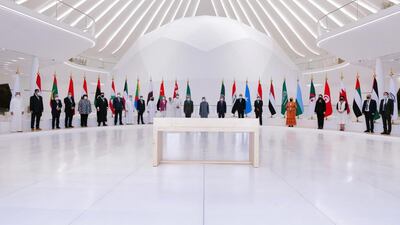
Sheikh Mohammed with the secretary general of the League of Arab States and the Arab ministers of culture, at the first Global Arabic Language Summit, at the Expo. -

Sheikh Mohammed signs the UAE Declaration on the Arabic Language at the summit. -

Sheikh Mohammed at the Global Arabic Language Summit. Experts were invited to discuss the importance of Arabic through panel discussions and workshops, on December 19 and December 20. -

Sheikh Mohammed says Arabic is 'the language of our identity, culture and sciences'.



