

Astronomers in the UK have discovered an ultramassive black hole about 33 billion times the mass of the Sun.
The gargantuan black hole is one of the biggest found, scientists from Durham University said.
The findings, published in the journal Monthly Notices of the Royal Astronomical Society, are “extremely exciting”, the team behind the discovery said.
“This particular black hole, which is roughly 30 billion times the mass of our Sun, is one of the biggest ever detected and on the upper limit of how large we believe black holes can theoretically become, so it is an extremely exciting discovery,” Lead author Dr James Nightingale, of the Department of Physics at Durham University, said.
Ultramassive black holes are the most massive objects in the universe, at between 10 billion and 40 billion times the mass of the Sun.
Astronomers believe they can be found at the centre of all large galaxies, such as the Milky Way.
Ultramassive black holes are rare and elusive, and their origins are unclear.
Some believe they were formed from the extreme merger of massive galaxies billions of years ago when the universe was still young.
The researchers used a phenomenon known as gravitational lensing, where they took help from a nearby galaxy by converting it into a giant magnifying glass.
Sultan Al Neyadi's life on the International Space Station - in pictures
-
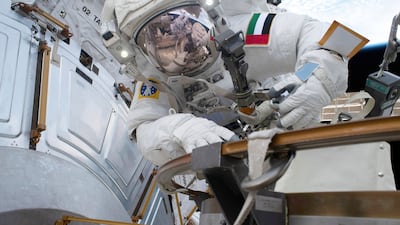
Emirati astronaut Sultan Al Neyadi has released more images of his historic space walk from the International Space Station on social media. @Astro_Alneyadi twitter -
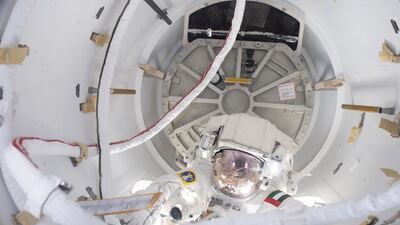
On Friday, Dr Al Neyadi became the Arab world's first astronaut to make space walk when he joined US astronaut Steve Bowen on ISS maintenance. @Astro_Alneyadi twitter -
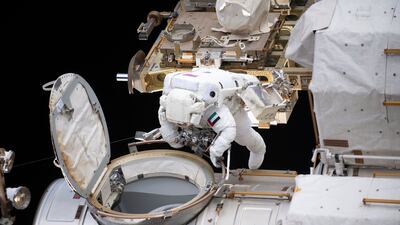
Dr Al Neyadi spent more than six hours outside the space station. @Astro_Alneyadi twitter -

Photos of Emirati astronaut Sultan Al Neyadi's space walk show him completing what Sheikh Hamdan bin Mohammed, Crown Prince of Dubai and President of the Mohammed bin Rashid Space Centre, described as a 'remarkable' accomplishment. @Astro_Alneyadi twitter -
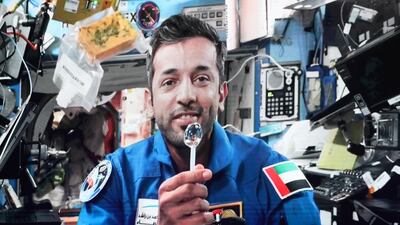
Sultan Al Neyadi, UAE Astronaut showing water during his first ‘ A Call with Space’ video chat with the public held at Dubai Opera in Dubai. Pawan Singh / The National -
Nasa astronaut Frank Rubio gives UAE astronaut Sultan Al Neyadi a haircut on board the International Space Station. Photo: MBRSC -
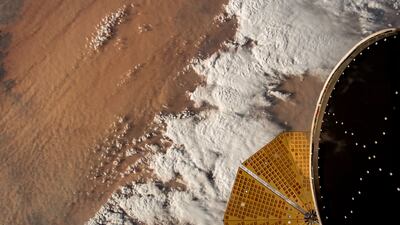
Sultan Al Neyadi shares images of sandstorm in Sahara Desert from space -

Sultan Al Neyadi shares images of sandstorm in Sahara Desert from space -
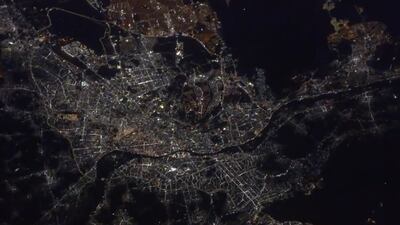
Dr Sultan Al Neyadi shared a video showing Cairo from space. Image: Screengrab -
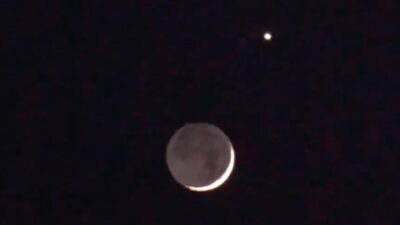
Sultan Al Neyadi shows breathtaking views of the crescent moon from space. -
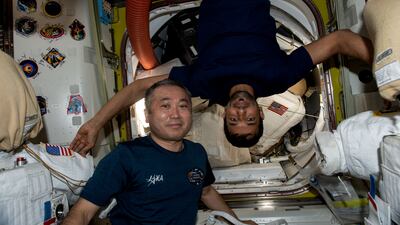
Astronaut Koichi Wakata and Sultan Al Neyadi inside the International Space Station's Quest airlock. Nasa -
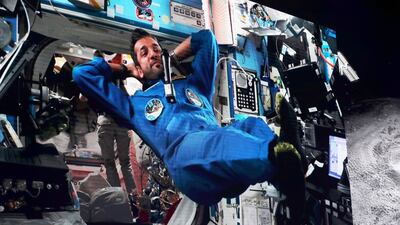
Sultan Al Neyadi, UAE Astronaut during his first ‘ A Call with Space’ video chat with the public held at Dubai Opera in Dubai. Pawan Singh / The National -
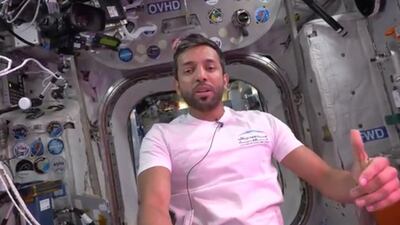
Dr Al Neyadi carries out experiments at the Columbus laboratory. Photo: Sultan Al Neyadi@Twitter -
UAE astronaut Sultan Al Neyadi in the Japanese KIBO module of the ISS. Photo: MBRSC -
UAE astronaut Sultan Al Neyadi has shared his first selfies taken from inside the International Space Station. Photo: Sultan Al Neyadi Twitter -
The images were snapped in front of the cupola - an observatory on the station - that shows stunning views of the Earth. Photo: Sultan Al Neyadi Twitter -
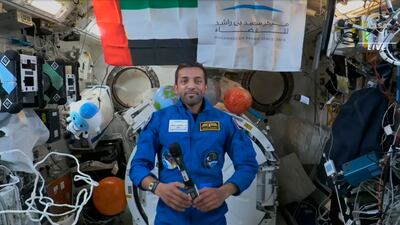
This photo provided by NASA shows Emerati astronaut Sultan al-Neyadi during an interview at the International Space Station on Tuesday, March 7, 2023. The first Arab astronaut assigned to a long spaceflight is still adjusting to life off the planet, five days after rocketing to the International Space Station. (NASA via AP) -

Sultan Al Neyadi’s, UAE Astronaut, speaking from ISS to UAE leaders. photo: Video screen grab / Nasa -
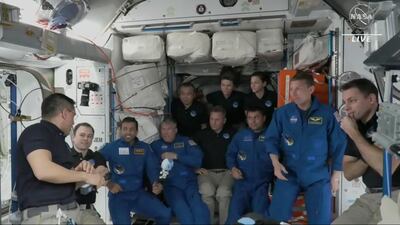
In this image from NASA TV, the four astronauts including United Arab Emirates' Sultan al-Neyadi, third left gather, during the welcoming ceremony, on the International Space Station, Friday, March 3, 2023. A new crew from the United States, Russia and United Arab Emirates has arrived at the International Space Station. The new arrivals include United Arab Emirates' Sultan al-Neyadi, the first astronaut from the Arab world who will spend an extended time in space. Al-Neyadi is only the second person from the UAE to rocket into orbit. (NASA TV via AP)


This revealed the presence of the ultramassive black hole, a region where gravity’s pull is so powerful that not even light can escape.
The scientists used supercomputer simulations at Durham University and images captured by the Hubble Space Telescope to confirm the size of the supermassive black hole.
They said this is the first black hole found using gravitational lensing.
“Most of the biggest black holes that we know about are in an active state, where matter pulled in close to the black hole heats up and releases energy in the form of light, X-rays and other radiation," Dr Nightingale said.
“However, gravitational lensing makes it possible to study inactive black holes, something not currently possible in distant galaxies.
“This approach could let us detect many more black holes beyond our local universe and reveal how these exotic objects evolved further back in cosmic time.”
The researchers said their work opens up the “tantalising possibility” that astronomers can discover more ultramassive black holes than previously thought.
The research was supported by the UK Space Agency, the Royal Society, the Science and Technology Facilities Council, part of UK Research and Innovation, and the European Research Council.

