Russian President Vladimir Putin during a news conference in Moscow. AP

Putin's warning over depleted uranium tank ammunition dismissed by UK


  • English
  • Arabic

The UK has accused Russian President Vladimir Putin of deliberate disinformation after he claimed Britain was supplying Ukraine with "weapons with a nuclear component".

After concluding a second day of talks with Chinese leader Xi Jinping, Mr Putin said Russia would "respond accordingly" if the UK sent depleted uranium tank ammunition to the government in Kyiv.

However, the Ministry of Defence dismissed the warning, saying the armour-piercing shells had been standard equipment for decades and had "nothing to do with nuclear weapons or capabilities".

After declaring relations between Russia and China to be “at their highest point”, Mr Putin said the UK planned to send the Ukrainians depleted uranium shells along with a squadron of Challenger 2 main battle tanks.

"It looks like the West, indeed, intends to fight Russia until the last Ukrainian," he said.

"If that happens, Russia will respond accordingly, given that the collective West is starting to use weapons with a nuclear component."

Mr Putin did not elaborate on what the response might be.

In response, a UK Defence Ministry spokesman said: "Alongside our granting of a squadron of Challenger 2 main battle tanks to Ukraine, we will be providing ammunition, including armour-piercing rounds which contain depleted uranium.

"Such rounds are highly effective in defeating modern tanks and armoured vehicles.

"The British Army has used depleted uranium in its armour-piercing shells for decades. It is a standard component and has nothing to do with nuclear weapons or capabilities.

"Russia knows this but is deliberately trying to disinform."

The Defence Ministry said independent research by scientists from groups such as the Royal Society had assessed that any impact to personal health and the environment from the use of depleted uranium munitions was "likely to be low".

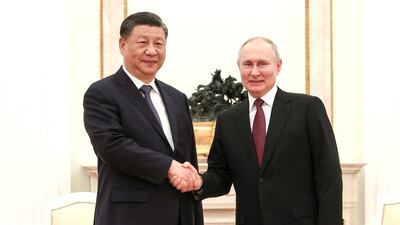
Vladimir Putin and Xi Jinping meet in Moscow — in pictures

  • China's President Xi Jinping with Russian President Vladimir Putin in Moscow. Reuters
    China's President Xi Jinping with Russian President Vladimir Putin in Moscow. Reuters
  • Mr Xi's motorcade drives toward the Kremlin. AP
    Mr Xi's motorcade drives toward the Kremlin. AP
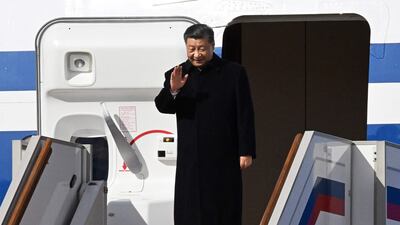
  • Mr Xi, accompanied by Russian Deputy Prime Minister Dmitry Chernyshenko, at a welcome ceremony at Moscow's Vnukovo Airport. AFP
    Mr Xi, accompanied by Russian Deputy Prime Minister Dmitry Chernyshenko, at a welcome ceremony at Moscow's Vnukovo Airport. AFP
  • Mr Xi arrives at Moscow's Vnukovo Airport. AFP
    Mr Xi arrives at Moscow's Vnukovo Airport. AFP
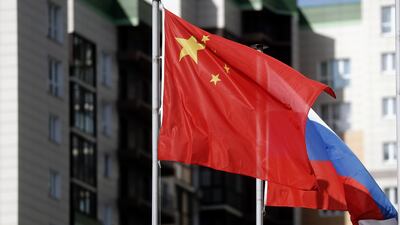
  • Both countries' national flags wave at the Russian-Chinese Greenwood business district in Moscow. EPA
    Both countries' national flags wave at the Russian-Chinese Greenwood business district in Moscow. EPA
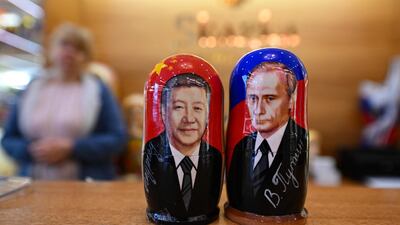
  • Traditional Russian dolls depicting the presidents at a gift shop in central Moscow. AFP
    Traditional Russian dolls depicting the presidents at a gift shop in central Moscow. AFP
Key facilities
  • Olympic-size swimming pool with a split bulkhead for multi-use configurations, including water polo and 50m/25m training lanes
  • Premier League-standard football pitch
  • 400m Olympic running track
  • NBA-spec basketball court with auditorium
  • 600-seat auditorium
  • Spaces for historical and cultural exploration
  • An elevated football field that doubles as a helipad
  • Specialist robotics and science laboratories
  • AR and VR-enabled learning centres
  • Disruption Lab and Research Centre for developing entrepreneurial skills
How to watch Ireland v Pakistan in UAE

When: The one-off Test starts on Friday, May 11
What time: Each day’s play is scheduled to start at 2pm UAE time.
TV: The match will be broadcast on OSN Sports Cricket HD. Subscribers to the channel can also stream the action live on OSN Play.

OIL PLEDGE

At the start of Russia's invasion, IEA member countries held 1.5 billion barrels in public reserves and about 575 million barrels under obligations with industry, according to the agency's website. The two collective actions of the IEA this year of 62.7 million barrels, which was agreed on March 1, and this week's 120 million barrels amount to 9 per cent of total emergency reserves, it added.

The 12 Syrian entities delisted by UK 

Ministry of Interior
Ministry of Defence
General Intelligence Directorate
Air Force Intelligence Agency
Political Security Directorate
Syrian National Security Bureau
Military Intelligence Directorate
Army Supply Bureau
General Organisation of Radio and TV
Al Watan newspaper
Cham Press TV
Sama TV

Countries recognising Palestine

France, UK, Canada, Australia, Portugal, Belgium, Malta, Luxembourg, San Marino and Andorra


Specs

Engine: 51.5kW electric motor

Range: 400km

Power: 134bhp

Torque: 175Nm

Price: From Dh98,800

Available: Now

Teaching your child to save

Pre-school (three - five years)

You can’t yet talk about investing or borrowing, but introduce a “classic” money bank and start putting gifts and allowances away. When the child wants a specific toy, have them save for it and help them track their progress.

Early childhood (six - eight years)

Replace the money bank with three jars labelled ‘saving’, ‘spending’ and ‘sharing’. Have the child divide their allowance into the three jars each week and explain their choices in splitting their pocket money. A guide could be 25 per cent saving, 50 per cent spending, 25 per cent for charity and gift-giving.

Middle childhood (nine - 11 years)

Open a bank savings account and help your child establish a budget and set a savings goal. Introduce the notion of ‘paying yourself first’ by putting away savings as soon as your allowance is paid.

Young teens (12 - 14 years)

Change your child’s allowance from weekly to monthly and help them pinpoint long-range goals such as a trip, so they can start longer-term saving and find new ways to increase their saving.

Teenage (15 - 18 years)

Discuss mutual expectations about university costs and identify what they can help fund and set goals. Don’t pay for everything, so they can experience the pride of contributing.

Young adulthood (19 - 22 years)

Discuss post-graduation plans and future life goals, quantify expenses such as first apartment, work wardrobe, holidays and help them continue to save towards these goals.

* JP Morgan Private Bank 

Updated: March 22, 2023, 4:51 AM