
The US is set to lift Covid-19 testing requirements for travellers from China on Friday, in a significant step towards normalising links between the two countries as the pandemic recedes.
The measure will be lifted because the US has evidence that cases, hospital admissions and deaths are declining in China, Reuters reported.
The Biden administration in January ordered all travellers older than two to provide a negative test before entering the US, after China’s pivot away from strict Covid restrictions.
The US joined India, Canada, Italy, Japan, South Korea and other countries in the move.
In February, South Korea said it would not require travellers from China to test for Covid-19 upon arrival as of March, although pre-departure tests will remain a requirement.
China was battered by a surge in Covid-19 cases after it abruptly abandoned its zero-Covid policy in early December, unleashing the virus on its 1.4 billion population.
In February, China's leaders declared a “major victory” over Covid claiming the world's lowest fatality rate, although experts have questioned that data.
The measure was initially put in place to protect American citizens while the US could determine the impact of the outbreak in China and gain insight into the variants that were circulating, Bloomberg reported.
The Biden administration will continue to monitor cases in China and other countries and will keep in place the traveller-based genomic surveillance programme.
-

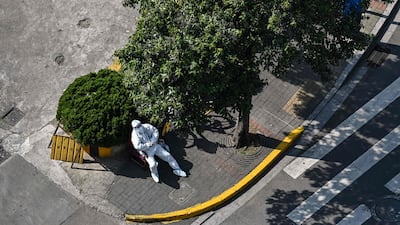
Nearly empty roads amid a phased lockdown due to Covid-19 in Shanghai, China. The country's largest city reported more than 13,000 daily Covid cases for the first time, as a sweeping lockdown of its 25 million residents and mass testing uncovered extensive spread of the highly infectious Omicron variant. Bloomberg -

Medical workers gather near a banner that reads 'Unite as one, resolutely win the battle against epidemic' during a departure ceremony before leaving for Shanghai, in Jinan, east China's Shandong Province. AP -
China has sent more than 10,000 health workers from across the country to Shanghai, including 2,000 military medical staff, as it struggles to tackle the rapidly spreading Covid-19 outbreak. AFP -
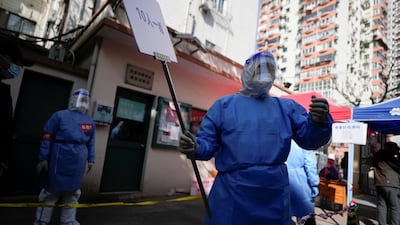
Workers in protective suits direct residents lining up for Covid testing. Reuters -
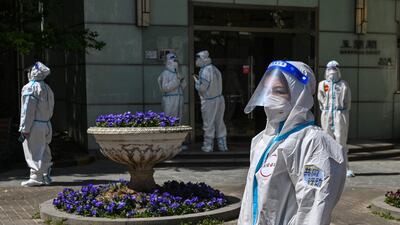
Medical workers and volunteers in a compound where residents are being tested for Covid-19. AFP -
Authorities are building the world’s largest makeshift isolation centre to help contain the outbreak in Shanghai. AFP -

A delivery man arranges his orders during lockdown in the Jingan district of western Shanghai. AP -
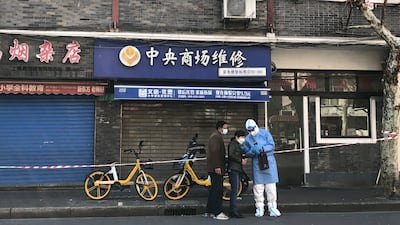
A worker in protective gear chats with residents outside shuttered shops in the Jingan district of western Shanghai. AP -
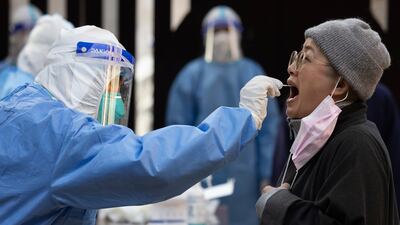
The number of cases continues to rise in Shanghai and Jilin, a north-eastern province. AP -
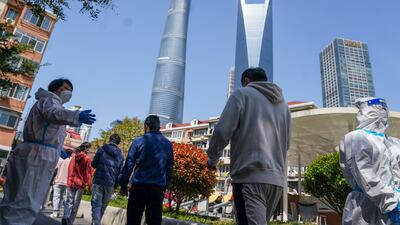
Residents wait to submit samples for tests at a community centre in the Pudong New Area of Shanghai. AP -
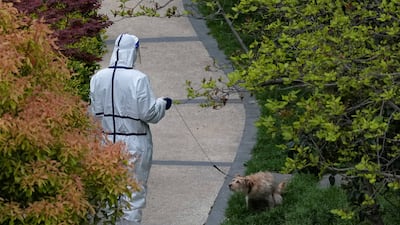
A person walks a dog. Reuters -
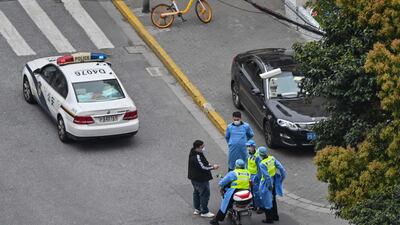
Policemen wearing protective gear on a street during patrols. AFP -

Workers remove their protective gear at the entrance of a neighbourhood. AFP -
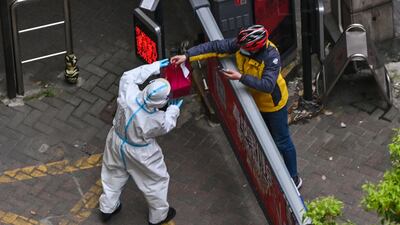
Food shortages and shuttered manufacturing plants have hit residents hard. AFP -

Workers unload groceries from a truck before distributing them to residents. AP -

A man helps a woman to consume a packet of traditional Chinese medicine, as she sits by the side of a road outside a residential compound. Reuters -
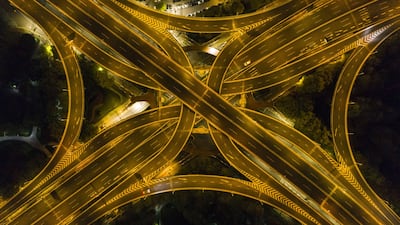
Empty highways at night in Shanghai. Bloomberg


Allies and partners have lifted similar restrictions for inbound flights from China and the US consulted with them on public health measures, according to the report.
The Washington Post reported on the plans earlier on Tuesday.
Removing the testing requirement will clear one of the last hurdles facing the global aviation industry after Covid, particularly for business passengers travelling between the world’s two biggest economies.
The move also potentially opens a window for Beijing to reciprocate by easing its own preflight testing rules for people coming from the US.
Barriers to full normalisation remain. China still demands PCR tests for travellers coming from the US — and has airline crew check the result before boarding — despite allowing people from some countries to provide rapid antigen tests.
Results might be checked on a random basis upon arrival, according to a post from the Chinese embassy in the US.
Flights between the US and China also remain capped at 12 per week. There are only 172 flights scheduled between the US and China for this month, 94.1 per cent lower than the same time in 2019, according to flight data company Cirium.
March of the pre-pandemic year had 2,926 flights offering about 850,000 seats among the US and Chinese airlines flying in both directions.

