

The head of Israel’s military said on Wednesday that Israeli jets struck a convoy suspected of carrying weapons into Syria on November 8, ending speculation about the attack, which occurred near a border crossing controlled by Iran-backed militias operating in both countries.
Lt Gen Aviv Kochavi said Israeli warplanes had struck “specific targets” in a convoy “passing from Iraq to Syria,” and that Israeli forces had attempted to reduce casualties by hitting a specific truck in the convoy.
He was talking about Israel’s intelligence capabilities at the University of Tel Aviv when he described the air strike, which was reported at the time by Iran’s state-linked Press TV news outlet, as well as Israeli media. The Israeli government did not comment on the attack at the time, in line with Israeli government policy on air strikes.
-
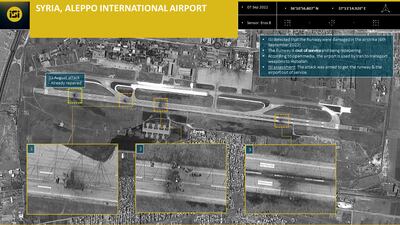
A satellite image shows damage at Aleppo airport in northern Syria following reported Israeli strikes on September 6. AFP -

More damage at Aleppo airport after Israeli strikes on August 31. -
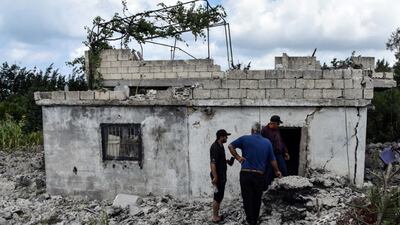
A building damaged by a reported Israeli air strike in the western Syrian coastal city of Tartus. AFP -
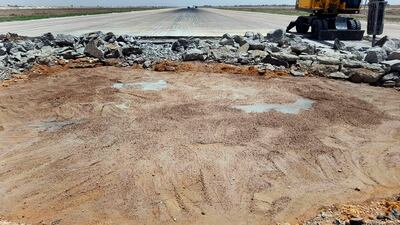
The damaged runway of the Damascus International Airport, when it was hit by an Israeli air strike on June 10. AP -
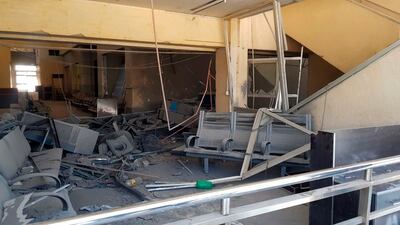
Syria said the June 10 strike caused "significant" damage to infrastructure and knocked out the main runway. AP -

Damage reported by the Syrian state media in Damascus in March. Reuters -

Fire burns after a reported Israeli missile attack on a container storage area in the port of Latakia in December 2021. Reuters -

Firefighters called in to tackle the Latakia blaze. Reuters -

An Israeli pilot in an F-35 fighter jet at Nevatim air base. Reuters -

An Israeli Air Force F-35 fighter jet performs an aerial demonstration at the Hatzerim air base. Reuters -

An Israeli F-15 fighter jet at the Blue Flag 2017 exercise at Israel's Ovda military air base. Reuters -
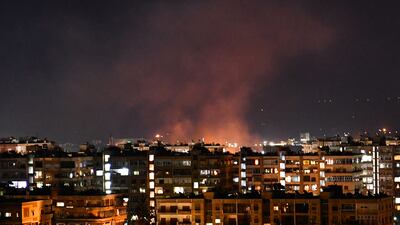
Smoke billows following an Israeli airstrike targeting Syrian capital Damascus in July 2020. AFP


Lt Gen Kochavi told a conference at a university north of Tel Aviv there had been an attempt to reduce civilian casualties by striking a specific truck suspected of carrying weapons.
“We need to make sure in some of the attacks that they don't kill whoever shouldn't be killed.”
Iran has long backed militia groups in Syria, sending advisers and also training proxy militant groups from Iraq, known as the Popular Mobilisation Forces, and coordinating with the Iran-backed Lebanese Hezbollah. The groups helped prop up the regime of Bashar Al Assad during the country’s bloody, 11-year civil war, which still simmers in the north of the country.
But they also helped Iran to establish what has been called the third missile front against Israel over the Israeli-occupied Golan Heights. Lebanese Hezbollah has amassed a vast stockpile of missiles — by some counts over 100,000, to attack Israel in the event of a repeat of the 2006 Israel-Hezbollah war. Israel’s defences are also deployed in the south to counter rocket fire from militants in Gaza, meaning that a large stockpile of missiles in Syria could overwhelm Israeli defences.
Israel has subsequently admitted to launching hundreds of air strikes in Syria targeting the weapons, but rarely comments on individual incidents.
Lt Gen Kochavi said Israel's actions in the region had “totally disrupted” Iran's desire to entrench itself militarily along Israel's border. He said they have prevented Iran from placing hundreds of surface-to-surface and surface-to-air missiles in Syria and Lebanon as well as tens of thousands of militiamen in the area, and the creation of a Syrian arm of Hezbollah.
Israel considers Iran to be its chief enemy and warns against what it views as its hostile activities in the region.

